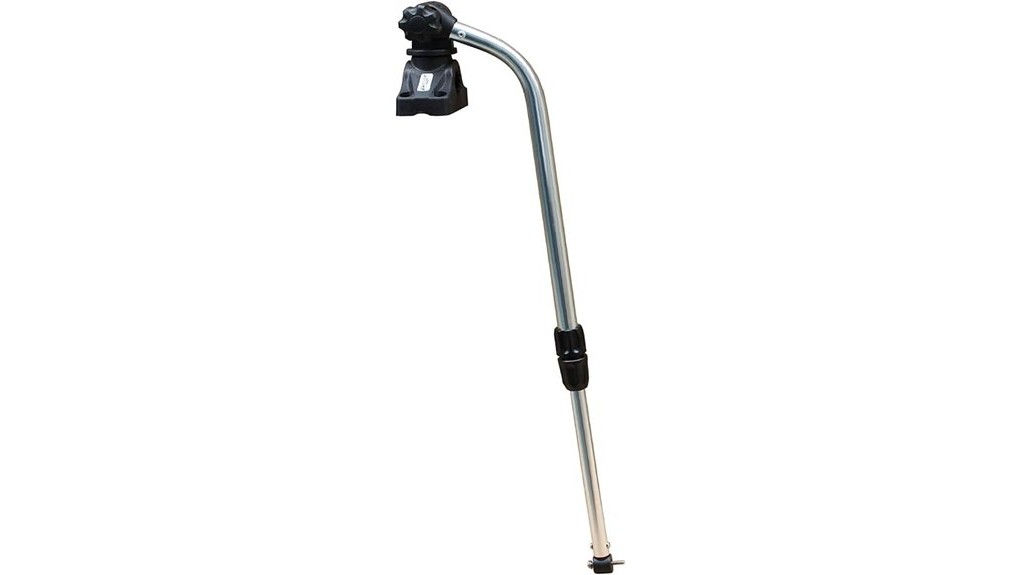
You’ll find the Brocraft Transducer Mounting Arm is a rugged, telescoping nylon-aluminum platform that gives you repeatable 17″–25″ placement with 360° swivel, slip-disc micro-adjustments, detents and torque-hold stability for cleaner sonar returns without hull modification. Its fiber-reinforced nylon lowers weight and galvanic risk while marine-grade aluminum adds stiffness and corrosion resistance, though plastic parts can wear under heavy load. Compare clamp fit, load capacity and signal path before buying, and the full review covers setup and limits.
Some Key Takeaways
- Rugged fiber-reinforced nylon and marine-grade aluminum construction balances corrosion resistance with low weight for kayak and small-boat use.
- Telescoping 17″–25″, 360° swivel, detents, and slip disc enable repeatable, fine transducer angle and position adjustments.
- Ideal for pedal-drive and hands-free kayakers needing non-invasive, clamp-on transducer placement without hull modification.
- Check clamp compatibility, load limits, and fastener specs to avoid creep, wear of plastic parts, or galvanic issues.
- Test at low speed and adjust height/angle to minimize cavitation, prop wash, and signal shadowing for consistent sonar returns.
What the Brocraft Transducer Mounting Arm Is and Who It’s For
Think of the Brocraft Transducer Mounting Arm as a rugged, adjustable platform engineered to secure transducers and kayak fish-finder units across small craft; it combines fiber-reinforced nylon and marine-grade aluminum to balance strength and corrosion resistance while offering 360° swivel, a slip disc for fine-tuning, and a telescoping range from 17″ to 25″. You’ll find it suits kayak anglers who need repeatable transducer placement without hull modification. Compared with fixed brackets, it gives more positional control and compact stowage. You’ll evaluate trade-offs in weight, complexity, and mounting footprint when matching it to kayaks, canoes, or small pontoons. It’s particularly well-matched to the needs of pedal drive kayakers who favor hands-free propulsion and long-range waterborne adventures.
Key Features and Materials That Matter for Marine Use
Because saltwater and constant vibration stress every component, you should prioritize materials and features that resist corrosion, maintain dimensional stability, and allow precise positioning. You’ll find Brocraft uses fiber-reinforced nylon and marine-grade aluminum to balance weight, stiffness, and corrosion resistance; nylon reduces galvanic risk, aluminum offers structural support. Compare this to all-plastic or stainless solutions: nylon/aluminum hybrids limit electrolytic attack while preserving dimensional stability under load. Check load capacity specifications for your transducer and vessel motion; insufficient capacity yields creep or failure. Fasteners, seals, and sliding interfaces should be marine-rated to preserve long-term function and predictable positioning. Consider also how total payload and storage capacity affect stability and mounting options.
Real-World Performance: Adjustability, Stability, and Signal Placement
When you mount a transducer on the Brocraft arm, its telescoping reach and 360-degree swivel give you precise placement options while the slip disc enables micro-adjustments to fine-tune pitch and yaw for peak signal return. You’ll appreciate how angle tuning is literal and repeatable: detents and friction settings hold chosen angles under load better than basic brackets. Attachment flexibility lets you adapt to hull contours or kayak rails without specialized adapters. Compared to fixed mounts, the arm reduces cavitation and signal shadowing by allowing incremental lateral and vertical offsets. Stability remains high under moderate chop, though extreme yawing stresses connectors more. This makes it a handy accessory for paddlers and anglers shopping for kayaks and flow meters who want reliable electronics placement.
Installation, Compatibility, and Setup Tips for Boats and Kayaks
If you’re mounting the Brocraft arm on a kayak or boat, start by evaluating rail size, hull contours, and transducer type to guarantee secure fit and peak signal path. You’ll compare clamp options against rail diameter and material; the aluminum clamp suits most powerboats and pontoons while nylon components reduce weight for kayak mounting. Position the telescoping arm to minimize turbulence and keep the transducer clear of prop wash. Use the 360-degree swivel and slip disc for fine transducer alignment, then torque fasteners to spec. Test at low speed and adjust height and angle for consistent sonar returns. Consider also browsing our selection of kayaks and other products tailored for outdoor enthusiasts to ensure your setup matches your water adventures.
Pros, Cons, and Final Buying Recommendation
After verifying fit, position, and signal during setup, assess the Brocraft arm by weighing its performance characteristics against your platform needs. You’ll appreciate durable marine-grade aluminum, fiber-reinforced nylon construction, 360° swivel, slip-disc micro-adjustments, and 17–25″ telescoping reach for stable transducer alignment. Pros: corrosion resistance, compact storage, broad compatibility across kayaks to powerboats. Cons: plastic components may wear under heavy load; not ideal if you require powered articulation (impacts battery life considerations only if paired with powered units). Check warranty details and customer service responsiveness. Compare pricing trends to alternatives; buy if balance of durability and cost fits your use case. For water-based users, consider pairing the arm with a dry box to keep electronics protected on water adventures.
Some Questions Answered
Can I Mount a Camera or Light on the Arm Instead of a Transducer?
Yes — you can mount a camera or light on the arm, provided you verify camera compatibility and light mounting load limits. The fiber-reinforced nylon and marine-grade aluminum offer corrosion resistance and stiffness comparable to purpose-built mounts, while the 360-degree swivel, slip disc and telescoping reach let you position devices similarly to transducers. Compare weight, mounting interface and vibration tolerance; heavier or high-vibration gear may need additional reinforcement or specialized brackets.
Is a Pad or Gasket Included to Protect Mounting Surface?
No, a protective pad or mounting gasket isn’t included with the arm. You’ll need to supply your own protective pad or mounting gasket to prevent abrasion and distribute load. Compared to integrated-gasket mounts, this arm relies on its corrosion-resistant materials and secure clamping for stability, so adding a dedicated pad improves surface protection and vibration damping. Choose marine-grade gasket material sized to your mounting footprint for best results.
Can the Arm Be Painted or Colored Without Voiding Warranty?
You can paint or color the arm, but you should check color options and warranty implications first. Modifying the marine-grade aluminum or fiber-reinforced nylon with solvents or coatings could void warranty if corrosion protection is altered or factory finishes are removed. Comparatively, non-invasive options like adhesive wraps or anodizing-compatible coatings minimize risk. Document factory finish condition before any change and consult the manufacturer to confirm which treatments preserve warranty coverage.
Are Replacement Slip Discs or Telescoping Parts Sold Separately?
Yes — you can often buy replacement parts like slip discs and telescoping sections separately, though availability varies. You’ll want to compare OEM versus aftermarket components for fit, materials, and corrosion resistance. OEM parts typically guarantee compatibility and longevity; aftermarket options may be cheaper but require careful verification of dimensions and materials. Check vendor listings or contact the manufacturer to confirm part numbers, compatibility with your arm, and warranty implications before ordering.
Does the Arm Interfere With Trailer Clearance During Transport?
You won’t typically have trailer clearance issues; the arm collapses to 17 inches so you can stow it to meet road clearance and trailer safety requirements. Compared to fixed mounts, its telescoping and 360° swivel reduce protrusion risk. Still, you should verify boat-to-trailer dimensions and secure the arm during transport. For low-clearance trailers or oversized transducers, a dedicated low-profile or removable mount may be safer.