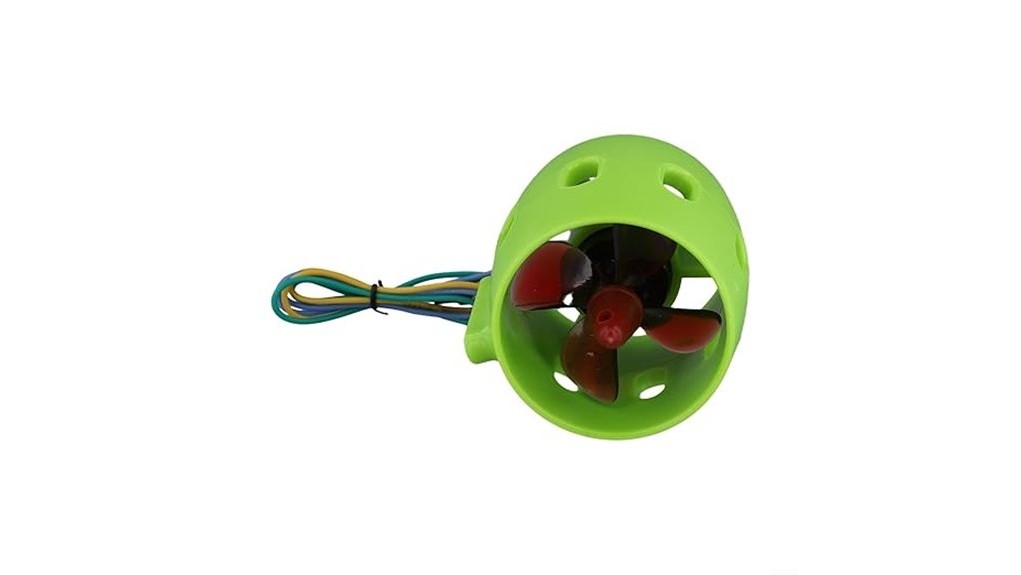
You’ll get a compact 12–24V brushless thruster (30–200W, 300KV) that gives predictable, low-noise thrust for RC bait boats, ROVs, and small workboats. Match power and 300KV to your vessel mass and prop load; guarantee controller headroom to 20A and robust wet-seals for dive depth. Check static-thrust and efficiency curves, prop balance, and corrosion-resistant fastenings for longevity. Installation is straightforward with a 74×75 mm footprint and 25 cm cable, and more setup and testing tips follow. In addition to these features, conducting thorough underwater thruster performance analysis will ensure optimal operation under various conditions. By evaluating thrust efficiency and power consumption, operators can enhance the overall performance of their underwater vehicles. This analysis will also aid in identifying potential areas for improvement, leading to more effective designs in future iterations.
Some Key Takeaways
- Confirm power, voltage, and KV suitability: match 30–200W, 12–24V, and 300KV to your vessel’s mass and propeller load.
- Check thrust and efficiency curves: review static thrust, thrust vs. RPM, and efficiency data for prop/gear selection.
- Inspect waterproofing and depth rating: evaluate drive depth, cable/wet-seal quality, and connector reliability for long-term use.
- Assess build and noise: verify PLA/PC housing, prop balance, cavitation testing, and low marine-noise performance.
- Verify installation and support: confirm mounting footprint, cable length, rotation options, warranty, and spare-part availability.
What This Thruster Is and Who It’s Best For
When you need compact, efficient underwater propulsion for RC bait boats, ROVs, or small marine vessels, the Boat Underwater Thruster Motor delivers a brushless 12–24V solution with 30–200W output and a 300KV stator for reliable thrust control. You’ll fit it to models, NEST ships, pull-net boats, and small lifeboats where space, efficiency, and low marine noise matter. Its 4-blade prop and compact PLA/PC housing offer predictable thrust and straightforward installation. Waterproof connectors and a short integrated cable simplify integration into existing systems. You’ll benefit from durable materials, energy-efficient operation, and adaptable clockwise/counterclockwise rotation options. It’s also a great match for paddlers and water enthusiasts looking to gear up for safer, more versatile water adventures.
Key Specs That Matter : Power, Voltage, KV, Depth, and Build
Because the thruster’s effectiveness depends on matched electrical and mechanical characteristics, you should prioritize its power, voltage range, KV rating, depth capability, and build quality when evaluating suitability. Match 30–200W power to your vessel’s mass and propeller load; guarantee 12–24V compatibility and controller headroom for the 20A max. KV (300KV) dictates rpm per volt—select for torque versus speed tradeoffs. Verify rated drive depth and cable/wet-seal quality; use waterproof connectors and preserved materials to prevent ingress. Inspect housing, PLA/PC composition, fastenings and propeller balance to minimize vibration and manage the thruster’s noise signature. Consider mounting and anchoring compatibility with your kayak and related anchor systems to ensure secure operation.
Real-World Performance: Thrust, Efficiency, and Durability
Although compact, the thruster delivers predictable real-world thrust across its 12–24V range, so you can size it to your craft by matching the 30–200W rating and 300KV speed constant to required RPM and prop load. You’ll measure static thrust, thrust vs. RPM, and efficiency curves to select gearing and propeller pitch. Conduct cavitation testing and noise profiling to validate performance under load and detect inefficiencies. Materials and sealing provide baseline corrosion resistance; inspect seals after salt exposure cycles. Plan scheduled checks and parts replacement—bearings, prop, and seals—for long term maintenance to preserve efficiency and reliability. Consider adding basic plastic welding and repair supplies to your kit to handle hull damage and maintain gear longevity, including plastic welding kits for quick field repairs.
Installation, Compatibility, and Setup Tips for RC Boats and ROVs
If you’re installing the Boat Underwater Thruster Motor on an RC boat or ROV, plan mounting, electrical, and sealing arrangements before you fit the unit so alignment, cooling, and cable routing are done once and correctly. Use mounting templates to mark hull cutouts and bolt patterns; confirm the 74 × 75 mm footprint and cable exit (25 cm) clearances fit. Select waterproof connectors rated for your voltage and current (12–24V, up to 20A). Align clockwise/counterclockwise rotation with propulsion geometry. Secure with corrosion-resistant fasteners, apply marine sealant to joints, and verify cable strain relief. Test motor spin and watertight integrity before deployment. Also consider carrying essential paddling and boating gear like deck-mount pumps for on-water emergencies and routine maintenance.
Buy or Skip? Pricing, Alternatives, and Final Recommendation
When weighing whether to buy the Boat Underwater Thruster Motor, consider its solid performance-to-cost ratio: the 12–24V, 30–200W brushless unit (300KV, up to 20A) delivers efficient, durable propulsion in a compact 74 × 75 mm package with a 25 cm cable, and is available in clockwise or counterclockwise rotation or matched pairs for balanced setups. You’ll assess pricing strategy against build quality and energy efficiency; compare market alternatives for KV, power range, and materials; factor warranty terms duration and coverage; and estimate resale value based on durability and brand. Recommendation: buy if specs match mission; otherwise skip. For paddlers and small-boat enthusiasts, consider accessories and mounting options tailored to propeller kayaks to ensure compatibility and optimal performance.
Some Questions Answered
Is the Thruster Waterproof Warranty Included and for How Long?
Yes — the thruster includes a warranty that covers waterproofing; the warranty duration is typically specified by the manufacturer. You’ll need to check Cloudpower’s documentation for the exact warranty duration and waterproof certification details. Verify the waterproof certification level (IP rating or depth rating) and the warranty duration before purchase. If documentation’s unclear, contact Cloudpower support to confirm warranty duration and waterproof certification for your specific model and intended depth use.
Can the Motor Be Repaired or Are Replacement Parts Available?
Yes—you can repair the motor and spare availability is generally good. You’ll find common components (propellers, cables, seals) replaceable; full motor rebuilds may require manufacturer parts. Use manufacturer parts lists and DIY guides for step‑by‑step procedures, torque specs, and sealing techniques. If you lack parts, contact Cloudpower with the model number for replacements. Keep electrical safety and waterproof sealing best practices in mind during repairs.
What Connector Type Is Used on the Power Cable?
The power cable uses a waterproof connector with a quick disconnect coupling for secure, wet-environment connections. You’ll find a sealed plug that mates via a threaded locking ring to maintain IP protection and prevent accidental unplugging. The coupling supports the 12–24V, up to 20A supply and is compatible with standard marine wire gauges used on brushless thrusters. You’ll want matching female/male counterparts for proper installation.
Is the Propeller Balanced or Customer Service Balance-Checked?
The propeller is shipped without individual dynamic balancing; you’ll receive factory-installed propeller alignment but not a certified, customer-service balance-checked unit. You can perform final dynamic balancing yourself or request post-sale balancing from the seller if available. Verify propeller alignment on installation, and if you detect vibration, run a dynamic balancing procedure or ask Cloudpower for guidance. Proper alignment and balancing optimize efficiency and reduce motor stress.
Does the Thruster Support Forward and Reverse Thrust Without ESC Changes?
Yes — you’ll get bidirectional control: the brushless efficiency motor supports forward and reverse thrust when paired with an appropriate ESC configured for reversible operation. You don’t need to change the thruster itself; you’ll set the ESC to accept reverse commands (throttle midpoint calibration or BR/REV mode). Make sure your ESC and controller firmware support bidirectional outputs and current limits up to the thruster’s 20A max to prevent damage.Boat Underwater Thruster Motor delivers a brushless 12–24V solution with 30–200W output and a 300KV stator for reliable thrust control.et-seals for dive depth. Check static-thrust and efficiency curves, prop balance, and corrosion-resistant fastenings for longevity. Installation is straightforward with a 74×75 mm footprint and 25 cm cable, and more setup and testing tips follow. In addition to these features, conducting thorough underwater thruster performance analysis will ensure optimal operation under various conditions. By evaluating thrust efficiency and power consumption, operators can enhance the overall performance of their underwater vehicles. This analysis will also aid in identifying potential areas for improvement, leading to more effective designs in future iterations.
Some Key Takeaways
- Confirm power, voltage, and KV suitability: match 30–200W, 12–24V, and 300KV to your vessel’s mass and propeller load.
- Check thrust and efficiency curves: review static thrust, thrust vs. RPM, and efficiency data for prop/gear selection.
- Inspect waterproofing and depth rating: evaluate drive depth, cable/wet-seal quality, and connector reliability for long-term use.
- Assess build and noise: verify PLA/PC housing, prop balance, cavitation testing, and low marine-noise performance.
- Verify installation and support: confirm mounting footprint, cable length, rotation options, warranty, and spare-part availability.
What This Thruster Is and Who It’s Best For
When you need compact, efficient underwater propulsion for RC bait boats, ROVs, or small marine vessels, the Boat Underwater Thruster Motor delivers a brushless 12–24V solution with 30–200W output and a 300KV stator for reliable thrust control. You’ll fit it to models, NEST ships, pull-net boats, and small lifeboats where space, efficiency, and low marine noise matter. Its 4-blade prop and compact PLA/PC housing offer predictable thrust and straightforward installation. Waterproof connectors and a short integrated cable simplify integration into existing systems. You’ll benefit from durable materials, energy-efficient operation, and adaptable clockwise/counterclockwise rotation options. It’s also a great match for paddlers and water enthusiasts looking to gear up for safer, more versatile water adventures.
Key Specs That Matter : Power, Voltage, KV, Depth, and Build
Because the thruster’s effectiveness depends on matched electrical and mechanical characteristics, you should prioritize its power, voltage range, KV rating, depth capability, and build quality when evaluating suitability. Match 30–200W power to your vessel’s mass and propeller load; guarantee 12–24V compatibility and controller headroom for the 20A max. KV (300KV) dictates rpm per volt—select for torque versus speed tradeoffs. Verify rated drive depth and cable/wet-seal quality; use waterproof connectors and preserved materials to prevent ingress. Inspect housing, PLA/PC composition, fastenings and propeller balance to minimize vibration and manage the thruster’s noise signature. Consider mounting and anchoring compatibility with your kayak and related anchor systems to ensure secure operation.
Real-World Performance: Thrust, Efficiency, and Durability
Although compact, the thruster delivers predictable real-world thrust across its 12–24V range, so you can size it to your craft by matching the 30–200W rating and 300KV speed constant to required RPM and prop load. You’ll measure static thrust, thrust vs. RPM, and efficiency curves to select gearing and propeller pitch. Conduct cavitation testing and noise profiling to validate performance under load and detect inefficiencies. Materials and sealing provide baseline corrosion resistance; inspect seals after salt exposure cycles. Plan scheduled checks and parts replacement—bearings, prop, and seals—for long term maintenance to preserve efficiency and reliability. Consider adding basic plastic welding and repair supplies to your kit to handle hull damage and maintain gear longevity, including plastic welding kits for quick field repairs.
Installation, Compatibility, and Setup Tips for RC Boats and ROVs
If you’re installing the Boat Underwater Thruster Motor on an RC boat or ROV, plan mounting, electrical, and sealing arrangements before you fit the unit so alignment, cooling, and cable routing are done once and correctly. Use mounting templates to mark hull cutouts and bolt patterns; confirm the 74 × 75 mm footprint and cable exit (25 cm) clearances fit. Select waterproof connectors rated for your voltage and current (12–24V, up to 20A). Align clockwise/counterclockwise rotation with propulsion geometry. Secure with corrosion-resistant fasteners, apply marine sealant to joints, and verify cable strain relief. Test motor spin and watertight integrity before deployment. Also consider carrying essential paddling and boating gear like deck-mount pumps for on-water emergencies and routine maintenance.
Buy or Skip? Pricing, Alternatives, and Final Recommendation
When weighing whether to buy the Boat Underwater Thruster Motor, consider its solid performance-to-cost ratio: the 12–24V, 30–200W brushless unit (300KV, up to 20A) delivers efficient, durable propulsion in a compact 74 × 75 mm package with a 25 cm cable, and is available in clockwise or counterclockwise rotation or matched pairs for balanced setups. You’ll assess pricing strategy against build quality and energy efficiency; compare market alternatives for KV, power range, and materials; factor warranty terms duration and coverage; and estimate resale value based on durability and brand. Recommendation: buy if specs match mission; otherwise skip. For paddlers and small-boat enthusiasts, consider accessories and mounting options tailored to propeller kayaks to ensure compatibility and optimal performance.
Some Questions Answered
Is the Thruster Waterproof Warranty Included and for How Long?
Yes — the thruster includes a warranty that covers waterproofing; the warranty duration is typically specified by the manufacturer. You’ll need to check Cloudpower’s documentation for the exact warranty duration and waterproof certification details. Verify the waterproof certification level (IP rating or depth rating) and the warranty duration before purchase. If documentation’s unclear, contact Cloudpower support to confirm warranty duration and waterproof certification for your specific model and intended depth use.
Can the Motor Be Repaired or Are Replacement Parts Available?
Yes—you can repair the motor and spare availability is generally good. You’ll find common components (propellers, cables, seals) replaceable; full motor rebuilds may require manufacturer parts. Use manufacturer parts lists and DIY guides for step‑by‑step procedures, torque specs, and sealing techniques. If you lack parts, contact Cloudpower with the model number for replacements. Keep electrical safety and waterproof sealing best practices in mind during repairs.
What Connector Type Is Used on the Power Cable?
The power cable uses a waterproof connector with a quick disconnect coupling for secure, wet-environment connections. You’ll find a sealed plug that mates via a threaded locking ring to maintain IP protection and prevent accidental unplugging. The coupling supports the 12–24V, up to 20A supply and is compatible with standard marine wire gauges used on brushless thrusters. You’ll want matching female/male counterparts for proper installation.
Is the Propeller Balanced or Customer Service Balance-Checked?
The propeller is shipped without individual dynamic balancing; you’ll receive factory-installed propeller alignment but not a certified, customer-service balance-checked unit. You can perform final dynamic balancing yourself or request post-sale balancing from the seller if available. Verify propeller alignment on installation, and if you detect vibration, run a dynamic balancing procedure or ask Cloudpower for guidance. Proper alignment and balancing optimize efficiency and reduce motor stress.
Does the Thruster Support Forward and Reverse Thrust Without ESC Changes?
Yes — you’ll get bidirectional control: the brushless efficiency motor supports forward and reverse thrust when paired with an appropriate ESC configured for reversible operation. You don’t need to change the thruster itself; you’ll set the ESC to accept reverse commands (throttle midpoint calibration or BR/REV mode). Make sure your ESC and controller firmware support bidirectional outputs and current limits up to the thruster’s 20A max to prevent damage.