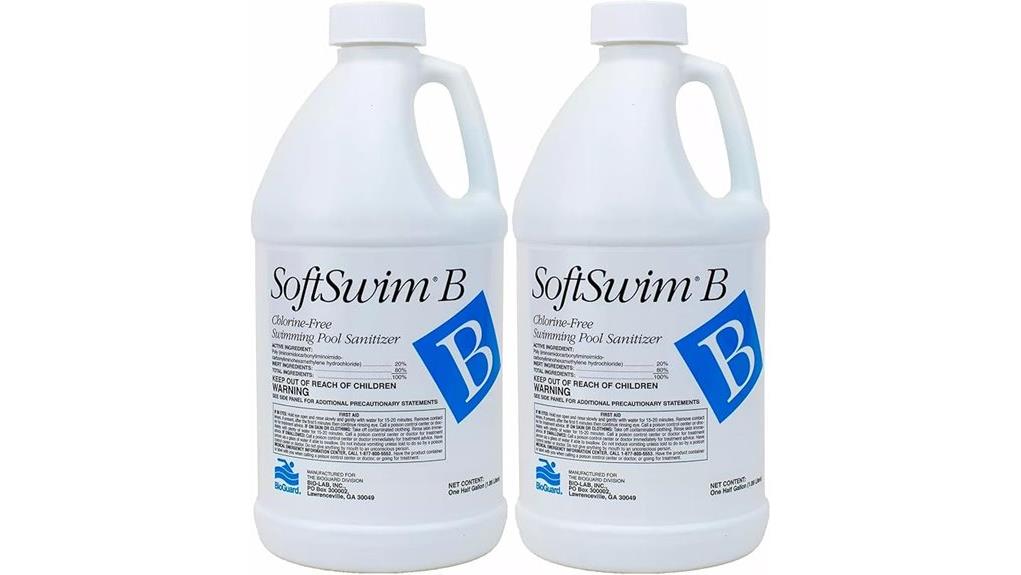
Bioguard SoftSwim B is a liquid biguanide sanitizer for chlorine‑free in‑ground or above‑ground pools up to 25,000 gallons; you’ll use it as step 2 of the SoftSwim program where pumps run ≥12 hours/day. It sanitizes via cationic membrane disruption rather than oxidation, gives UV‑stable, pH‑neutral residuals and a softer swimmer feel, and demands strict dosing, weekly residual testing and compatible oxidizers for compliance. Continue for detailed dosing, testing and operational guidance.
Some Key Takeaways
- SoftSwim B is a liquid biguanide sanitizer offering chlorine-free sanitation for pools up to 25,000 gallons.
- It sanitizes via cationic membrane disruption rather than oxidizing organic matter like chlorine.
- UV-stable residuals persist in sunlight and exert minimal impact on pool pH.
- Provides a softer, low-odor water feel with reduced eye and skin irritation compared to chlorine.
- Requires routine residual testing, limited shock options, and adherence to specific compatibility and maintenance protocols.
What SoftSwim B Is and Who It’s For
For owners of in-ground or above-ground pools up to 25,000 gallons, BioGuard SoftSwim B is a liquid, biguanide-based sanitizer designed as step 2 of the SoftSwim program to deliver chlorine-free sanitation and a soft water feel. You’ll apply a UV-stable, non-chlorine liquid formulated for home pools with bottom drains and continuous circulation; it’s specified for systems running pumps ≥12 hours/day. You’ll appreciate minimal pH influence, reduced chemical additions, and a softer tactile water quality that’s suitable for sensitive swimmers. Follow manufacturer dosing, recordkeeping, and compatibility checks to remain compliant with product instructions and local regulations.
How Biguanide (SoftSwim B) Works vs. Chlorine
Typically, biguanide (SoftSwim B) sanitizes pools by disrupting microbial cell membranes through cationic interaction rather than by oxidizing organic matter like chlorine does. You’ll rely on a contact biocide mechanism: biguanide binds negatively charged cell surfaces, destabilizes membranes, and inactivates bacteria and some protozoa without generating free halogen oxidants. In contrast, chlorine’s efficacy stems from oxidation comparison—it converts organics and microbes via hypochlorous acid and free chlorine residuals. Regulatory controls differ: you’ll monitor biguanide concentration and algicide compatibility, not chlorine demand or combined chlorine limits. Treatment policies emphasize residual dosing, compatibility, and documented testing protocols.
Real‑World Performance: Water Feel, Stability, and pH Impact
Having reviewed how biguanide inactivates microbes differently from chlorine, you should next assess how that chemistry affects water feel, stability, and pH behavior in real use. You’ll observe a distinct water texture: softer, less volatile than chlorinated pools, reducing eye and skin irritation risk. Formulation confers sunlight resilience; active biguanide doesn’t photodegrade, so sanitizer residuals remain stable under UV exposure. Operationally, SoftSwim B exerts negligible acidifying or alkalinizing effect — you won’t rely on it to correct pH. Monitor total alkalinity and carbonate hardness per standard protocols; maintain filtration and circulation to preserve sanitizer distribution and regulatory compliance.
How to Use SoftSwim B in Your SoftSwim Program (Dosage & Schedule)
When you integrate SoftSwim B into your SoftSwim program, follow a consistent dosing schedule based on pool volume and measured biguanide residuals to maintain the manufacturer-recommended target range. For initial dosing, calculate gallons, then add the specified milliliters per 1,000 gallons to reach the target residual; distribute product around the circulation intake with pump running. After 24 hours, test residual and adjust. Your maintenance schedule should specify routine residual checks (at least weekly) and fixed maintenance additions after heavy bather load or rain. Record doses, test results, and corrective actions to demonstrate regulatory compliance and quality control.
Pros, Cons, and When to Choose SoftSwim B Over Other Sanitizers
In evaluating BioGuard SoftSwim B against other sanitizers, weigh its biguanide chemistry, UV stability, and pH neutrality as primary decision criteria because those characteristics directly affect operational control, regulatory monitoring, and swimmer comfort. You’ll gain eye comfort, low odor, and maintenance simplicity from a chlorine-free program that keeps water soft and stable under sunlight. Consider limited shock options, incompatible oxidizers, and slower kill rates for certain pathogens as cons; biguanide systems demand specific algaecides and periodic monitoring to confirm algae resistance. Choose SoftSwim B when you prioritize swimmer comfort, straightforward dosing, and facilities with rigorous circulation and program compliance.
Some Questions Answered
Does Softswim B Require Special Storage or Temperature Conditions?
Yes. You should store SoftSwim B in cool storage with freeze protection to maintain chemistry and packaging integrity. Keep containers upright, sealed, and sheltered from direct sunlight and heat sources; avoid temperatures below freezing and extremes above manufacturer-recommended ranges. Follow local regulatory labeling for chemical storage, separate from incompatible substances, and guarantee secondary containment and spill control. Inspect periodically for leaks and comply with disposal and return guidelines.
Is Softswim B Safe for Use With All Pool Liners and Equipment?
Yes. You can use SoftSwim B with most vinyl liners and standard pool materials; it’s formulated for vinyl compatibility and minimizes equipment corrosion compared with chlorine. Still, you should follow manufacturer guidelines, avoid prolonged contact with untreated metals, and monitor metal components and seals per regulatory maintenance protocols. Perform periodic compatibility checks on nonstandard liners or exotic metals and document any deviations from recommended concentrations and exposure times.
Can Softswim B Be Used in Saltwater or Mineral Pools?
Yes — you can use SoftSwim B in saltwater and mineral pools, but you’ve got to follow compatibility limits and monitoring protocols. Biguanide-based SoftSwim B is chemically compatible with salt chlorination only if the salt cell is turned off or isolated, since electrolysis can degrade biguanide. For mineral pools, the formulation’s stability is acceptable, but you must verify manufacturer guidance, maintain target sanitizer levels, and record regular water chemistry to meet regulatory safety margins.
How Long Does an Open Bottle of Softswim B Remain Effective?
An open bottle of SoftSwim B remains effective for roughly 6–12 months under proper storage; unopened stability extends longer per manufacturer guidance. You’ll track shelf life and expiration timeline by recording opening date and inspecting clarity and odor. Store sealed, upright, away from heat and direct sunlight, in a cool, ventilated area with original label intact. Follow disposal and regulatory handling instructions if degradation is evident.
Are There Any Pets or Plant Safety Concerns After Application?
Yes — you should limit pet exposure and monitor plant sensitivity after application. You’ll keep pets out of treated water until labeled residual levels are achieved and circulation has run per instructions. Biguanide systems are gentler than chlorine, but ingestion or prolonged contact can irritate animals. Avoid splashing treated water onto nearby vegetation; some plants may show sensitivity. Follow label directions, observe for adverse effects, and consult manufacturer for specific safety thresholds.