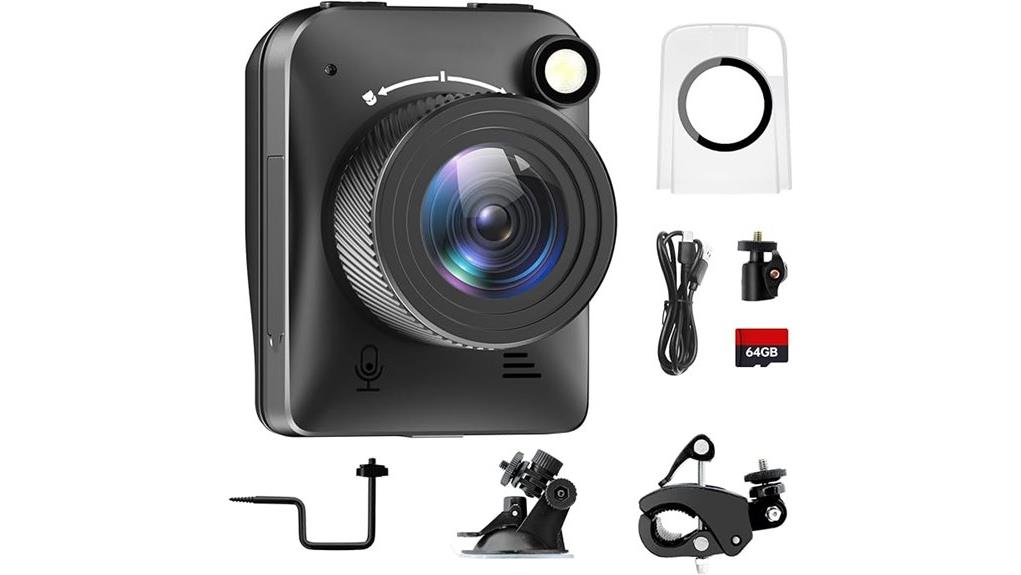
You’ll find the Dsoon TL3000 is a rugged, low‑maintenance time‑lapse tool that gives you 32MP stills and 4K UHD video from a 1/2‑inch sensor, an f/1.2 stabilized wide lens, and ±3 EV manual exposure control. It trades DSLR-level low‑light finesse and cinematic motion for six‑month battery potential, IP66 weather sealing, compact mounts and simple workflows. It’s best for long outdoor projects and set‑and‑forget installs; keep going to see specific performance, tips and limitations.
Some Key Takeaways
- Compact, IP66-sealed time-lapse camera with 32 MP stills and 4K AVI video for long outdoor deployments.
- f/1.2 wide-angle lens plus optical stabilization yields good daylight and improved low-light performance, though noise rises at high ISO.
- Extremely long battery life (up to six months at conservative intervals) ideal for unattended, long-duration projects.
- Best suited for static, set-and-forget workflows like construction and plant growth; less ideal for fast motion or cinematic shoots.
- No cellular connectivity; rely on USB/SD retrieval and use rugged mounting and cases for transport and stability.
Dsoon TL3000 at a Glance: Key Specs and What It Promises
Although it’s ultra-compact, the Dsoon TL3000 promises pro-level time-lapse capabilities for both outdoor and indoor projects: you get a 1/2-inch CMOS sensor, 4K UHD video (AVI) and 32 MP stills, a wide-angle lens with f/1.2 aperture, optical stabilization, and manual ±3 EV exposure control. You’ll appreciate its compact portability and IP66 weather sealing for exposed sites; compare that to bulkier rigs needing enclosures. The user interface is minimalist—physical controls plus a 2-inch IPS flip display—favoring set-and-forget workflows. Battery management supports extended deployments with up to six months runtime under conservative intervals. Consider pairing it with an external monitor for better framing and exposure control external camera monitors.
How the TL3000 Performs in Real Use: Image, Video, Low-Light, and Stabilization Tests
How does the TL3000 hold up when you actually put it to work? You’ll find 32 MP stills deliver strong image clarity in daylight, resolving fine textures compared with similar ultra-compact units. 4K video is sharp at standard intervals but fast pans reveal occasional motion blur; adjust exposure and interval to reduce it. Its optical stabilization shows measurable stabilization effectiveness on moderate vibrations, outperforming basic fixed lenses. In dim scenes the fill light and f/1.2 aperture improve low light performance, though noise rises beyond ISO thresholds. Overall, results are pragmatic: excellent for static time-lapse, conditional for dynamic scenes. Consider pairing the TL3000 with on-camera LED lights for photography to improve low-light color and clarity.
Battery, Durability, and Mounting: Field Endurance, IP66 Housing, and Installation Options
When you mount the TL3000 for extended field use, its battery capacity and IP66-rated housing work together to minimize maintenance and downtime. You’ll find stated battery life up to six months (4320 hours) under conservative intervals, which compares favorably to similar ultra-compact time-lapse units. The IP66 enclosure resists dust and heavy spray, keeping internals stable across temperature swings to 50°C. Included mounting options—sucker bracket, circular tube bracket, and nail bracket—give flexible attachment points for poles, glass, or walls. In practice you’ll balance interval frequency and mount stability to optimize endurance and image consistency in outdoor deployments. Consider pairing your TL3000 with a rugged case for transport and storage to protect gear during travel and fieldwork, especially if you use Pelican cases for photography.
Time-Lapse Features and Workflow: Intervals, Storage, File Formats, and Sample Setup Tips
With your TL3000 mounted and its power profile understood, you’ll next set up capture parameters that balance interval, storage, and output format to match your project goals. You’ll choose interval ranges—from seconds for stop-motion to minutes or hours for construction—and compare battery versus mains options for duration. Use workflow automation: scheduled starts, USB offload, and automated timelapse rendering on desktop. File management benefits from 64 GB included micro SD and AVI (4K) or 32 MP JPEG outputs; archive originals, export compressed video. Practical setup tips: test exposure, lock manual focus, monitor free card space, and log capture metadata for later review. Consider pairing the TL3000 with portable photo printers for instant, on-site prints of standout frames.
Who Should Buy the TL3000 and How It Compares to Alternatives
Although the TL3000 is compact and straightforward to deploy, it's best suited for users who need long-duration, outdoor-ready time-lapse capture rather than cinematic motion‑picture work. You’ll appreciate its IP66 housing, six-month battery potential, and 4K/32MP output for construction, weather, plant/garden growth, courtyard renovation, and creative stop motion with stable, interval-driven frames. If you need remote monitoring, note there’s no built-in cellular — you’ll rely on periodic USB/SD access. Compared to DSLRs or intervalometers, the TL3000 trades ultimate image control and low-light finesse for rugged autonomy and simplicity, making it ideal for field-centric, low-maintenance projects. Proper gear storage in a dry cabinet will help preserve your camera investment over time.
Some Questions Answered
Does the TL3000 Support Wireless Remote Control or Smartphone App?
No — it doesn’t support wireless pairing or a mobile app. You’ll need to control the TL3000 via its onboard buttons, timed settings, or by connecting the micro SD/USB to a desktop. Compared to cameras with Wi‑Fi or Bluetooth, the TL3000 is more manual and rugged, trading remote convenience for long battery life and IP66 protection. If wireless pairing matters, you’ll want a different model with dedicated mobile app support.
Can I Use External Power Sources or Solar Panels With the Camera?
Yes — you can use an external battery; the camera supports continuous powering via USB for long deployments. Solar compatibility is practical if you pair a solar panel with a regulated USB power bank sized for the camera’s draw and desired interval duty cycle. Compared to internal-only setups, external battery plus solar offers much longer runtime and weatherproof flexibility, but make sure the power bank provides stable output and fits the IP66 housing strategy.
Are There Firmware Updates and How Are They Installed?
Yes — firmware availability exists, and you can update via two update methods. You’ll download firmware files from the manufacturer or support contact, then install either by copying to the micro SD card and booting the camera or by connecting via USB and running the updater tool. Compared to OTA systems, these manual methods are more reliable but slower; they require careful version matching and backup of settings before you proceed.
What Accessories Are Available Beyond Included Mounting Brackets?
You can buy extra batteries, polarizing filters lens hoods, anti theft cages, and extension arms to expand use. Compare battery packs for capacity and runtime; filters and hoods reduce glare and improve contrast versus stock optics; cages offer theft and weather reinforcement but add weight; extension arms provide flexible mounting reach compared to included brackets. Choose accessories by trade-offs: runtime, image quality, security, and mounting versatility to match your project needs.
Is the Waterproof Housing Serviceable for Repairs or Battery Replacement?
Yes — the waterproof housing allows limited waterproof maintenance and battery accessibility. You’ll unfasten seals to reach the internal battery compartment, but doing so can compromise IP66 integrity if seals aren’t reseated correctly. Compared to user-replaceable external housings, this design is less service-friendly yet still repairable for battery swaps and seal replacement. You should follow manufacturer guidance and use replacement gaskets to restore reliability after any maintenance.