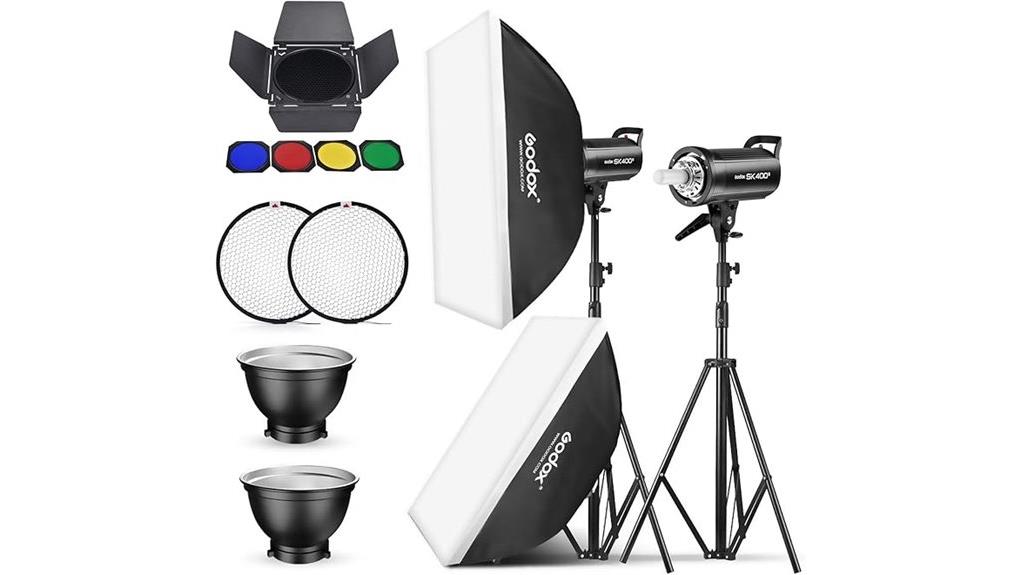
You’ll get two 400Ws Bowens‑mount monolights with reliable 2.4G wireless control, 40‑step 1/16–1/1 output, and ≤2% consistency for predictable manual exposures. Each head has a 150W variable modeling lamp, fast 0.1–1.0s recycling, and built‑in cooling and protections for extended studio work. They mount to standard stands and accept common modifiers, but they’re mains‑only and not ruggedly pro‑built. Keep going and you’ll find detailed notes on setup, triggers, and typical shoot uses.
Some Key Takeaways
- Two 400Ws Bowens‑mount monolights provide reliable manual studio flash power with 1/16–1/1, 40‑step control and ≤2% output shift.
- Built‑in 2.4G Godox X wireless (16 groups, 32 channels) enables fast, reliable triggering with Godox transmitters.
- 150W modeling lamp with 5%–100% control and quick 0.1–1.0s recycling supports efficient portrait and e‑commerce workflows.
- Mains‑powered only (no native battery), robust cooling, and protection make it ideal for studio use but limited for travel.
- Best for entry‑to‑enthusiast studios needing affordable, scalable multi‑light setups; skip if you require battery portability or pro weather sealing.
What the Godox SK400II 2‑Pack Is and Who It’s For
Cutting straight to it: the Godox SK400II 2‑Pack is a pair of 400Ws Bowens‑mount monolights (800Ws total) designed as studio strobes for stills and location work. You’ll find compact, manual-controlled units offering 400Ws per head with Bowens compatibility, 2.4G wireless integration, and adjustable modeling lamps. They suit small studios, portrait, e-commerce, and location shoots where predictable color and repeatable manual output matter. If you’re an entry photographers seeking affordable lighting that scales into multi‑light setups, these deliver straightforward controls, RF triggering, and common modifiers. They’re technical, serviceable tools for disciplined lighting workflows without advanced automation. These kits pair well with ring lights for brightening selfies and on-location portrait work.
Key Specs That Matter: Power, Modeling Lamp, Recycling, and Stability
Because output consistency and response speed define how you light a scene, the SK400II’s 400Ws heads, 40-step 1/16–1/1 adjustable output, and ≤2% output shift are the specs you'll check first. You get precise increments for exposure control, which supports predictable power consistency across shots. The 150W modeling lamp offers 5%–100% control so you can set modeling intensity for composition and focus without affecting flash output. Recycling runs 0.1–1.0 s thanks to large capacitors, enabling continuous shooting. The unit’s display and controls preserve settings, while built-in cooling and protections maintain stable operation during extended sessions. These features make the SK400II a strong match for photographers who value reliable gear and good light stand compatibility.
Real‑World Performance: Setup, Syncing, and Shooting Scenarios
When you set up the SK400II pair in a small studio or on location, mounting the Bowens heads to stands and modifiers is straightforward and the built‑in 2.4G X system makes syncing with Godox triggers fast and reliable. You’ll position one unit as key and the other as fill or background, adjust output precisely on the LCD, and rely on 0.1–1.0 s recycling for paced shooting. For travel considerations, note mains power only—carryable battery packs aren’t supported natively. Flash modifiers attach securely; use grids or softboxes for contrast control. Use short sync speeds and careful ambient balancing for mixed‑light scenes. For buyers interested in wireless setups, consider learning more about wireless flash triggers to get the most from the 2.4G system.
Compatibility, Controls, and Wireless Features to Know
Although the SK400II is a studio‑focused monolight, its built‑in Godox 2.4G X wireless system gives you robust trigger compatibility and precise remote control of groups and channels. You get 16 wireless groups and 32 channels, letting you isolate lights or trigger multiple heads. Control is via the clear LCD and knurled dials; settings persist with auto memory. Channel scanning speeds finding a free frequency in busy RF environments. The head accepts standard Godox transmitters (Xpro, X1, XT32, FT‑16). Keep an eye on firmware updates for improved stability and added trigger compatibility with newer transmitters. Many photographers pair the SK400II with portable LED panels from our selection for consistent color temperature and seamless workflow with studio strobes, especially when using video light panels.
Buy or Skip? Practical Pros, Cons, and Recommended Use Cases
With reliable on-board wireless control established, it’s time to judge whether the SK400II pair fits your workflow and budget. You’ll buy if you need 400Ws per head, fast recycling (0.1–1.0s), accurate output readout, Bowens compatibility, and integrated Godox 2.4G triggering for multi-light setups. You’ll skip if you require weather sealing, higher sync speeds, or battery portability. Pros: consistent ≤2% output stability, 150W modeling lamp, solid cooling and protection. Cons: mains-only 110V, limited max sync, modest build compared to pro monolights. Recommended for studio portraits, e‑commerce, and small commercial shoots; consider budget alternatives for disposable budgets or longer‑term durability concerns. These kits pair well with umbrella lighting setups for photographers who prefer soft, diffuse light from umbrella lighting and want a compact, affordable studio solution.
Some Questions Answered
Is the Kit Compatible With European 220–240v Power Without a Converter?
No — it’s not voltage switchable for European compatibility, so you’ll need a converter or transformer for 220–240V. The SK400II kit ships for 110V operation and lacks a built‑in auto voltage switch. You’ll risk damage or nonoperation if you plug it directly into European mains. Use a reliable step‑down transformer rated above the combined draw, make certain proper grounding, and verify cooling/overheat protection under converted power.
Can These Strobes Be Used Safely Outdoors in Light Rain?
No—you shouldn’t use them in light rain. The units aren’t water resistant, so weatherproofing precautions are essential: keep flashes under shelters, use rain covers or plastic bags sealed with gaffer tape, and elevate stands on nonconductive, dry surfaces. Use umbrellas cautiously—umbrella compatibility is fine for light diffusion, but umbrellas offer little weather protection; combine umbrellas with a dedicated rain shield or shoot under a canopy to prevent moisture damage.
Are Spare Modeling Lamp Bulbs Included or Available Separately?
No, spare bulbs aren’t listed as included; you’ll need to buy modeling replacements separately. The kit typically ships with the installed 150W modeling lamps, but manufacturers and retailers sell spare bulbs and compatible modeling replacements (150W, 5600K) as service parts. Check Godox part numbers or third-party Bowens‑mount compatible halogen modeling bulbs. Verify voltage and socket type before ordering, and keep extras on hand to avoid downtime.
What Is the Physical Weight of Each Monolight With Stand Mount?
Each monolight with stand mount weighs approximately 1.5 kg to 2.2 kg depending on measured configuration. You’ll typically see the bare head near 1.5 kg; adding the mounting bracket and foot raises it toward 2.2 kg. Use a scale to confirm your unit since accessories and manufacturing tolerances cause variance. For shipping or rigging, plan on the higher value per head to guarantee safe support and transport.
Do These Units Support High-Speed Sync (HSS) With Any Triggers?
No — these units don’t support high speed sync (High speed) natively. You’ll use them with Godox triggers, but HSS capability is limited by the SK400II’s circuitry. They work with compatible triggers (Xpro, X1, X2, XT32, FT-16) for regular sync and wireless control, yet HSS won’t function reliably. Expect standard sync limitations and reliance on camera/trigger features for any advanced fast-shutter work, so plan lighting accordingly.