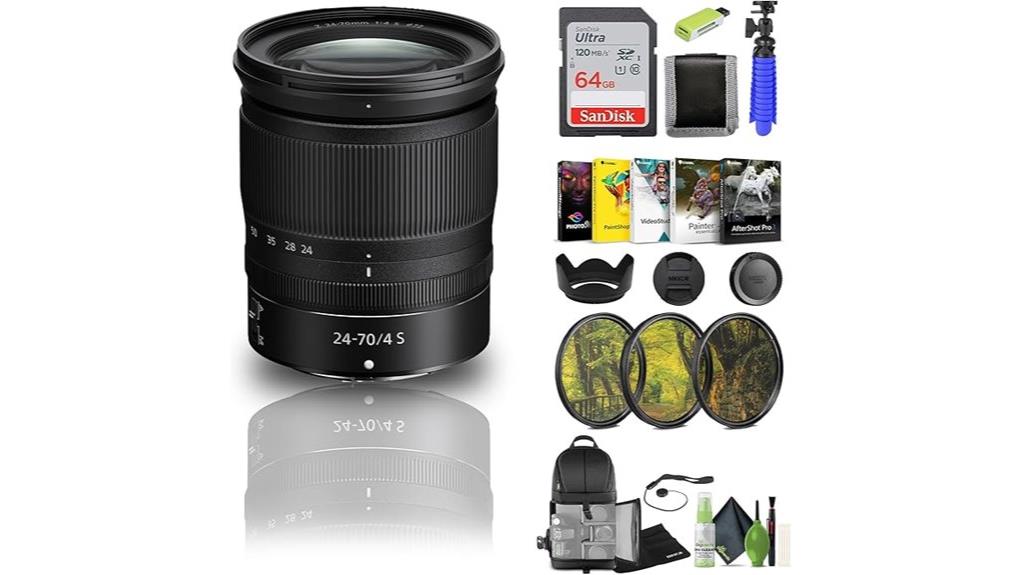
You’ll find the Nikon NIKKOR Z 24–70mm f/4 S (20072) is a compact, weather-sealed standard zoom that delivers sharp, stabilized images with quiet stepping-motor AF suited for hybrid photo/video use. Its three asphericals, one ED-aspherical, Nano Crystal and SIC coatings, and fluorine front reduce aberrations, flare and grime. Internal focusing and minimal focus breathing aid rack-focus work, while a four-blade diaphragm and f/4 max aperture impose bokeh and low-light trade-offs. Continue for detailed specs, handling notes, and verdict. In addition to the Nikon NIKKOR Z 1728mm performance reviews, users often praise its wide-angle capabilities and versatility for landscape and architectural photography. Photographers appreciate the lightweight design, which makes it an ideal choice for travel and on-the-go shooting. Overall, the lens is regarded as a valuable addition to any Nikon Z camera setup.
Some Key Takeaways
- Sharp optics with three aspherical and one extra-low dispersion aspherical element deliver high resolution across the zoom range.
- Quiet, fast stepping-motor AF and minimal focus breathing suit both stills and hybrid video workflows.
- Built-in optical stabilization and internal focusing improve handheld shooting and preserve balance.
- Weather-sealed, button-less retractable barrel plus bundled hood, case, caps, and filters make it travel-ready.
- Trade-offs: modest f/4 maximum aperture and four-blade diaphragm limit low-light performance and bokeh creaminess.
What the Nikon Z 24–70mm F/4 S Actually Includes and Who It’s For
Anyone picking up the Nikon NIKKOR Z 24–70mm f/4 S gets a complete kit aimed at travel, run-and-gun, and hybrid photo/video work: the lens itself (Model 20072) with a 72mm snap-on front cap and LF-N1 rear cap, HB-85 hood, CL-C1 case, a 3-piece 72mm filter kit, LC-72B cap, plus useful accessories—64GB memory card, card reader, memory wallet, 12-inch flexible tripod, lens cap keeper, cleaning kit, Corel photo software, and a pro sling backpack—so you can shoot immediately and protect the optic in the field. You’ll find the box contents thorough and practical. The kit targets users seeking immediate deployment: travel shooters, content creators, and hybrid photo/video operators who need compact protection, basic filtration, media and on-the-go support. A pro sling backpack is especially useful for photographers who value portable gear storage while moving between shoots.
Core Optical and Mechanical Features That Affect Image Quality
Having the lens and accessories sorted, you’ll want to understand how the optical and mechanical design determines image quality. You rely on three aspherical elements plus an extra-low dispersion aspherical element to control spherical and chromatic aberrations across 24–70mm. Nano Crystal and Super Integrated coatings, with fluorine on exposed surfaces, improve coating performance against flare and ghosting. Internal focusing moves only internal groups, preserving balance and minimizing focus breathing. A four-blade aperture blades diaphragm yields distinct bokeh character and diffraction behavior at smaller stops. Weather-resistant construction and stable mount alignment guarantee consistent optical performance under field conditions. For best results in maintaining that optical performance, consider using lens cleaning solutions designed for camera optics.
Real-World Performance: Autofocus, Stabilization, and Handling
While testing the NIKKOR Z 24–70mm f/4 S, you'll notice its autofocus combines speed and silence—thanks to a stepping motor that drives internal focusing groups without changing lens length—making subject acquisition fast for stills and unobtrusive for video. You get fast AF performance with predictable tracking and reliable subject relock. Optical image stabilization delivers smooth stabilization for handheld shooting across the zoom range, reducing motion blur at slower shutter speeds. The barrel ergonomics provide good grip comfort and intuitive control placement. Focus breathing is minimal, so framing stays consistent during rack focus, benefiting hybrid photo/video workflows. This lens is a solid choice for photographers who value versatile zoom performance and regularly shoot both stills and video.
Durability, Accessories, and Everyday Usability for Photo and Video
Beyond autofocus and stabilization, you’ll find the 24–70mm f/4 S built for dependable field use: its dust- and moisture-resistant barrel and fluorine-coated front element shrug off grime and light moisture, while the button-less retractable design keeps the lens compact for transport. You’ll appreciate robust weather sealing during extended shoots; coatings and sealed mounts reduce service needs. The bundled accessories—hood, case, caps, filters, memory card, cleaning kit, tripod and backpack—support photo and 1080p video workflows out of the box. Internal focusing and modest weight maintain balance on Z-series bodies, and pocket portability is improved for travel. Many photographers pair the lens with Pelican cases to protect gear during rugged shoots.
Final Verdict: Strengths, Trade-Offs, and Who Should Buy It
If you need a reliable, compact standard zoom that balances image quality, weather resistance, and video-friendly AF, the NIKKOR Z 24–70mm f/4 S delivers predictable performance and durable build quality. You get sharp optics with advanced coatings, quiet stepping-motor AF, internal focusing, and weather sealing — a clear value proposition for hybrid shooters and travelers. Trade-offs include a modest f/4 aperture and a 4-blade diaphragm versus faster, creamier alternatives; optical stabilization helps but doesn’t replace faster glass in low light. Buy it if you prioritize versatility, portability, and robustness; consider lens alternatives only if you need faster apertures. The lens is a strong match for photographers who value gear designed for digital camera enthusiasts and everyday shooting enthusiast photographers.
Some Questions Answered
Does This Lens Support In-Camera Lens Corrections on All Z Cameras?
Yes — you’ll get in-camera lens corrections on most Z cameras, but it depends on firmware compatibility and available correction profiles. Newer Z bodies (Z6, Z7, Z8, Z9, Z5, Z50, Z30, etc.) will apply distortion, vignetting and chromatic aberration corrections automatically when the camera recognizes the lens and has matching correction profiles. You should update camera firmware to the latest version to guarantee full profile support and peak performance.
Can the Lens Be Used With Full-Frame FX and DX Crop Modes Interchangeably?
Yes — you can use it in both FX compatibility and Crop adaptation modes interchangeably on Z bodies that offer frame-size switching. You'll get full-frame coverage in FX mode and an effective narrower field of view in DX (crop) mode, with focal length unchanged but image area reduced and effective pixel density increased. Camera metering, autofocus and in-camera corrections still function; expect different framing, resolution and crop-factor-dependent depth-of-field effects.
Is the Optical Image Stabilization Cooperative With In-Body Stabilization (IBIS)?
Yes — the lens’ optical stabilization cooperates with in-body stabilization, allowing stabilization blending for enhanced shake reduction. You’ll get combined sensor-shift and lens-element corrections that improve motion smoothing across focal lengths and during panning. The system prioritizes ideal axis control automatically, yielding steadier handheld stills and smoother video. Expect marginally better low-shutter performance and reduced micro‑vibration compared with using either stabilization method alone.
Are There Any Known Focus Breathing or Chromatic Aberration Issues in Video?
You’ll see minimal focus breathing and only slight color fringing in high-contrast edges when using the lens for video. The internal focusing and stepping motor keep focus shifts restrained, reducing breathing artifacts for most productions. Chromatic aberration is generally well-controlled by the aspherical/ED elements and coatings, but you’ll still need minor correction in post for strong highlights or high-contrast edges to eliminate residual color fringing.
What Third-Party Filters Are Recommended for the 72MM Thread?
Use high-quality 72mm filters like B+W Filters and Hoya Pro1 for general protection and color fidelity. Choose NiSi Nano or Breakthrough X4 for low reflections and durability. For variable ND, use Tiffen Variable cautiously for color shift. Prefer Heliopan Slimline or Zeiss T* Enhancer for minimal vignetting and robust build. For strong ND/grad work, Formatt Hitech Firecrest offers neutral density and excellent color neutrality.