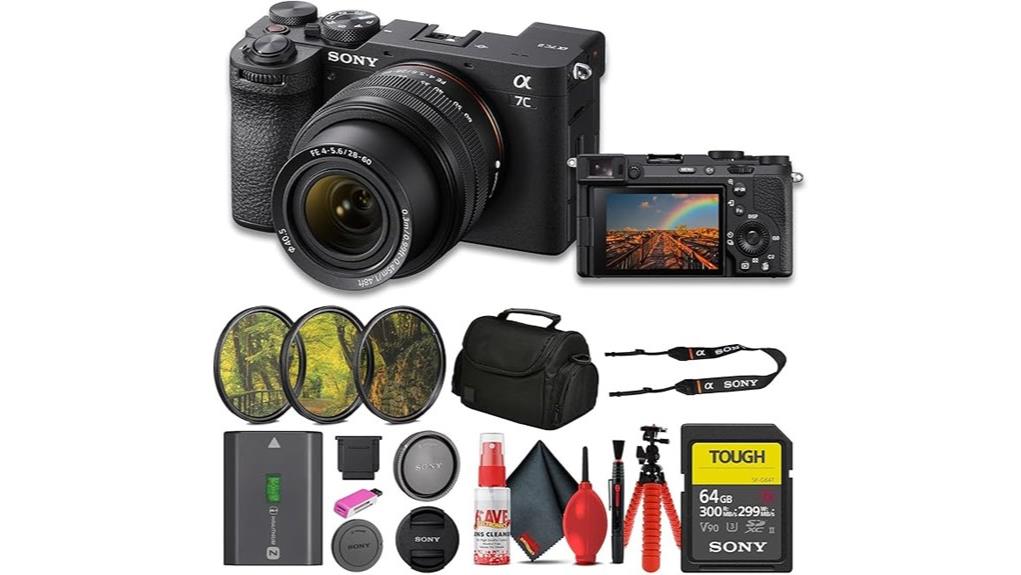
You’ll get true full‑frame quality in a pocketable body with the Sony a7C II — a 33MP BSI sensor and BIONZ XR deliver clean, detailed stills and 10‑bit 4K/30p with S‑Log3/S‑Gamut3 for grading. Its 759‑point phase‑detect AF, 10fps burst and 7‑stop IBIS keep subjects sharp in action and low light. Controls are compact but usable, with a vari‑angle screen and decent EVF. Keep going to see how it handles real shoots and alternatives.
Some Key Takeaways
- 33MP full‑frame BSI sensor and BIONZ XR deliver crisp, low‑noise stills with wide dynamic range for flexible post‑processing.
- 10‑bit 4K/30p video with S‑Log3, S‑Gamut3, and user LUT support suits run‑and‑gun and pro workflows.
- 759‑point phase‑detect AF and reliable subject tracking maintain sharp focus for people, animals, and action.
- 7‑stop in‑body stabilization plus 10 fps AF/AE burst enable steady handheld shooting in low light and action.
- Compact, ergonomic body with vari‑angle touchscreen and decent EVF offers portable full‑frame performance for travel and events.
Verdict Up Front: Is the Sony a7C II Worth Buying?
While it’s compact enough to carry all day, the a7C II packs full-frame performance that’ll satisfy serious hybrid shooters: a 33MP BSI sensor and BIONZ XR deliver crisp stills and 10‑bit 4K/30p video, the 759‑point AF and 7 stops of IBIS keep subjects sharp, and the vari-angle touchscreen plus pro video features (S‑Log3, S‑Gamut3, S‑Cinetone, user LUTs) give you creative control—so if you want a lightweight body without sacrificing image quality or advanced video tools, the a7C II is a compelling buy. You’ll appreciate its clear value proposition: pro features in a portable package. Consider purchase timing around promotions or kit bundles to maximize return on investment. We also recommend checking our selection of essential mirrorless accessories like camera bags and extra batteries to get the most out of the a7C II.
What the Sensor, Processor, and Image Quality Deliver
Having established why the a7C II is a compelling compact hybrid, let’s look at what powers that performance: a 33MP full‑frame Exmor R BSI sensor paired with the BIONZ XR engine. You’ll get back illuminated performance that lowers read noise and boosts usable ISO, so Low light scenes retain detail with restrained grain. The sensor/processor tandem delivers wide Dynamic range, preserving highlights and shadows for cleaner pulls. For video and stills, 10‑bit output plus S‑Log3/S‑Gamut3 gives you latitude for precise Color grading without posterization. Overall, the platform balances resolution, sensitivity, and processing muscle for versatile image quality. For the best results, pair the camera with a calibrated monitor and proper profiling workflow to ensure true-to-life color.
Autofocus, Speed, and Stabilization in Real-World Shooting
Because the a7C II combines a 759-point phase-detect AF array with the BIONZ XR smarts, you get fast, confident subject acquisition across roughly 94% of the frame and reliable tracking for people and animals in both stills and 4K video. You’ll notice real world tracking holds locked targets during erratic motion and zone shifts, aided by predictive AF and quick recalculation. Continuous shooting at 10 fps with AF/AE delivers usable frames for action, and the 7-stop IBIS stabilizes handheld pans and low shutter speeds. In dim scenes, low light bursts maintain focus and exposure consistency with minimal noise. Regular sensor cleaning using proper cleaning kits helps keep autofocus and image quality consistent over time.
Ergonomics, Viewfinder, and Handling for Everyday Use
Grab the a7C II and you’ll immediately notice Sony distilled full-frame capability into a compact, all-day body that balances small size with usable controls. You’ll appreciate the refined comfort grip that reduces hand fatigue during long shoots while preserving pocketability for travel. Button placement favors thumbs and index finger, letting you change exposure, AF, and drive modes without shifting your stance. The 2.36m-dot EVF is crisp enough for critical framing, and the 3.0-inch vari-angle tilt mechanism gives flexible monitoring for low and high angles. Overall handling is balanced, precise, and optimized for efficient, on-the-go work. Consider pairing it with a sturdy travel tripod to maximize stability and compositional options on the move.
Who Should Buy It and Better Alternatives to Consider
If you shoot travel, run-and-gun video, or everyday street and event work and want full-frame image quality in a pocketable body, the a7C II is a compelling choice—its 33MP BSI sensor, 7-stop IBIS, and 10-bit 4K workflow give you technical headroom for stills and video without a heavy kit. You’ll appreciate its AF coverage, compact ergonomics, and battery life for travel vloggers and hybrid creators. Portrait photographers will like sharp files and shallow depth control, though dedicated studio shooters may prefer larger bodies. Budget shooters should compare the a7C II to used a7 III or newer APS-C hybrids as alternatives. Also consider pairing it with a compact camera bag designed for mirrorless kits to keep your setup protected and travel-ready.
Some Questions Answered
How Long Does the Battery Last in Real-World Shooting Conditions?
You’ll typically get about 500–700 shots per charge in mixed shooting scenarios, or roughly 1.5–3 hours of continuous video recording depending on resolution and stabilization. Battery endurance drops with heavy autofocus, IBIS, 10-bit 4K, and EVF use; stills with intermittent LCD use push toward the higher end. Carry a spare for extended sessions, especially for long handheld stabilized video or fast continuous shooting that increases power draw.
Can It Record External Clean 10-Bit 4K Over HDMI?
Yes — you can record clean 10‑bit 4K over HDMI to an external recorder while using external monitoring; the a7C II outputs a clean 4:2:2 10‑bit signal via HDMI without on‑screen overlays. It supports HDMI pass through for real‑time monitoring to an external display/recorder, and you’ll benefit from the sensor’s 10‑bit output, S‑Log3/S‑Gamut3 compatibility, and robust AF while recording externally for higher quality workflows.
Is the Included 28–60mm Lens Weather-Sealed?
No — the included 28–60mm lens isn't fully weather-sealed. You’ll get basic dust and moisture resistance in some mounts, but it's not rated for robust weather resistance like pro-grade lenses. Its lightweight lens construction prioritizes compactness and portability over heavy-duty sealing. If you shoot in harsh conditions, you should add extra protection (rain cover or a weather-sealed alternative) to preserve camera and lens reliability.
How Fast Is Autofocus in Low-Light Video Recording?
You’ll get fast, reliable autofocus in low-light video, thanks to the 33MP BSI sensor and 759-point phase-detection AF that maintain low light tracking down to near-starlight levels. You’ll see smooth subject continuity with motion interpolation disabled for native AF or enabled in post for gentler motion. Autofocus locks and follows subjects quickly at typical cine ISOs, with occasional hunting only in extreme, contrast-free scenes.
Does It Support In-Camera Vertical Video and Metadata?
Yes — you’ll get in-camera vertical video with proper vertical metadata and portrait tagging. The camera records orientation data so clips import as portrait in compatible NLEs and mobile apps, and it embeds vertical metadata for playback. You’ll still want to confirm your workflow supports Sony’s tags and LUTs; otherwise you can transcode while preserving orientation. This streamlines delivery for social platforms and keeps framing and metadata consistent.