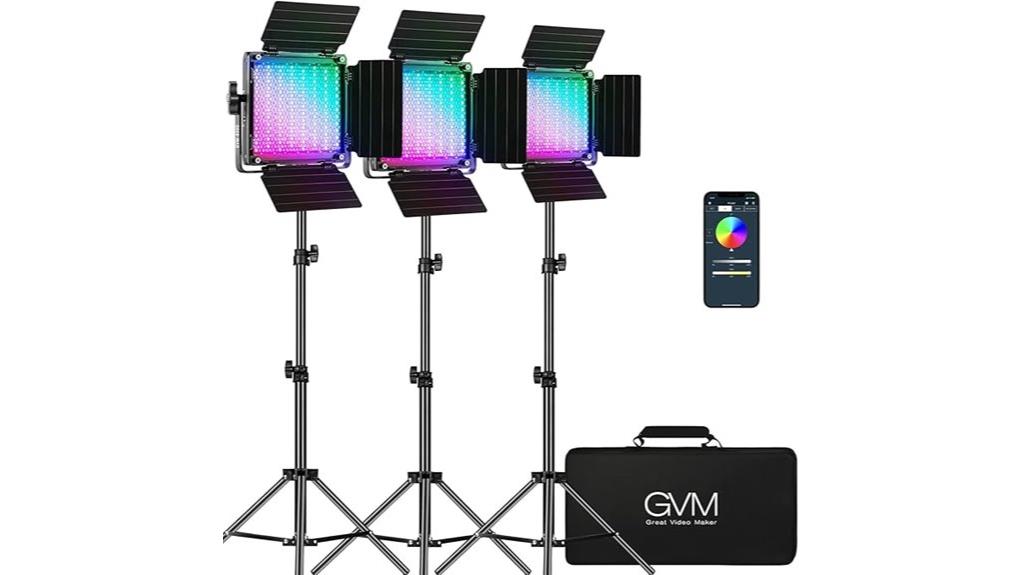
You’ll get three metal‑housed RGB 850D panels that deliver strong, shadow‑free 360° output with bi‑color 3200–5600K control and CRI 97+ for reliable skin tones. They support AC or Sony F750/970 batteries, include adjustable U‑brackets, diffusion, and app control with master/slave linking. Color is predictable with minimal tint shift when dimming, and RGB lets you craft looks precisely. If you want full kit details, setup tips, and real‑world performance notes, keep going.
Some Key Takeaways
- Produces shadow-free 360° RGB output with strong bi-color (3200–5600K) versatility for interviews and streaming.
- High color fidelity: CRI 97+ and stable color temperature with negligible tint shift when dimming.
- Portable, durable metal build with adjustable U-brackets, dual AC/battery power, and included battery plates.
- Intuitive app and master/slave workflow enable precise color control, scene presets, and linked multi-light setups.
- Good value for creators and small studios, though kit cost is higher and batteries are not included.
Quick Verdict: Is the GVM RGB 850D Kit Worth Buying?
While it won’t replace high-end studio fixtures, the GVM RGB 850D three-pack gives you professional-grade, flexible lighting at a compelling price: you get shadow-free 360° RGB output, wide bi-color range, excellent CRI (97+), robust metal construction, and versatile control via master/slave and app—so if you need portable, color-accurate, and customizable LED panels for video work, this kit is worth buying. You’ll gain predictable color fidelity and app precision for interviews, streaming, and small-scale production. Consider affordability comparison against rivals: it balances cost and features well. Metal housing and heat management suggest reliable long term durability for regular field use. These panels are especially useful for photographers who value bi-color versatility in both studio and on-location shoots.
What’s in the Kit and Key Specs (Lights, Mounts, Power Options)
Because the GVM RGB 850D kit targets run-and-gun and studio users alike, it ships as a complete three-light package with the essential mounting and power accessories you’ll need to get started. You get three 850D panels (aluminum alloy U-brackets), a single AC adapter with multi-outlet splitter, three Sony F750/970-compatible battery plates, diffusion fabrics, and basic unboxing accessories such as cables, screws, and a compact soft case. Mounting hardware includes adjustable U-brackets with 5/8″ and 1/4″-20 options for stands or cages. Specs: 624 LED beads, bi-color 3200–5600K, RGB control, CRI 97+, dual power. The kit is well suited for photographers and videographers seeking LED panels for photography thanks to its versatile power and mounting options.
How the RGB, Bi‑Color, and CRI 97+ Perform in Real Shoots
Color accuracy and versatility are the strengths you’ll notice on set: the 850D’s bi‑color range (3200–5600K) lets you match tungsten to daylight without hue shifts, its RGB controls provide precise hue and saturation adjustments for creative looks, and the CRI 97+ keeps skin tones and practicals rendering with minimal color error. You’ll get consistent temperature consistency across intensities, with negligible tint drift when dimming. Saturation control is precise enough for subtle gels or bold looks, aiding real world mixes between LEDs and practical sources. Overall color rendering is accurate, predictable, and repeatable for narrative and commercial shoots. Perfect LED lights like these are ideal for continuous lighting setups where consistent output matters.
Setup, Controls, App Use, and Master/Slave Scene Workflows
How do you get the 850D kit ready and keep control reliable on set? Start by mounting lights with U-brackets, attaching grid modifiers for directional control, and fitting power (AC or Sony batteries). Set one unit as master, assign channels, then link slaves; confirm via the LCD. Use the GVM app for fine adjustments, color calibration, and scene selection, but expect occasional app troubleshooting—restart the app, confirm Bluetooth, and check channel matching. Regularly install firmware updates to maintain sync and feature parity. Document your master/slave assignments and test personalized scenes before shooting to avoid interruptions. For consistent results across shoots, consider creating and saving preset lighting profiles that match your typical setups.
Pros, Cons, and Who Should Buy the GVM RGB 850D
When you need versatile, high‑quality lighting that’s easy to dial in, the GVM RGB 850D delivers: it offers wide CCT range (3200–5600K), full RGB control with high saturation, and exceptional color accuracy (CRI 97+), all housed in a robust, well‑dissipating aluminum shell with reliable mounting and power options. Pros: precise color control, strong output, intuitive app, master/slave scenes, solid build. Cons: kit cost versus budget alternatives, batteries not included so factor battery lifespan and extra expense for Sony F750/970 packs. Who should buy: content creators and small studios needing accurate, flexible lighting with app-driven workflows. Consider pairing these lights with umbrella lighting kits for softer, more flattering portraits and videos with umbrella diffusion.
Some Questions Answered
Are Sony F750/F970 Batteries Included With the Kit?
No, Sony F750/F970 batteries aren’t included. You’ll need to supply compatible batteries or use the AC power adapters provided. The kit supports battery compatibility with Sony F750/F970 cells and accepts dual power options for flexible setups. You’ll connect either the battery plate or the AC adapter depending on location. This guarantees continuous operation and reliable heat-dissipating metal construction for indoor or outdoor shooting.
Does the Kit Include AC Power Adapters for All Three Lights?
Yes — the kit includes AC adapters for each light, so you’ll be able to run all three from mains power. You’ll also have dual power options for flexibility: AC adapters or Sony F750/970 batteries (sold separately). This supports straightforward power management on set, with metal housings aiding heat dissipation during continuous use. Use the adapters for reliable, uninterrupted operation indoors and when batteries aren’t practical.
Can the Lights Be Powered via USB-C or Only the Listed Options?
No — the lights don’t support USB C compatibility for powering; they use AC adapters or Sony F750/970 batteries. You’ll need to rely on the listed options. There’s no Power delivery over USB-C implemented, so you can’t substitute a USB-C PD source. If you require portable USB-C PD powering, you’d need a third-party adapter or mod, but that would be unofficial and may void warranty or risk improper voltage/current delivery.
What Is the Mounting Thread Size on the U‑Shaped Brackets?
The mounting thread size is 1/4″-20 on the U-shaped brackets. You’ll use standard 1/4″-20 mounting hardware to attach the lights to stands, arms, or quick-release plates. This common thread lets you integrate the lights with most tripods and grip gear without adapters. If you need rosette or 3/8” compatibility, plan to add an adapter or specialized mounting plate; the stock bracket expects 1/4″-20 fittings.
Is There a Warranty and How Long Does It Last?
Yes — you get a limited warranty; the warranty length is typically one year from purchase for defects in materials and workmanship. You should review the Service terms for specifics like coverage exclusions, required proof of purchase, and authorized repair procedures. If you need extended support options or region-specific terms, contact the seller or GVM directly and keep serial numbers and receipts handy to expedite any warranty claim under the stated Service terms.