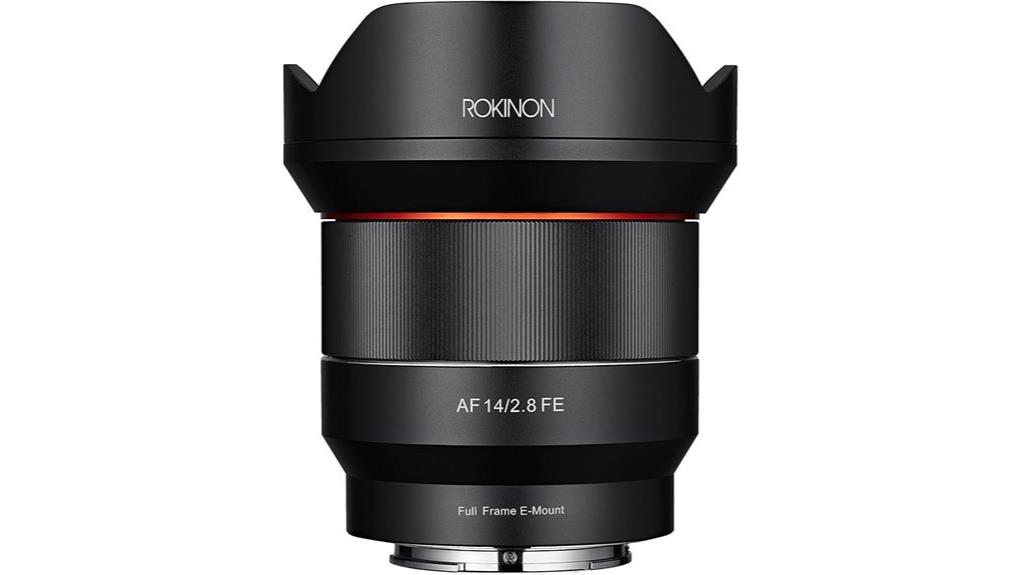
You’ll get a compact, weather‑resistant 14mm f/2.8 that gives a 113.9° field on Sony E bodies, strong center sharpness wide open and peak resolution around f/5.6–f/8, plus three asphericals, two ED elements and UMC coatings to control aberrations. Autofocus is quick and reliable with Sony hybrid systems, and handling is solid at 450 g, though there’s no stabilization and corners can soften for astro work — keep going to see detailed test results and comparisons.
Some Key Takeaways
- Excellent center sharpness at f/2.8 with peak detail across the frame around f/5.6–f/8.
- 113.9° ultra-wide field with three asphericals and two ED elements controls aberrations and maintains foreground-to-background continuity.
- Fast f/2.8 delivers strong low-light and astrophotography performance, though slight corner softening and controlled coma remain.
- Barrel distortion is consistent and easily corrected in RAW, with minimal resolution loss after edits.
- Compact 450 g weather-sealed aluminum build, reliable Sony AF, but lacks IBIS and uses a seven-blade diaphragm.
Quick Verdict and Who This Lens Is For
While it’s a specialist optic, the Rokinon AF 14mm F2.8 delivers a strong combination of ultra-wide field of view (113.9°), fast f/2.8 aperture, and robust optical design—three aspherical and two ED elements with UMC coating—that makes it ideal for landscape, architecture, astrophotography, and low-light wide-angle work on Sony E-mount full-frame or APS-C bodies. You’ll get a commanding wide perspective for expansive scenes, controlled creative distortion for foreground emphasis, and usable performance in low light thanks to the f/2.8 aperture and coatings. It’s aimed at travelers, night shooters, and architectural photographers needing travel versatility without complex handling. The site also offers resources for mastering wide-angle techniques, including composition and lens selection tips for wide-angle lenses.
Key Specs and What They Mean for Real Shooting
Because the 14mm focal length and 113.9° field of view define how you compose, this lens forces you to think in extremes—huge foregrounds, converging architecture, and expansive skies—and the fast f/2.8 aperture combined with three asphericals and two ED elements lets you retain edge-to-edge detail and control chromatic aberration in low-light and night scenes. You’ll find focal characteristics favor exaggerated perspective and deep DOF at typical landscape apertures. Aperture behavior provides usable f/2.8 low-light performance and sharpness gains toward f/5.6–f/8. Edge performance is improved by asphericals; expect measurable field curvature that benefits foreground-to-background continuity but requires framing adjustments. This lens is aimed at photographers who prefer prime lenses and want to master focal-length-specific techniques for stunning images, especially when using prime lenses to develop consistent compositional skills.
Real-World Performance : Sharpness, Distortion, and Night/Astro Shots
Having covered how focal length and aperture shape composition and depth, let’s examine how the Rokinon AF 14mm performs on image quality metrics you care about: sharpness, distortion, and night/astro capability. You’ll find center sharpness strong wide open at f/2.8; stopping to f/4–f/8 tightens detail across the frame. Distortion is barrel-type but consistent and correctable in RAW with minimal resolution loss. For astrophotography the lens delivers wide sky coverage with controlled edge coma for most stars; slight corner softening persists. With proper exposure and tracking, star trailing is minimal, making this a capable, affordable astro performer. Many enthusiasts who enjoy close-up and detailed work will also appreciate how this ultra-wide perspective complements macro composition techniques for creative framing.
Handling, Autofocus, and Build Quality in Daily Use
If you handle the Rokinon AF 14mm regularly you’ll notice its compact, 450 g aluminum alloy build feels reassuringly solid and balances well on most Sony E bodies. The integrated petal hood and weather-resistant finish aid field use while keeping weight low. Ergonomic controls are minimal but logically placed; the manual-focus ring gives precise tactile feedback for fine adjustments. AF responsiveness is strong with Sony hybrid systems, delivering quick lock times and consistent tracking in daylight. Focus accuracy is reliable across the frame, though extreme edges need attention for critical work. Overall daily handling prioritizes durability, portability, and predictable autofocus behavior. For outdoor photographers using heavier setups, pairing the lens with a heavy-duty tripod can improve stability and image sharpness in challenging conditions.
Value Comparison and Final Buying Recommendation
While the Rokinon AF 14mm F2.8 delivers excellent wide-angle performance and robust handling for its price, you should weigh its strengths—fast f/2.8 aperture, three asphericals and two ED elements, UMC coatings, reliable Sony-compatible AF, compact 450 g weather-resistant aluminum body—against limits like no image stabilization and a seven-blade diaphragm when comparing alternatives. In a strict price comparison, it undercuts native Sony ultra-wides while matching core optical specs. You’ll get solid sharpness, usable AF and good long term durability from aluminum construction. Buy if you prioritize optical value and weight; consider alternatives if IBIS or smoother bokeh matter. This makes it a practical choice for mirrorless camera enthusiasts who want solid performance without the premium price.
Some Questions Answered
Does This Lens Accept 82MM or Other Front Filters?
No — it doesn’t accept a standard 82mm screw-on filter. You’ll need a filter adapter or a specially designed magnetic holder system to use front filters because the lens has an integrated petal hood and a bulbous front element. Use a compatible adapter that mounts to the lens body or a large 150–170mm rectangular filter holder solution (check specific adapter model fit). Avoid forcing screw filters; they won’t seat properly or vignette.
Is There a Lens Calibration/Firmware Update Available?
No official firmware availability exists from Rokinon for this lens; you won’t find manufacturer firmware updates. For calibration procedures, rely on your camera’s AF microadjustment or in-camera lens calibration tools and follow objective steps: mount lens, use focus chart at recommended distances, set camera to single-point AF, take series of images, adjust microadjustment until front/back focus is eliminated. For persistent issues, contact Elite Brands Inc support for service calibration.
How Compatible Is It With Sony In-Body Stabilization?
Yes — you’ll get In body stabilization support when using this Sony E-mount lens on bodies with IBIS. The lens lacks optical stabilization, so Stabilization performance depends on the camera’s IBIS algorithms and focal length. At 14mm you’ll see excellent shake reduction for handheld stills and reasonably steady video; low-light and slow-shutter shots benefit most. Expect improved stabilization when the camera and lens communicate AF and EXIF data correctly.
Can It Be Used for Video Autofocus During Filming?
Yes—you can use it for video autofocus during filming. You’ll get reliable autofocus responsiveness from the internal fast, quiet motor that works with Sony’s phase- and contrast-detect hybrid AF. Continuous tracking performs well for moderate subject motion, though extreme fast-moving subjects may challenge the system. You can also use manual-focus override for fine control. Expect no in-lens stabilization; pair with a stabilized body or gimbal for smooth handheld footage.
Is There an Official Service Center Outside the US?
Yes — you can access Authorized centres outside the US. You should contact Elite Brands Inc customer service to confirm specific Authorized centres in your country and to verify International warranty coverage. They’ll provide regional service locations, required documentation, and shipping instructions. If no local centre exists, they’ll direct you to an approved international repair partner or advise on warranty service procedures, repair costs, and authorized return channels for out-of-country claims.