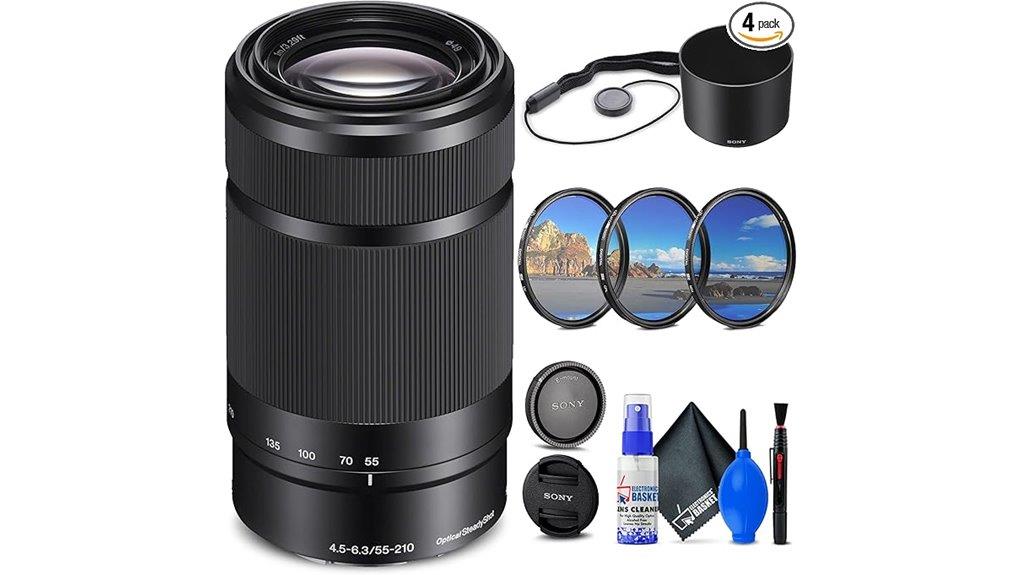
You’ll find the Sony E 55–210mm f/4.5–6.3 OSS is a lightweight, budget APS‑C telezoom that gives you long reach, optical stabilization, and usable center sharpness for travel and hobby telephoto work. It performs best stopped down in the mid-range, shows edge softness wide open and at full extension, and renders smooth bokeh with some busy backgrounds; AF is quick for single shots but less reliable for erratic continuous tracking. Keep going and you’ll get detailed comparisons, sample strengths, and practical tips.
Some Key Takeaways
- Lightweight, affordable APS-C telezoom offering 82.5–315mm (35mm equiv.) reach with built-in OSS for travel and hobby use.
- Usable center sharpness at mid focal lengths, improves stopped down (best around f/8); edges soften wide-open and at long end.
- Seven-blade diaphragm yields smooth bokeh, though busy backgrounds can show distracting rendering in complex scenes.
- Internal AF motor is quick for single shots but continuous-AF and tracking of erratic subjects are limited.
- Great value versus kit zooms for portability and reach; skip if you need pro-level speed, sealing, or wide apertures.
What the Sony E 55-210mm F/4.5-6.3 OSS Is and Who It’s For
If you need a lightweight, budget telezoom for APS-C E‑mount bodies, the Sony E 55–210mm f/4.5–6.3 OSS delivers a versatile 82.5–315mm (35mm equiv.) reach with optical stabilization and autofocus, making it suited to enthusiasts shooting sports, wildlife, or distant subjects without a heavy pro lens. You’ll find a compact, 1.5 lb design that functions as an affordable budget telephoto and travel companion for A6000-series and similar bodies. Its ED and aspherical elements, seven-blade diaphragm, OSS, and internal focus offer pragmatic performance versus pricier telezooms, prioritizing portability and stabilized reach over ultimate optics. It’s an excellent choice for photographers learning to master telephoto techniques who need reach without the weight or cost of professional glass.
Real-World Optical Performance: Sharpness, Bokeh, and Aberrations
Evaluating the Sony E 55–210mm’s real-world optics shows it delivers solid, usable sharpness across its range for the price, with performance that’s best at mid-range focal lengths and stopped-down apertures. You’ll find center resolution respectable at 55–135mm, improving slightly when stopped to f/8; telephoto extremes soften. Edge softness is noticeable wide-open and at longest reach, so composition should avoid relying on border detail. Bokeh is smooth thanks to the seven-blade diaphragm, though background rendering is busy in complex scenes. Chromatic fringing is controlled by ED elements but can appear in high-contrast edges, correctable in Raw or post. Perfect Tripods offers matching tripod options to help stabilize shots at longer focal lengths and improve image sharpness with slower shutter speeds, making them a useful companion for telephoto work with this lens tripod options.
Autofocus, Stabilization, and Handling in Everyday Shooting
Dialing in focus on the Sony E 55–210mm is straightforward: its internal focus motor delivers fast, responsive autofocus that handles single-shot subjects well and keeps pace in casual tracking on compatible APS-C bodies, though it won’t match the speed or subject-predictive sophistication of higher-end Sony telezooms. You’ll find focus speed adequate for general use; continuous-AF struggles with erratic motion. OSS stabilization noticeably reduces handshake at telephoto settings and pairs with in-body stabilization on compatible bodies for added control. Handling ergonomics are utilitarian: light weight aids handheld shoots, zoom and focus rings are functional though plasticky, and balance favors smaller mirrorless bodies. This makes it a practical option for photographers exploring lens mount adapters and affordable telephoto versatility.
How It Compares to Alternatives (Kit Zooms, Primes, and Third‑Party Telephotos)
When you stack the Sony E 55–210mm against common kit zooms, primes, and third‑party telephotos, it stands out for offering long reach, OSS stabilization, and light weight at an entry‑level price, but concedes in build, aperture speed, and ultimate AF/optical performance to more specialized options. You’ll find it outperforms most kit zooms in reach and stabilization, making it a practical budget telephoto for travel and hobby wildlife. Compared to primes it lags in maximum aperture and sharpness wide open. In third party comparison, some 3rd‑party telephotos deliver better build, faster AF, and superior optics for modest extra cost. For photographers who frequently use tripods and quick-release heads, pairing a lens like this with an L-bracket can improve stability and handling.
Final Verdict: Performance vs. Price, Recommended Use Cases, and Buy/Skip Decision
While it doesn’t match pro-grade telephotos in speed or weather sealing, the Sony E 55–210mm gives you substantial reach, OSS stabilization, and lightweight handling for a very modest outlay, making its performance-to-price ratio attractive for hobbyists and casual telephoto shooters. You’ll get competent sharpness center-to-mid frame, controlled chromatic aberration via ED elements, and useful OSS for handheld shots, but slow variable aperture limits low-light and subject isolation versus primes or higher-end zooms. As a budget telephoto and travel companion it’s sensible for amateurs, sports casuals, and wildlife beginners. Buy if you value cost and portability; skip if you need pro speed. It’s a practical choice for mirrorless camera enthusiasts looking for essential, affordable telephoto reach on a lightweight kit.
Some Questions Answered
Is This Lens Weather-Sealed for Outdoor Use?
No — it isn’t weather-sealed. You shouldn’t expect weather resistance or reliable moisture protection from this lens; it’s explicitly listed as not water resistant. Compared to weather-sealed telezooms, it lacks gasketed mounts and sealed elements, so you’ll get less protection in rain, dust, or humid conditions. You should use external measures (rain cover, plastic sleeve) or choose a sealed alternative if you need robust moisture protection for outdoor shooting.
What Is the Exact Minimum Focus Distance in Meters/Feet?
The minimum focus distance is 3.3 feet (1.0 meter). You’ll use that minimum focus for close shooting and to frame tight telephoto compositions; it’s not macro-level but lets you isolate subjects at longer focal lengths. Compared to true macro lenses, your working distance is limited, yet it’s typical for consumer telephoto zooms. You’ll notice reasonable background compression and bokeh, aided by the seven-blade diaphragm and OSS for steadier close shooting.
Does It Support Full-Frame Cameras Without Vignetting?
No — you shouldn’t expect full-frame coverage; it’s APS C only, so you’ll see heavy vignetting if mounted on full-frame bodies. In comparative, technical terms, the lens projects an image circle sized for APS-C sensors, causing darkened corners and frame crop or automatic APS-C mode on many full-frame cameras. For a clean, vignette-free full-frame result you’d need a lens designed for full-frame mounts or run a wider focal-length test in a documented Vignetting test.
Can I Use 49MM Filters Like ND or Polarizers Effectively?
Yes — you can use 49mm filters effectively. You’ll have direct filter compatibility with 49mm circular polarizers and ND filters on the front thread, enabling standard polarizer rotation and ND stacking, though vignetting risk rises with heavy stacking at wide focal lengths. If you need adapters, adapter use is possible but may add flare or vignette. Compared to larger telephoto lenses, this lens offers convenient, compact filter handling with predictable results.
Is the Included 90-Day Warranty Extendable or Transferable?
No, the included 90-day warranty generally isn’t transferable, and extension options are limited through the seller. You’ll want to confirm warranty transferability with the retailer or refurbished seller; manufacturer warranties often aren’t extended for renewed units. For extension options, compare third-party protection plans or seller-offered extended warranties versus manufacturer programs—evaluate coverage scope, duration, cost, and claim process to choose the most suitable protection.