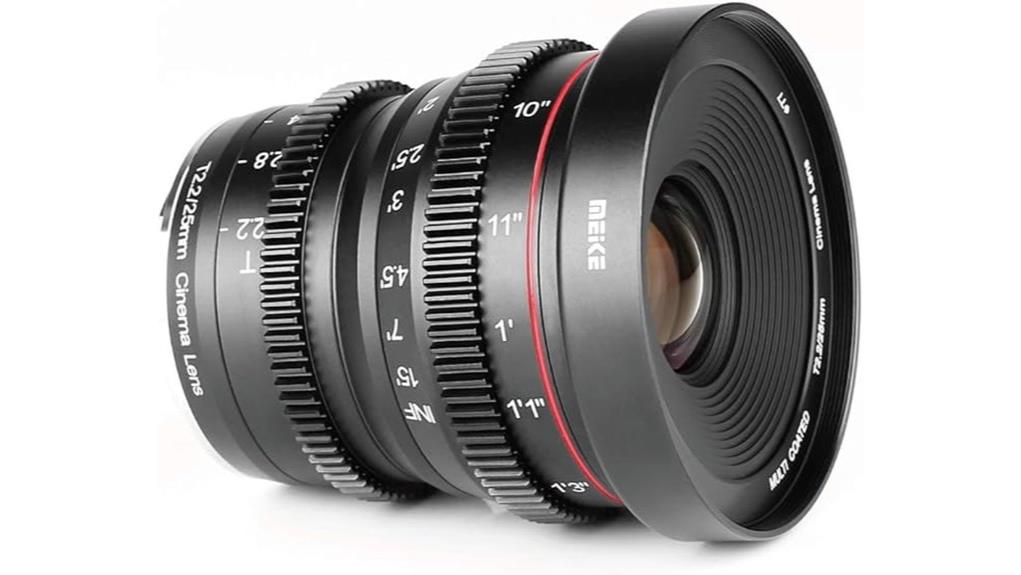
You’ll find the Meike 25mm T2.2 is a compact, affordable MFT cine prime that gives a neutral, filmic look with strong center sharpness at T2.2 and improved edge performance by T4. Its long, smooth focus throw and tactile markings suit repeatable pulls; multilayer coatings control highlights and flare well for the price. Weighing ~21.9 oz with a 55mm filter thread and 0.25 m close focus, it’s ideal for mirrorless and BMPCC rigs—keep going to see detailed tests and handling notes.
Some Key Takeaways
- Strong center sharpness at T2.2 with improved edge-to-edge performance by T4 for versatile image quality.
- Smooth, neutral bokeh with modest onion-ring texture and natural color rendition suited for cinematic looks.
- Compact, aircraft‑grade aluminum body (~21.9 oz) with long, tactile focus throw and repeatable markings.
- Good flare control from multilayer coatings, though strong backlight can cause subtle veiling.
- Affordable, portable cine prime ideal for MFT users and BMPCC setups, but T2.2 and manual controls limit low‑light workflows.
What This Review Covers and Who the Meike 25mm T2.2 Is For
Although compact and budget-oriented, this review focuses on the Meike 25mm T2.2 manual-focus cinema lens’ optical performance, mechanical build, and practical suitability for Micro Four Thirds systems. You’ll get measured observations on resolution, contrast, and coating performance relevant to cinema aesthetics, plus notes on focus throw and aperture control. The scope excludes rig-specific mounting or exhaustive lab charts; instead it targets applicable findings for target creators evaluating lens fit. You’ll see summarized ergonomics testing highlighting ring feel, weight balance, and repeatable markings to inform user workflow decisions, helping you judge suitability for run-and-gun and controlled productions. We also note how lens adapters can expand mount compatibility for mirrorless setups and mount flexibility.
Key Specs and Real-World Shooting Setup (MFT Mount, T2.2, 55mm Filter, Close Focus)
For quick reference, the Meike 25mm T2.2 for Micro Four Thirds is a compact, manual-focus cinema prime with a T2.2 maximum aperture, 25 mm focal length (effective field of view like a ~50mm on full-frame equivalence), and a 55 mm filter thread; it’s built from aircraft‑grade aluminum, weighs about 21.9 oz, and focuses down to 0.25 m for tight close-ups. You’ll exploit MFT adaptability for lightweight rigs and small cinema cameras. T2.2 usage gives usable low-light exposure and controlled depth. Close focus enables intimate framing on documentary shoots. Filter options (55mm) simplify ND/protection stacking. Mounting is straightforward; follow gear balance and matte box clearance. This makes it a natural fit for mirrorless camera enthusiasts looking to keep setups compact and versatile.
Image Quality in Practice: Sharpness, Bokeh, Color and Flare Control
Typically you’ll judge the Meike 25mm T2.2 by how it resolves detail across the frame, renders out-of-focus areas, and handles color and highlights under contrasty lighting. You’ll find center sharpness strong at T2.2 with improved edge-to-edge performance by T4, delivering reliable sharpness consistency for MFT sensors. The bokeh character is neutral—smooth discs with modest onion-ring texture and controlled background separation at close focus. Color rendition stays balanced thanks to multilayer coatings, yielding natural skin tones and saturated midtones. Flare resistance is good for the price; strong backlight can induce subtle veiling but not severe contrast loss. This makes the lens a practical choice for photographers focused on close-up detail and macro-style compositions.
Handling and Build: Focus Throw, Size, Weight, and Compatibility With BMPCC
When you mount the Meike 25mm T2.2, its compact, aircraft‑grade aluminum body and 21.92‑ounce weight make it noticeably manageable on small rigs like the BMPCC without needing heavy support. You get a long, smooth focus throw geared for repeatable manual pulls; markings are clear and tactile. Build quality feels solid with tight tolerances and consistent resistance along the ring. Weight balance on the BMPCC stays front‑light but controllable; you may counterbalance for gimbal work. Mount durability is adequate for regular use on Micro Four Thirds cameras, though it’s not weather sealed so treat it accordingly. Perfect tripods can further improve stability for handheld and gimbal setups when using compact cinema lenses like this one, especially with a tripod selection.
Value Judgment: Strengths, Trade-Offs, and Who Should Buy This Lens
Having covered handling and build, it’s time to rate what the Meike 25mm T2.2 actually offers you in real-world value. You get a compact, robust MFT cine prime with predictable manual focus, durable aluminum construction, and consistent multilayer coating delivering neutral cinematic characterization. Strengths: low weight, tight focus throw, affordable optics for small rigs and BMPCC users. Trade-offs: T2.2 limits low-light headroom, manual aperture and focus slow some workflows, and image stabilization claims are tenuous on a lens of this class. Buy if you prioritize price positioning, portability, and controlled, filmic look over ultimate low-light performance. If you’re pairing this lens with outdoor setups, consider a heavy-duty tripod to maximize stability and sharpness when shooting at slower shutter speeds or in windy conditions with heavy-duty tripods.
Some Questions Answered
Does This Lens Work on Mirrorless Mounts Beyond MFT With an Adapter?
Yes — you can use this MFT lens on other mirrorless bodies with the right adapter. You’ll need adapters matching the Micro Four Thirds mount to your camera’s bayonet; check Adapter compatibility and Mount options for flange focal distance differences. Manual focus and aperture control will remain; electronic communication won’t. On shorter flange systems you’ll maintain infinity focus; on longer-flange cameras infinity may be lost without corrective optics.
Is the Aperture T-Stop Calibrated for Video Exposure Accuracy?
Yes — the T2.2 marking is intended as a calibrated t-stop for video exposure accuracy, but expect some calibration variance between copies. You’ll get reasonable exposure consistency for practical shooting, yet true lab-grade matching may vary due to manufacturing tolerances and coatings. If you need absolute precision for multi-lens shoots, test and meter each lens, or profile them in-camera or in post to make certain consistent exposure across setups.
Can I Use Variable ND Filters With the 55MM Thread?
Yes — you can use variable ND filters with the 55mm thread, but check filter compatibility and vignetting concerns. You’ll screw a 55mm variable ND onto the front without adapters; just confirm the filter’s optical quality and stopping range. On wide apertures or with stacked filters you might see edge darkening on Micro Four Thirds sensors, so test at wide angles and widest settings to evaluate vignetting and color consistency before critical shoots.
How Does the Lens Perform in Timelapse or Long-Exposure Shooting?
You’ll get reliable results for timelapse and long exposures if you control settings and stabilization. The manual focus and T2.2 aperture let you set precise focus and depth, while the 55mm filter thread accepts ND filters to lengthen exposures for smooth motion blur and modest star trails. Use a sturdy tripod, remote shutter or intervalometer, and mirror lock or electronic shutter to avoid vibration. Expect some coma at edges on very long star-trail frames.
Are There Service or Repair Centers for Meike Lenses Locally?
Yes — you can find repair options, but availability varies by region. Check Meike’s warranty coverage first; they list voluntary return and separate manufacturer warranty details. Contact Meike support for authorized service centers or ship-to-repair instructions. If no authorized centers exist locally, use certified local technicians experienced with Micro Four Thirds optics and cinema lenses, but note that repairs by local technicians may void warranty, so confirm coverage before proceeding.