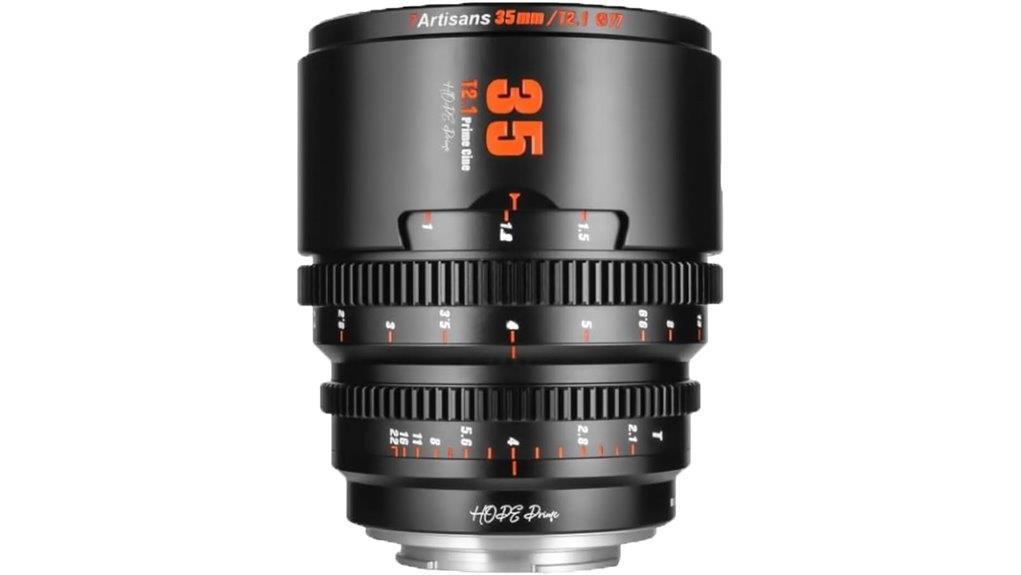
You’ll find the 7artisans Hope Prime T2.1 35mm gives you cine-grade mechanics and a fast T2.1 aperture at a budget price, with strong center sharpness wide open and improved microcontrast stopped down. Edges stay softer for a cinematic look, and chromatic aberration can appear in high-contrast areas but’s manageable with correction. Focus throw is a long, smooth 260° ideal for pulls, though it trades some edge acuity for character; keep going and you’ll learn how it compares and when to buy.
Some Key Takeaways
- Strong center sharpness at T2.1 with improved microcontrast when stopped down, suited for portrait and documentary work.
- Edges are deliberately softer for a cinematic look, sacrificing some clinical resolving power and edge acuity.
- All-metal build, 260° smooth focus throw, and geared controls make it follow-focus and cage friendly.
- T2.1 low-light performance holds contrast and produces round highlights from the 10-blade diaphragm.
- Minor chromatic aberration and slight focus breathing under close pulls, correctable in post or with profiles.
How the 7artisans Hope Prime T2.1 (35mm) Performs Optically on APS-C
Evaluating the 7artisans Hope Prime T2.1 (35mm) on APS-C shows it’s a purpose-built cine optic that delivers usable sharpness and controlled rendering rather than clinical perfection. You’ll notice center sharpness is strong wide open, with microcontrast improving stopped down; edges remain softer, reflecting a deliberate optical character. Chromatic aberration is present in high-contrast shifts but remains manageable with correction or in-camera profiles. You’ll appreciate the 10-blade diaphragm’s influence on bokeh rendition — round highlights but with occasional nervousness near the frame edge. Overall, the lens favors cinematic mood over clinical resolving power, useful for portrait and documentary work. The site Perfect Portrait Lenses offers guidance on choosing portrait optics and portrait lenses suited to cinematic looks.
Build, Cine Controls, and Handling for Run-and-Gun and Studio Work
Feel the solid, all-metal construction the moment you mount the 7artisans Hope Prime T2.1 (35mm)—it’s clearly engineered for regular cine use, with a weight and balance that sit reassuringly on Fujifilm APS-C bodies without feeling front-heavy. You’ll notice a restrained matte finish that reduces reflections and feels durable. Focus offers 260° travel with smooth, damped rotation; gear tension is consistent, compatible with follow-focus. The aperture and focus gears are well-indexed but lack hard stops. Quick release-friendly footprint works on cages, though you’ll want counterbalance for extended handheld work. Handheld balance is good, but rigging improves control for precise pulls. Perfecting focus often starts with lens calibration to ensure consistent sharpness across your gear.
Real-World Image Samples: Low Light, Portraits, Street, and Motion
Switch to T2.1 and you’ll immediately see how the Hope Prime 35mm handles low-light and practical shooting: contrast holds up well, cores stay punchy, and the ten-blade diaphragm produces pleasing, rounded highlights, but micro-contrast softens a touch in extreme shadows. You’ll find portraits render with natural skin tones, tight yet forgiving falloff, and controlled ambient bokeh that keeps backgrounds readable. Street frames remain crisp across the field, with minimal breathing and reliable color. For motion you’ll get smooth motion blur and predictable smear at slower shutters, though fine detail can wash when pushed hard in dim scenes. For studio and run-and-gun setups, pairing the lens with video light kits can neatly balance exposure and enhance subject separation.
How It Compares Vs Similar 35MM Cine and Photo Primes
When you line the 7artisans Hope Prime 35mm up against comparable cine and photo primes, it stands out for its cine-oriented mechanics and T2.1 speed but trails some rivals in micro-contrast and edge-to-edge acuity. You’ll appreciate the long 260° focus throw and solid manual ergonomics that make calibrated pulls easy, and the 10-blade diaphragm produces pleasing bokeh character. Color rendition skews natural but less punchy than premium glass. You’ll notice minimal but present focus breathing under close pulls—manageable for handheld but relevant for tight cinema setups. Overall, it’s a capable, budget-conscious cine choice with measured compromises. Gimbal users will find its manual focus ergonomics and smooth control useful for stabilized camera movement.
Should You Buy It? Use Cases, Price/Value, Warranty, and Buying Tips
Although it’s not the sharpest 35mm you can buy, the 7artisans Hope Prime T2.1 gives you cine-grade mechanics and a fast T2.1 aperture at a highly competitive price, making it a sensible pick if you prioritize manual control and low-light capability over ultimate micro-contrast and edge acuity. You should buy it if you need smooth 260° focus throw, durable build, and follow-focus compatibility for portraits, street, or documentary work. Consider warranty nuances (one-year manufacturer warranty, 30-day return varies by seller). Use a buying checklist: mount compatibility, filter size, sample images, and seller return policy before committing. Many photographers choose adapters to expand lens options across systems, especially when using lens mount adapters for creative photography.
Some Questions Answered
Does the Lens Support Autofocus With Adapted Lenses or Camera Firmware?
No — you won’t get autofocus compatibility with this lens; it’s a manual-focus cine optic and won’t rely on camera-driven AF even with firmware updates. You should critically expect manual operation only, though adapters or camera firmware updates won’t add AF functionality. You can use electronic adapters for metadata or aperture control on some systems, but autofocus compatibility remains unsupported, so plan to focus manually or use follow-focus tools for precise, repeatable pulls.
Is the Lens Weather-Sealed or Moisture-Resistant?
No, it isn’t fully weather-sealed and doesn’t claim formal moisture resistance. You’ll get a robust, cine-style metal build and smooth focus gearing, but there’s no official gasketed sealing or IP rating. That means you shouldn’t rely on it in rain, heavy mist, or dusty environments without extra protection. If you need true weather sealing, you’ll want a lens or housing that explicitly lists weather sealing and moisture resistance.
Can the Aperture Be De-Clicked or Adjusted Remotely?
No — you can’t adjust the aperture remotely; it’s a manual aperture lens. You can, however, de-click it by design: the iris offers stepless control for smooth T-stop changes suited to cine work. That said, there’s no electronic control or camera-driven aperture signaling, so you won’t get iris control from the body or exposure automation. You’ll need to operate the ring physically, which gives precise tactile control but limits remote workflow flexibility.
What Are the Lens’s Exact Dimensions and Weight?
The exact dimensions aren’t widely published by 7artisans, but you should expect a compact cine form factor roughly 75–85mm in length and about 70–80mm in maximum diameter; weight specs are commonly reported around 600–700 grams. You’ll want to verify specific exact dimensions and weight specs with the seller or official datasheet before purchase, since variations occur between batches and mount versions and precise measurements matter for rigging and balance.
Does It Come With Case, Caps, or a Lens Hood Included?
No — it typically ships without a full hard case; you’ll get basic caps but not a dedicated lens pouch or lens stand included. You’ll find front and rear caps for protection, but a padded pouch, dedicated stand, or robust hard case is usually sold separately. Be critical: if you need transport or rigging support, plan to buy a quality lens pouch and consider a third-party lens stand or tripod mount to protect and stabilize the optic.