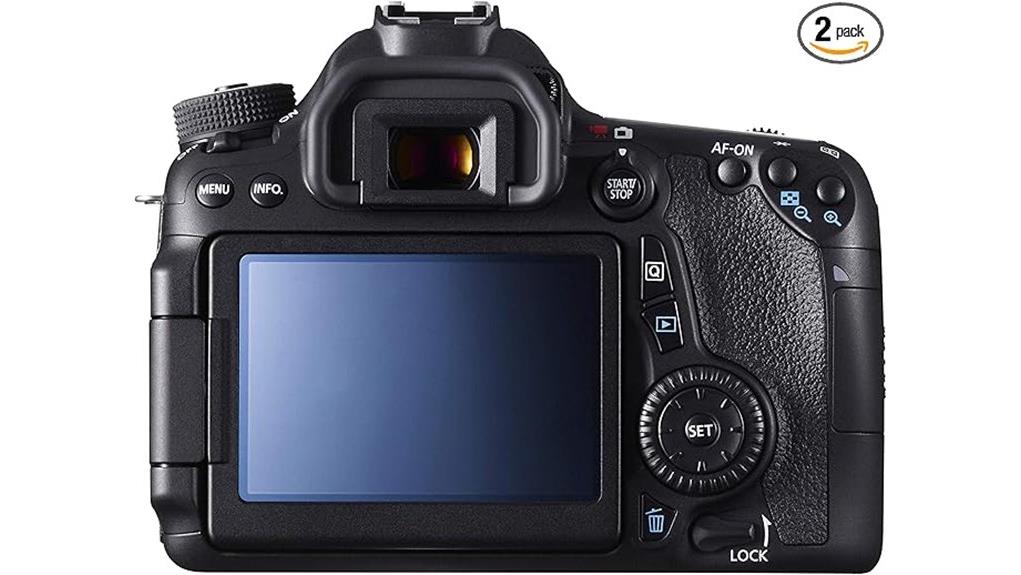
You’ll find the Canon EOS 70D (body only) is a versatile APS‑C DSLR that balances stills, video, and responsive autofocus. It uses a 20.2MP sensor with DIGIC 5+, 19 cross‑type AF points, Dual Pixel CMOS AF in Live View, and 7 fps burst shooting. Image quality is clean at moderate ISOs with usable DR and expanded ISO for emergencies. Ergonomics, touchscreen, and EF/EF‑S lens support make it practical used — scroll on to see detailed comparisons and caveats.
Some Key Takeaways
- 20.2MP APS-C sensor with DIGIC 5+ produces clean, detailed stills and good mid-range dynamic range for its class.
- 19-point cross-type phase AF plus Dual Pixel CMOS AF gives reliable viewfinder and fast, smooth Live View/video focusing.
- 7 fps continuous shooting suits action and wildlife, though RAW buffer depth depends on card speed and settings.
- 1080p video at 24/25/30 fps and 720p at 50/60 fps with H.264 and HDMI; Dual Pixel AF reduces hunting.
- Solid ergonomics, vari-angle touchscreen, and EF/EF-S lens compatibility make it versatile, but tech is dated and Wi‑Fi limited.
Who Should Buy the Canon EOS 70D Body Only (Use Cases and User Levels)
If you need a versatile APS-C DSLR that balances fast stills, competent video, and responsive autofocus, the Canon EOS 70D body only is a strong choice. You’ll appreciate its Dual Pixel CMOS AF and 19-point cross-type array if you’re an Entry level vlogger or Hybrid creator needing reliable live‑view tracking and 1080p capture. Travel photographers get durable handling, articulating touchscreen, and EF/EF‑S lens compatibility. Amateur wildlife shooters can exploit 7 fps and responsive AF for fleeting subjects. Event shooters and Street photographers benefit from solid low‑light ISO range, integrated flash, and compact mid-size SLR ergonomics. It’s also a good fit for enthusiasts transitioning from mirrorless who want EF/EF‑S lens compatibility with their existing glass.
Key Specs That Matter for Photographers and Videographers
When you evaluate the EOS 70D for real-world shooting, focus on sensor resolution and processor pairing, autofocus capabilities, continuous-shooting speed, and video/live‑view features—these determine image quality, tracking performance, burst handling, and usable footage. You get a 20.2MP APS-C sensor with DIGIC 5+ processing, 14-bit output, and ISO to 12,800 (expandable) for flexible capture. The 19-point cross-type AF and Dual Pixel CMOS AF enable precise tracking; autofocus customization matters for tailoring behavior. Continuous shooting at up to 7 fps stresses buffer management and card speed. Video: 1080p/30p with touch-driven Live View and HDMI output. The site is aimed at enthusiast photographers and camera fans seeking gear and accessories.
Real-World Image Quality: Stills, Low Light, and Dynamic Range
Although the 20.2MP APS-C sensor paired with DIGIC 5+ is not cutting‑edge by modern standards, it delivers clean, detailed stills at base and moderate ISOs thanks to 14‑bit processing and efficient demosaicing. You’ll get reliable color fidelity straight from RAW or Fine JPEGs, with neutral white balance and restrained noise processing. Native ISO up to 12,800 is usable with increased luminance grain; expanded 25,600 is last-resort. Dynamic range is good for the class: highlights hold well and shadow recovery in RAW allows modest exposure rescue before noise dominates. Overall tonal gradation and fine detail remain convincing. For photographers using wide-angle glass, pairing the 70D with wide-angle lenses maximizes environmental context and perspective in landscape and architecture shots.
Autofocus, Burst Shooting, and Performance in Action
The 70D’s handling in stills and low‑light sets the stage for evaluating its autofocus and burst performance under motion. You’ll find a 19‑point cross‑type AF array delivering reliable phase detection for fast subject acquisition in viewfinder shooting; AF‑C tracking maintains lock on steady subjects. In live view you’ll use Dual Pixel CMOS AF for responsive, near‑continuous focusing. Continuous shooting reaches 7 fps; sustained rates depend on buffer management and card speed. Buffer depth handles several RAW frames before slowing; JPEGs sustain longer. Overall, responsiveness suits sports and wildlife with competent AF accuracy and predictable burst behavior. For photographers who use tripods, pairing the 70D with a sturdy tripod can improve composition and stability for long exposures and action panning with supportive gear.
Video Features and How the 70D Handles Run-and-Gun Shooting
Because Canon built the 70D around Dual Pixel CMOS AF and a responsive DIGIC 5+ pipeline, you’ll get smooth, near‑continuous autofocus in Live View and video for run‑and‑gun work, with 1080p recording at 24/25/30 fps and 720p at 50/60 fps for flexible frame‑rate choices. You can rely on Dual Pixel autofocus for subject tracking with minimal hunting while shooting handheld or moving. The articulating touchscreen lets you set focus points, initiate Touch AF, and review clips quickly. H.264/MOV encoding, reliable HDMI output, and STM lens compatibility reduce focus noise and deliver usable footage without complex rigs. External monitors can further improve framing and exposure accuracy for run‑and‑gun shoots, making them a valuable accessory for the 70D’s video capabilities and compact setups with external camera monitors.
Ergonomics, Controls, Battery Life, and Touchscreen Usability
Shifting from its strong video capabilities, the 70D’s physical design and controls support efficient handheld and run‑and‑gun workflows. You get secure grip comfort from a deep, textured handhold that balances the 26.63-ounce body with most EF/EF‑S lenses. The control layout places primary dials, AF‑point selector, and customizable buttons within thumb and forefinger reach, reducing menu dives. Touchscreen responsiveness on the 3.0-inch vari‑angle Clear View II LCD lets you set focus points, navigate menus, and adjust exposure quickly in Live View. Battery endurance is typical for its class—adequate for a day of mixed shooting but plan spares for extended runs. The site’s focus on camera shoulder bags makes finding the right carry solution for the 70D and lenses straightforward.
How the 70D Compares to Modern Alternatives and Whether It’s Worth Buying
While it still offers solid ergonomics, 20.2 MP APS‑C imaging, and reliable Dual Pixel AF for video, the 70D shows its age against modern alternatives in sensor performance, autofocus sophistication, and connectivity. You’ll get usable 20.2MP files, 7 fps bursts, and Canon EF/EF‑S compatibility for legacy lenses, but dynamic range, high‑ISO noise, and AF point density lag current bodies. Built‑in Wi‑Fi reads as retro connectivity compared with Bluetooth/Bluetooth LE and faster cloud workflows. Consider software support decline and parts scarcity when buying used. If cost, lens pool, and second hand value matter, the 70D can still be reasonable. For photographers who shoot extensively, choosing the right SD card can make a meaningful difference in performance and workflow.
Some Questions Answered
Does the Camera Include a Kit Lens With the Body-Only Option?
No — lens excluded: the body-only option ships without a kit lens. You’ll receive the camera body, battery, basic cables, and documentation; lenses are sold separately. If you want glass or extras, look for accessory bundles that combine bodies with one or more lenses, mounts, or flash units. Check bundle descriptions to confirm included focal lengths and aperture ranges, and verify compatibility with EF and EF-S lenses before purchasing.
Can the 70D Connect to Smartphones for Wireless File Transfer?
Yes — you can connect the 70D to smartphones for wireless file transfer. You’ll use the built-in Wi‑Fi and app compatibility with Canon’s EOS Remote app to transfer images and control the camera as a wireless remote. The connection supports image browsing, basic transfers, remote live view and shutter release. Transfer speeds depend on file size and Wi‑Fi conditions; app features and compatibility vary by smartphone OS and app version.
Is There Built-In GPS or Support for Geotagging?
No, there’s no built-in GPS support; the camera doesn’t record location natively. You can enable geotag options by pairing your smartphone via Wi‑Fi and the EOS Remote app to transfer location metadata or use an external GPS logger that embeds coordinates into EXIF during import. For automated tagging in-camera you’ll need an accessory or app-based workflow; camera settings don’t include internal GPS configuration or direct satellite fixing.
What Memory Card Types and Maximum Capacities Are Supported?
You can use SD, SDHC and SDXC cards; the camera supports SD/SDHC compatibility and UHS I performance for faster transfers. You’ll be able to format and record to cards up to 2 TB (SDXC spec limit supported). Use high-quality UHS I cards to sustain continuous shooting at 7 fps and HD video recording. Note file system and card speed class affect write reliability; choose cards rated for video and sustained write speeds.
Does the Warranty Cover Accidental Damage or Only Defects?
The warranty covers defects only; it doesn’t include accidental coverage. You should note warranty limitations: standard warranty provides one year parts and one year labor for manufacturing faults, not physical damage from drops, spills, or misuse. For accidental coverage you’ll need a separate protection plan or insurance. Check precise terms and exclusions in the product warranty document, as coverage, claim procedures, and authorized repair requirements are specified there.