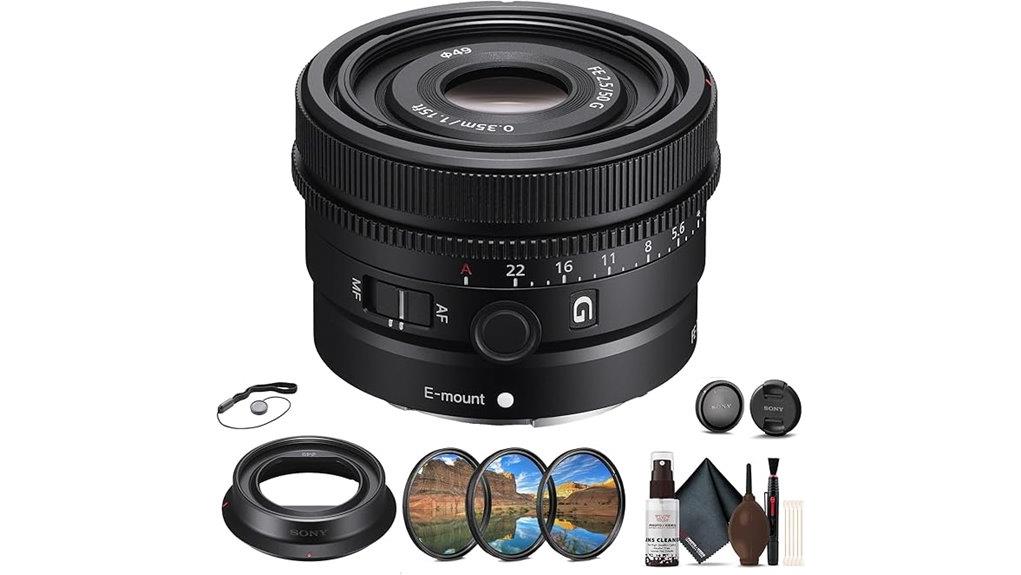
You’ll like the Sony FE 50mm F/2.5 G if you need a pocketable, precision 50mm that’s sharp across the frame by f/4, delivers smooth bokeh with slight onion-ring character, and focuses fast and quietly with Dual XD Linear Motors. It’s lighter and more consistent than many classic 50/1.8/1.4 options, and serves APS-C users as a useful short-tele. It trades f/1.4 shallow depth and IBIS for compactness and weather-sealed practicality — more details follow.
Some Key Takeaways
- Compact, lightweight 50mm f/2.5 G prime balancing portability with high-resolution performance for travel and everyday use.
- Excellent center sharpness wide open, edge-to-edge crispness by f/4, with pleasing bokeh and subtle onion-ring hints.
- Fast, quiet Dual XD Linear Motors deliver smooth, accurate autofocus and minimal focus breathing for stills and run‑and‑gun video.
- Weather-sealed, well-built lens with physical aperture ring, de-click switch, AF/MF toggle, and focus-hold button.
- Great alternative to faster 50mm primes when compactness, consistent frame performance, and tactile controls matter.
Quick Verdict: Who Should Buy the Sony FE 50mm F/2.5 G
Who should buy this lens? You’ll choose the FE 50mm f/2.5 G if you need a compact, lightweight prime that balances image quality with portability. Portrait shooters get a modest short-tele perspective on APS-C and natural field on full-frame for head-and-shoulder work. Travel vloggers benefit from low weight, close 13.8-inch focus and quiet Dual XD Linear Motors for run-and-gun shooting. You’ll prefer it when you want faster apertures than kit zooms but don’t need f/1.8 speed. Compare it to 50mm f/1.8 options for size and sealing; pick this for handling, build, and versatile framing. It’s also a great match for mirrorless camera systems that prioritize compact, high-performance lenses.
Real-World Performance: Sharpness, Bokeh, Autofocus, and Video Behavior
You’ll notice the FE 50mm f/2.5 G balances clinical sharpness with pleasing out-of-focus rendering, so it’s worth comparing to faster 50s to see what you give up and gain. In sharpness tests you’ll find edge-to-edge crispness by f/4 and excellent center resolution wide open, useful for portraits and landscapes. The bokeh character is smooth with subtle onion-ring hints from aspherics; backgrounds melt without harsh highlights. Autofocus reliability is high thanks to Dual XD Linear Motors, delivering quick, quiet locks and minimal focus breathing. Video autofocus performs smoothly for run-and-gun work; low light performance is competent, not class-leading. This lens is a strong choice for photographers who prefer prime lenses and want high image quality in a compact package.
Key Specs That Matter: Optics, Handling, Controls, and Durability
Although it’s compact, the FE 50mm f/2.5 G packs a precise optical formula and refined handling that matter in real-world use. You get two ED and three aspherical elements, with modern optical coatings to suppress flare and retain contrast for high-res sensors. Dual XD linear motors deliver fast, quiet AF; internal focus preserves balance and enhances focus ergonomics for run-and-gun shooting. Physical aperture ring, de-click switch, AF/MF toggle and focus hold button give tactile control. Despite light weight, build quality feels solid, and dust- and moisture-resistant weather sealing lets you work confidently outdoors and on set. It’s an excellent option for photographers seeking essential lens gear that enhances everyday shooting.
How It Compares: 50mm Alternatives and APS-C Options
Curious how the FE 50mm f/2.5 G stacks up against other 50mm primes and APS-C alternatives? You’ll find it balances size, sharpness, and AF speed better than many vintage primes adapted to E-mount, which can deliver character but lack autofocus and weather sealing. Versus classic Sony 50/1.8 or faster 50/1.4s, the f/2.5 is smaller, quieter, and more consistent across the frame, though not as shallow for portraits. On APS-C bodies the lens becomes a practical 75mm equivalent—competitive with native APS-C primes for reach and compactness. Consider third party alternatives for price or unique rendering. As a specialist retailer for camera gear, we often recommend compact, versatile lenses like this one for enthusiast photographers.
Buy or Skip? Price, Use-Case Recommendations, and Bundle/Value Considerations
If you shoot travel, street, or run-and-gun portrait work and value compactness, the FE 50mm f/2.5 G is worth considering because it delivers sharp, consistent optics, fast XD Linear Motor AF, and weather sealing in a pocketable package. You should buy if you prioritize travel friendly size, reliable AF, and buttery rendering without heavy glass. Skip if you need f/1.4 shallow depth or IBIS—affordable alternatives offer wider apertures or stabilization at lower cost. Bundles with a 49mm filter kit, hood, and cleaning tools add value for shooters starting out. Evaluate weight, aperture needs, and lens ecosystem before deciding. It also pairs well with telephoto setups for wildlife and sports when used as a compact, high-quality standard prime in a broader lens kit.
Some Questions Answered
Does This Lens Accept 49MM Screw-On Filters?
Yes — you can fit 49mm screw-on filters using the lens’ 49mm filter thread. You’ll notice optical coatings remain effective with quality filters; don’t stack thick filters or hood use may vignette. Compared to larger 52–77mm primes, the 49mm thread keeps weight and cost down and preserves close-focus performance. You’ll want thin, multi-coated filters to avoid added reflections and maintain contrast, especially for portraits and landscape detail.
Is the Aperture Ring De-Clicked for Smooth Video Use?
Yes — you can switch to a de-clicked, smooth aperture for video. You’ll get smooth aperture control via the physical ring’s de-click switch, offering clickless mechanics for silent, gradual exposure pulls. That gives a more cinematic look compared to clicky still-lens rings. You’ll appreciate the tactile control and consistent stops when shooting photos, while filmmakers benefit from stepless adjustments and reduced noise for clean, uninterrupted footage.
Can It Be Used on Sony APS-C Bodies Without Limitations?
Yes — you can use it on Sony APS-C bodies, but expect a 1.5x crop factor (75mm equivalent) that tightens framing. You’ll retain full autofocus performance with Dual XD Linear Motors and internal focusing, so AF speed and accuracy stay high. Mind there’s no in-lens stabilization, so for low-light handheld you’ll rely on camera IBIS or higher ISO. Its compact size and close focus still suit portrait and street work well.
Does It Support Full Electronic EXIF and Aperture Control?
Yes — you’ll get full metadata and electronic aperture control via lens communication. The lens delivers electronic aperture changes, reliable autofocus control with Dual XD Linear Motors, and transfers full metadata to the camera for accurate files. You’ll appreciate precise AF behavior, Linear Response manual focus, and consistent exposure automation compared to older mechanical designs. In short, it behaves like a native modern E-mount lens with complete electronic integration for imaging workflows.
Is There Weather Sealing for Shooting in Light Rain?
Yes — you get weather resistant construction that holds up for light rain and splashes. You’ll notice sealed mounts and gaskets from seal integrity testing that protect internal mechanics, though it’s not fully waterproof for heavy storms or submersion. Compared to non-sealed primes it’s more reliable in damp shoots; compared to pro-grade fully weatherproof lenses it’s intermediate. Always dry and inspect seals after exposure to extend longevity.