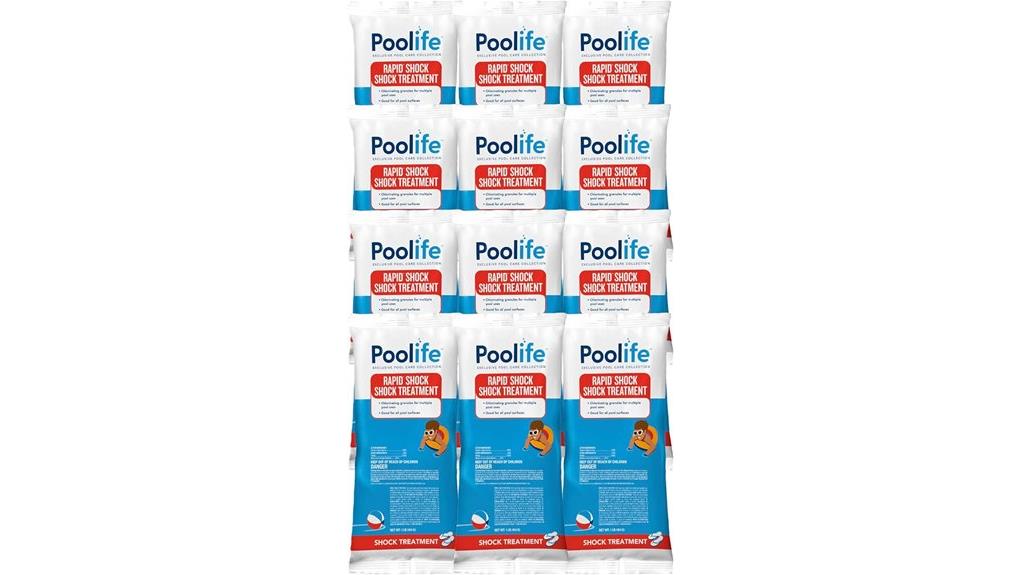
You’ll get fast, predictable chlorine recovery with Poolife Rapid Shock, a fast-dissolving calcium hypochlorite granule that’s free of cyanuric acid so you won’t get stabilizer buildup. It raises free chlorine quickly, kills contaminants within minutes, and often clears water in hours for routine cases. Dosed in 1 lb pre-measured bags (9–16 oz per 10,000 gal) and safe for common surfaces when used properly, it’s ideal for quick sanitation—keep going for practical tips and caveats.
Some Key Takeaways
- Fast-dissolving calcium hypochlorite delivers rapid free-chlorine boost for quick sanitation without adding cyanuric acid (CYA).
- Pre-measured 1 lb bags simplify accurate dosing; typical weekly maintenance is 9–16 oz per 10,000 gallons.
- Kills bacteria and many algae strains within minutes; visible clarity often returns within hours under normal conditions.
- Safe for vinyl, plaster, and fiberglass when used as directed; avoid mixing with other chemicals or recent CYA treatments.
- Best when you need fast chlorine recovery without raising stabilizer levels; not a substitute for non-chlorine oxidizers or long-term algicide plans.
What Poolife Rapid Shock Is and Why CYA-Free Chlorine Matters
While you’re looking for a fast, reliable shock treatment, Poolife Rapid Shock delivers: it’s a fast-dissolving calcium hypochlorite granule formulated without cyanuric acid (CYA). You’re getting a straightforward sanitizer that raises free chlorine quickly without adding stabilizer. That CYA-free choice limits long-term CYA implications, so you won’t silently build stabilizer levels that reduce chlorine effectiveness. You’ll appreciate predictable dosing and compatibility with common surfaces. If you prefer some UV protection, consider stabilizer alternatives like separate dichlor dosing or controlled CYA additions. Overall, it’s practical for rapid sanitation when you want control over CYA levels.
How Rapid Shock Performs: Speed of Kill, Clarity, and Typical Results
When you need fast results, Poolife Rapid Shock raises free chlorine quickly and starts killing organic contaminants within minutes, delivering visible clarity often within a few hours. You’ll see a rapid kill of bacteria and many algae strains, with cloudy water clearing faster than with slower stabilizers. Results depend on load and circulation: heavy contamination may need repeat treatment, but typical pools reach swim-ready clarity within a day. You get consistent, measurable improvement without CYA buildup. Expect reliable sanitation and noticeably clearer water; performance is pragmatic rather than miraculous, matching its formulation and intended shock-use scenarios.
Safe, Simple Dosing and Application (Including 1 Lb Bags and 9–16 Oz per 10,000 Gal)
Having seen how Rapid Shock quickly restores chlorine and clears contaminants, you’ll appreciate how straightforward dosing is. You get 1 lb pre measured bags that simplify routine treatment; each sachet helps guarantee dosing accuracy. Typical maintenance calls for 9–16 oz per 10,000 gallons weekly, so you can match dose to bather load or weather. Application is user friendly: broadcast granules into deep water while running the pump, avoiding concentrated piles. Store bags sealed, cool, dry—storage considerations matter for potency and safety. Overall, the system reduces guesswork and supports consistent, predictable chlorination without added CYA.
Compatibility, Surface Safety, and When to Choose This Shock Over Others
Although Rapid Shock’s CYA-free calcium hypochlorite formula works across common pool surfaces, you should still consider pool type and recent treatments before use. You’ll find strong surface compatibility with vinyl, plaster, and fiberglass when you follow dosing and wait times. Don’t mix with other chemicals or recent cyanuric acid treatments; that can reduce effectiveness or produce residues. Choose this shock when you want fast chlorine recovery without raising CYA, especially after heavy use, storms, or early algae signs. If you need non-chlorine oxidizers or stabilized shocks for long-term CYA control, consider alternatives to protect pool longevity.
Bottom Line: Who Should Buy Poolife Rapid Shock and Expected Maintenance Outcomes
If you want fast, reliable chlorine recovery without raising cyanuric acid, Poolife Rapid Shock is a strong choice for routine and reactive sanitation. You should buy it if you need quick restoration after heavy use, storms, or algae scares and want to avoid CYA buildup that complicates long-term chemistry. Its pre-measured bags simplify dosing for seasonal maintenance and make budget planning predictable. Expect consistent sanitization, faster clarity, and swim-ready water post-treatment without residue on common surfaces. It won’t replace broad-spectrum algicides or long-term stabilizer strategies, but it’s an efficient, CYA-free option for regular and spot treatment.
Some Questions Answered
Is Poolife Rapid Shock Safe to Store Indoors Long-Term?
Yes — you can store it indoors long-term if you follow precautions. You’ll keep it cool, dry, and away from heat or flammable storage, seated on a stable shelf. Check container compatibility: keep it in its original, sealed bag or a compatible plastic/resistant container to avoid moisture and reactions. Don’t mix with other chemicals, ventilate the area, and inspect regularly for degradation or leaks to maintain safety.
Can Rapid Shock Be Used With Saltwater Chlorinators?
Yes — you can use Rapid Shock with saltwater chlorinators, but monitor for Saltwater compatibility and Electrolysis impact. It dissolves quickly and won’t add CYA, so it restores chlorine without stabilizer buildup. However, frequent heavy dosing can raise chlorine intermittently and may influence electrolysis cell scaling or run time, so test levels and adjust chlorinator settings after treatment to avoid over-chlorination or unnecessary wear.
Does It Affect Pool Water pH or Alkalinity Significantly?
No, it won’t cause major pH drift or destabilize Alkalinity buffering when used as directed. You’ll see only minor, short-lived pH shifts from calcium hypochlorite addition; Alkalinity buffering usually prevents big swings. If your total alkalinity or pH is already low or you overdose, you might need to adjust with alkalinity increaser or pH adjuster. Monitor levels after treatment to confirm you stay within target ranges.
Are There Special Precautions for Treating Heavily Soiled Filters?
Yes. If you’re treating heavily soiled filters, you should backwash or remove debris first, then perform a thorough filter cleaning. Wear protective gear—gloves and eye protection—when handling concentrated chlorine and when rinsing trapped grime. Avoid adding granules directly into the skimmer with clogged media. Run the pump after cleaning to circulate and monitor pressure; repeat cleaning if pressure stays high or clarity doesn’t improve.
Can Rapid Shock Be Used Immediately Before or After Swimming?
No — you shouldn’t use Rapid Shock immediately before or after swimming. Immediate clearance claims refer to fast water clarity, not instantaneous safe swim levels; you’ll want swimmer safety first. Wait until chlorine stabilizes in the target range (5–10 ppm as recommended) and any strong odor dissipates. Follow dosing guidance (9–16 oz per 10,000 gallons weekly) and test levels before allowing swimmers back in for safe, clear water.