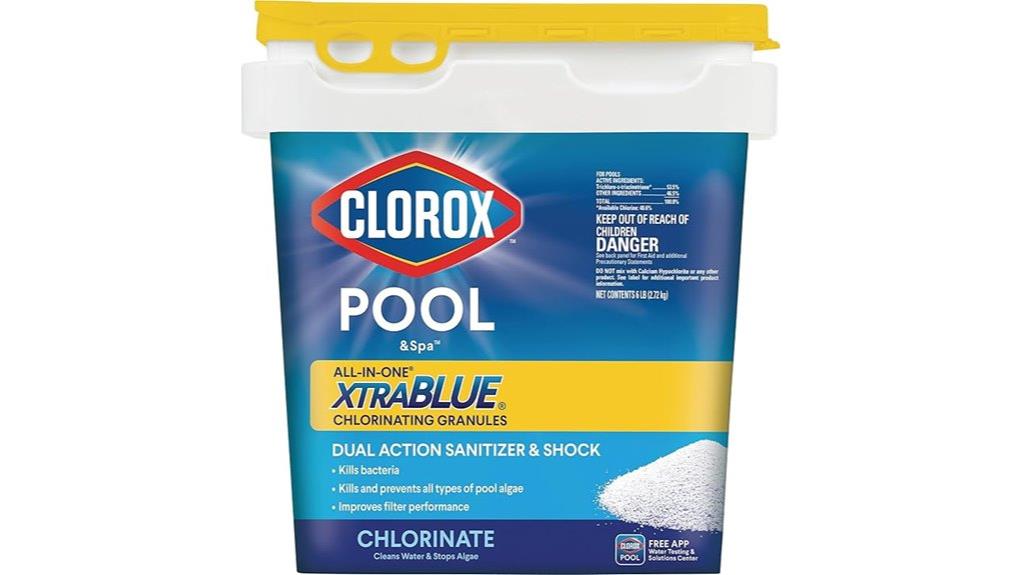
You’ll find CLOROX XtraBlue granules are a fast‑dissolving dichlor that sanitizes, shocks, and helps control algae while maintaining stabilized free chlorine under sunlight. You’ll add granules to water with gloves and eye protection, target 1–3 ppm FC for maintenance, and use example doses (1 tsp/300 gal; ~1.5–2 oz/10,000 gal per ppm). It’s convenient and clear‑water effective, but raises cyanuric acid over time and costs more per pound; keep filtration running and test frequently to learn practical tips. Clorox® Pool&Spa™ product benefits include enhanced clarity and protection against harmful contaminants. Additionally, these products are designed to be user-friendly, making maintenance easier for pool owners. By regularly incorporating these solutions, you can ensure a safe and enjoyable swimming experience.
Some Key Takeaways
- Fast-dissolving dichlor granules sanitize and shock in one step, improving clarity and reducing treatment time.
- Stabilized formula maintains residual FC and resists sunlight degradation but can raise cyanuric acid over time.
- Effective against bacteria and common algae when dosed to reach and maintain 1–3 ppm free chlorine.
- Use gloves/eye protection, add granules to water, and keep swimmers out until chlorine returns to safe levels.
- Higher per-pound cost than unstabilized chlorine; convenient for homeowners and small pools, less ideal for very large systems.
What This Product Is and Who Should Use CLOROX XtraBlue Chlorinating Granules
Designed as a concentrated pool sanitizing granule, CLOROX Pool & Spa All-in-One XtraBlue Chlorinating Granules combine stabilized chlorine with shock treatment to kill bacteria, prevent and treat green, mustard, and black algae, and maintain a residual sanitizer level against sunlight degradation. You’ll find a technical, quick-dissolving formula in blue packaging that signals multi-function performance. You should use it if you manage residential or small commercial pools, need combined sanitizer/shock action, and want reduced odor and eye irritation. Consumer demographics include homeowners, pool service technicians, and seasonal operators seeking efficient, single-product maintenance compatible with standard filtration systems.
How to Use XtraBlue Granules Safely and the Exact Dosing for Common Pool Sizes
When handling XtraBlue granules, follow safety precautions and precise dosing to protect yourself and maintain proper pool chemistry: wear gloves and eye protection, avoid breathing dust, add granules to water (not directly to skimmer or concentrated spots), and keep swimmers out until chlorine returns to safe levels. Use a safety checklist and measure chemicals on a stable surface. For dosing, target 1–3 ppm free chlorine: typical doses—small spa (300 gal): 1 tsp; 10,000 gal pool: 1.5–2 oz for 1 ppm; 20,000 gal: 3–4 oz for 1 ppm. Use a dosage calculator or app for exact adjustments. Hth pool care features and benefits include a comprehensive approach to maintaining a clean and safe swimming environment. Their innovative products are designed to optimize water quality while minimizing the effort required from pool owners. By utilizing these solutions, you can enjoy a sparkling pool all season long.
Performance in Practice : Sanitizing, Shocking, Algae Control, and Water Clarity
Evaluate XtraBlue granules by measuring free chlorine residuals and observing water response after standard shock and maintenance doses: the product combines stabilized chlorine for sustained sanitizer residual with fast-dissolving dichlor chemistry that provides both immediate oxidizing action and ongoing hypochlorous availability. You’ll see rapid FC rise and measurable drop-off consistent with stabilization kinetics; maintain recommended FC to prevent algae regrowth. Single-step shocks reduce organic load and speed clarity recovery when combined with filtration. Monitor shock frequency based on bather load and sunlight; escalate dosing and circulation for visible blooms. Results: effective sanitization, predictable decay curve, improved clarity when used per protocol.
Compatibility, Filtration Impact, and Tips to Minimize Eye Irritation and Odor
Although XtraBlue granules are formulated to work with common pool materials and equipment, you should confirm compatibility with your specific system and follow dosing guidelines to avoid stress on sensitive components. You should verify pool compatibility with liners, seals, and metal fittings; consult manufacturer specs. Proper dosing maintains sanitizer residual without overloading the filter, supporting filter longevity by reducing particulate load. Run filtration after application and backwash/clean cartridges as indicated. To minimize eye irritation and odor, maintain target free chlorine and combined chlorine limits, use stabilizer as recommended, and avoid high initial doses near swimmers. Test frequently.
Pros, Cons, and Buying Guidance (Value, Alternatives, and When to Choose XtraBlue)
Having confirmed compatibility and proper dosing to protect equipment and water balance, you can weigh the practical benefits and trade-offs of XtraBlue for routine pool care. You’ll get fast-dissolving, stabilized chlorine that sanitizes and shocks in one step, reducing maintenance time and potential eye irritation. Downsides: higher per-pound cost versus bulk unstabilized chlorine and limited pack size for large pools—see price comparison before buying. Consider environmental impact: stabilized chlorine releases cyanuric acid buildup risk with frequent use. Choose XtraBlue when convenience, clarity, and odor control matter; opt for alternatives for budget-sensitive or large-capacity systems.
Some Questions Answered
Is Xtrablue Safe Around Poolside Plants and Landscaping?
Yes — it can be risky to plants if pool splash or runoff contacts foliage or soil. You’ll avoid foliar burn by keeping concentrated granules and treated water off leaves; rinse spray-wetted foliage with fresh water. Repeated chlorine exposure raises soil salinity, which can harm roots and reduce nutrient uptake. Monitor surrounding soil salinity and use barriers, proper drainage, or buffer planting zones to protect landscaping. Clorox Pool&Spa product effectiveness review suggests that when used properly, these products can maintain clear and safe water while minimizing potential harm to nearby plants. Users should be mindful to follow application guidelines and consider the surrounding environment to mitigate any risks. Regular monitoring and adjustments based on the findings of reviews can lead to better outcomes for both pool maintenance and landscaping health.
Can I Store Leftover Granules in an Unheated Garage?
Yes. You can store leftover granules in an unheated garage if you control exposure. The product has reasonable storage stability but shows temperature sensitivity; avoid freezing and extreme heat swings. Keep granules in their original, tightly sealed container, elevated off concrete, and away from moisture, combustibles, acids, and sunlight. Label the container, check for clumping or discoloration before use, and follow manufacturer warranty and disposal guidance.
Will This Product Damage Pool Toys or Vinyl Liners?
Generally, it won’t damage vinyl liners or most pool toys when used per label; you’ll preserve vinyl compatibility by maintaining recommended chlorine residuals and stabilizer levels. High, prolonged free chlorine or undissolved granules can degrade plastics and reduce toy durability. Rinse toys after heavy treatment and avoid directly applying granules. Monitor and adjust chemistry with test strips to prevent oxidative deterioration of vinyl and molded toy materials.
Are There Special Disposal Instructions for Unused Product?
Yes. You shouldn’t pour unused granules down drains or into the environment; they can harm aquatic life and affect environmental impact. You’ll follow local hazardous-waste regulations: contact your municipal waste authority for disposal instructions or hazardous-waste collection events. Empty, triple-rinsed containers may be eligible for household recycling if local programs accept them; otherwise, dispose per label directions. Keep product sealed, labeled, and out of reach until properly handled.
Does Xtrablue Affect Saltwater Chlorination Systems?
Yes — XtraBlue can be used in saltwater systems, but you’ll need to monitor for saltwater compatibility and electrode corrosion. The stabilized granules deliver free chlorine, which won’t harm the generator chemistry, yet added cyanuric acid and copper-free formulation may raise long-term corrosion risk at electrodes if levels aren’t controlled. You should follow manufacturer dosing, keep cyanuric acid and total dissolved solids within specs, and inspect/clean electrodes regularly to minimize corrosion.