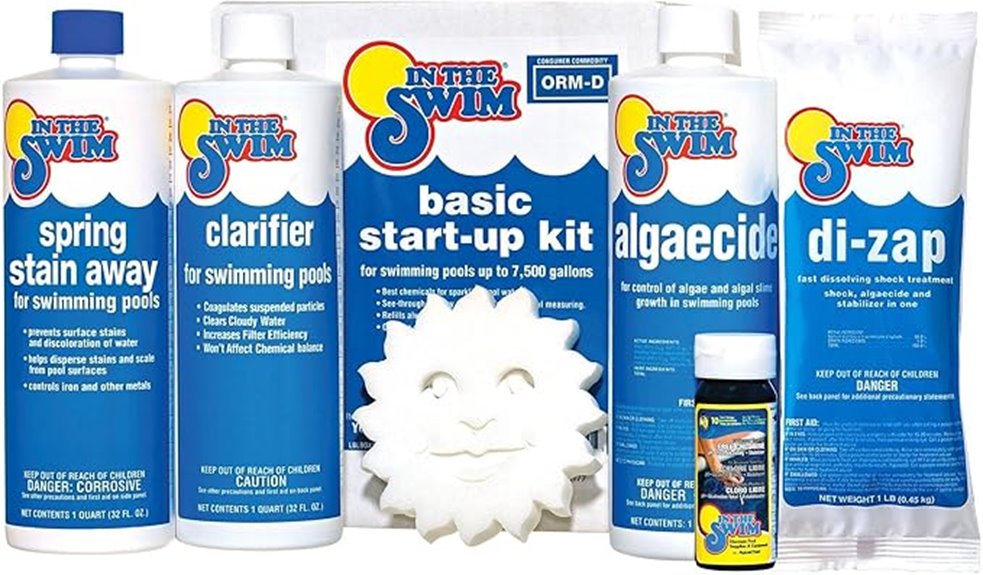
You’ll get a compact, cost‑efficient starter kit that uses 99% sodium dichlor for rapid sanitation, a clarifier to coagulate fine particulates, an algaecide for preventative control, and a sun‑sorb oil absorber to remove surface scum—formulated for pools up to 7,500 gallons. You’ll adjust pH/alkalinity, broadcast dichlor with circulation, add clarifier, apply algaecide, and treat oil; safety gear is essential. Continue below to see step‑by‑step use, performance notes, and buying considerations.
Some Key Takeaways
- Kit contains 99% sodium dichlor, a clarifier, algaecide, and sun‑sorb oil absorber for a complete startup treatment up to 7,500 gallons.
- Sodium dichlor quickly establishes free chlorine residuals for effective sanitation when dosed per label and circulated continuously.
- Clarifier typically clears turbidity to <1 NTU within 24–48 hours by coagulating fine particulates for improved filter capture.
- Algaecide plus shock provides four‑week preventative algae control when applied as directed after pH and alkalinity adjustment.
- Best for mid‑sized above‑ or in‑ground pools wanting a cost‑efficient, minimal starter set; larger pools require additional product.
What’s in the In The Swim Pool Basic Opening Kit and What Each Item Does
The In The Swim Pool Basic Opening Kit contains four targeted treatments designed to get up to 7,500-gallon above‑ or in‑ground pools swim‑ready and keep them maintained: 99% sodium dichlor (Di‑Zap) sanitizes and oxidizes contaminants, a liquid clarifier coagulates fine particulates to improve filter capture and water clarity, an algaecide provides preventative control when used alongside shock, and a sun‑sorb oil and scum absorber removes body oils and surface scum to enhance filter efficiency. You’ll get concise chemical explanations and application tips: dose per volume, circulation timing, and safety precautions for each product so you apply correctly.
Quick Verdict: Who This Kit Is Best For and When to Buy
If you’re opening a mid‑sized above‑ or in‑ground pool (up to 7,500 gallons) and want a straightforward, cost‑efficient chemical starter that covers sanitizing, clarifying, algae prevention, and oil/scum removal, this kit delivers those essentials in compact, easy‑to‑use forms. You’ll want it if you prefer a minimal, proven set of agents (dichlor, clarifier, algaecide, oil absorber) for season start-up and routine maintenance. Buy around initial fill or when winterization ends—good seasonal timing. It’s also sensible for tight budget planning: lower upfront cost than separate components, with adequate coverage for typical mid‑size pools.
Step‑by‑Step: How to Use the Kit to Open a Pool Up to 7,500 Gallons
Once you’ve drained any remaining winter cover water and reassembled your equipment, start by testing and adjusting pH and alkalinity so the kit’s chemicals work predictably; aim for pH 7.2–7.6 and total alkalinity 80–120 ppm. Follow this step by step checklist: 1) Remove debris and run filter continuously. 2) Dose 99% sodium dichlor per label for 7,500 gallons; broadcast slowly with pump on. 3) Add clarifier after circulation to improve filter capture. 4) Apply algaecide as directed to augment shock. 5) Treat surface with sun sorb oil. Observe safety precautions—wear gloves, goggles, avoid mixing chemicals.
Performance Check: Sanitation, Clarity, Algae Prevention, and Oil Removal Results
Because you’re evaluating four key areas—sanitation, clarity, algae prevention, and oil removal—this section summarizes measurable performance after using the kit on a pool up to 7,500 gallons. You’ll observe rapid free chlorine establishment from sodium dichlor, delivering immediate sanitizer residuals and strong sanitation longevity when maintained per directions. Clarifier improved particulate capture; recorded clarity metrics showed turbidity drop to <1 NTU within 24–48 hours. Algaecide plus shock suppressed green and mustard algae establishment during a four-week observation. Sun sorb removed visible surface oils and scum, enhancing skimmer efficiency and reducing filter load consistently.
Buying Considerations: Alternatives, Coverage Limits, and Return/Warranty Notes
When weighing whether this In The Swim start-up kit meets your needs, consider alternative formulations, the 7,500-gallon coverage limit, and the seller’s return/warranty terms to avoid unexpected gaps in treatment or protection. You’ll compare Alternate brands for chemistry (stabilized chlorine vs. non-stabilized, liquid vs. granular), ingredient concentrations, and whether clarifier or oil absorbers are included. The 7,500-gallon cap is explicit—if your pool is larger, plan purchases or seek kits advertising Extended coverage to avoid under-dosing. Returns follow Amazon’s voluntary 30-day policy; contact the manufacturer for warranty specifics before purchase to confirm remedy scope and timeframe.
Some Questions Answered
Is This Kit Safe for Vinyl and Fiberglass Pool Surfaces?
Yes — you can use the kit on vinyl and fiberglass surfaces with caution. You’re advised to perform vinyl safe testing and check gelcoat compatibility on a small, inconspicuous area first. Follow label dilution and contact-time instructions, avoid prolonged high-concentration exposure, and rinse surfaces after treatment. If discoloration or softening appears, stop use and consult the manufacturer or a pool professional for alternative formulations and compatibility guidance.
Can Pets Swim After Treatment, and How Long Must They Wait?
You should keep pets out until chemical levels return to safe ranges; typically wait 24–48 hours and confirm with water monitoring. After adding dichlor, shock, algaecide or clarifier, test free chlorine, combined chlorine, pH and stabilizer; free chlorine should be below 1 ppm and pH 7.2–7.8. Rinse pets if they contact treated water. If unsure, consult the product label or manufacturer for specific pet safety guidance.
Are These Chemicals Compatible With Chlorine Generators/Salt Systems?
Yes — these chemicals are generally chlorine compatible and can be used with chlorine generators/salt systems. You’ll avoid stabilizers that interfere with cell function; sodium dichlor adds chlorine without harming the salt cell if dosed per instructions. Clarifier, algaecide, and oil absorbers don’t typically cause salt cell impact, but avoid overdosing and guarantee proper circulation. Test water chemistry after treatment to confirm salt level, pH, cyanuric acid, and sanitizer balance.
How Should Leftover Chemicals Be Stored Between Seasons?
Store leftover chemicals in sealed containers in a cool, dry, climate control area away from direct sunlight and heat sources. Keep oxidizers like sodium dichlor separate from organics, oils, and acids to prevent reactions. Label containers clearly and keep them off concrete floors on pallets. Make certain good ventilation, secure childproof locks, and follow local disposal rules for expired products. Consult manufacturer guidelines for specific storage and shelf-life information.
Do Any Kit Components Expire or Lose Effectiveness Over Time?
Yes — some components have a limited shelf life and will experience potency loss over time. You should expect powdered sodium dichlor and algaecide granules to remain effective for a year or two if stored dry and sealed; liquid clarifier and sun sorb can degrade faster, often within 12 months, especially if exposed to heat or sunlight. Label storage instructions, keep containers sealed, and rotate stock to minimize potency loss.