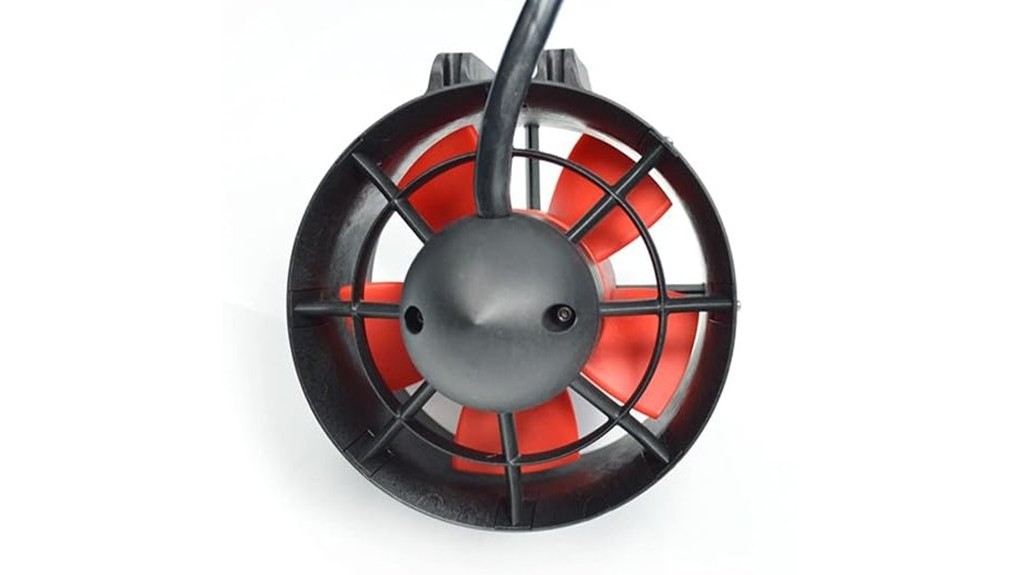
You’ll get a compact, purpose‑built 12–24 V brushless thruster delivering about 9.2 kgf at 24 V with a 110 mm three‑blade prop, suited for small boats, subs and ROVs. It scales near‑linearly with voltage, draws roughly 17–45 A under load, and can cavitate under heavy pitch causing extra current and reduced thrust. Installation needs 110 mm clearance, stainless fasteners and a bidirectional ESC; performance and durability are solid — keep going for installation tips and alternatives.
Some Key Takeaways
- Compact 1080W brushless thruster delivers up to 9.2 kgf thrust at 24 V with a 110 mm three‑blade prop.
- Expect 17–45 A under load; battery sag and higher current with cavitation are possible.
- Fits into a 130 × 140 mm shell footprint; allow clearance for the 110 mm prop and avoid cavitation.
- Robust nylon and injection‑mold construction with reinforced bearings and corrosion‑resistant nonmetallic parts.
- Best for RC boats, subs, small ROVs, and kayaks; verify waterproofing, spare parts availability, and ESC compatibility.
What the Underwater Thruster MAX 24V 1080W Is and Who It’s For
While compact and purpose-built for small watercraft and underwater vehicles, the Underwater Thruster MAX 24V 1080W is a high-torque, brushless propulsion unit rated for 12–24 V input that delivers up to 9.2 kgf of thrust at 24 V using a 110 mm three‑blade nylon prop. You’ll find it suited for RC boats, submarines, and lightweight surface craft where marine compatibility and compact design matter. You’ll appreciate beginner friendly install cues, a 1 m cable, and simple rotation reversal via motor-lead swap. Technical users gain customization options for CW/CCW pairing and ESC matching to optimize thrust versus current draw. It’s a great match for kayaks and GPS enthusiasts seeking reliable propulsion for water adventures.
Real-World Performance: Thrust, Current Draw, and Efficiency at 12–24V
Because real-world conditions change electrical load and hydrodynamic resistance, you’ll want precise expectations for thrust, current draw, and efficiency across 12–24 V when planning power and cooling. You can use thrust mapping: measured outputs (3.5 kg @12 V, 5.7 kg @16 V, 9.2 kg @24 V) plotted versus input show near-linear thrust scaling with voltage and RPM. Expect current draw 17–45 A under load; factor battery sag during peak bursts. Monitor prop wash effects on efficiency; repeated cavitation raises current and lowers thrust. Verify waterproofing ratings before prolonged submersion to guarantee consistent thermal dissipation and long-term performance. Also consider carrying a small fiberglass repair kit aboard to fix accidental hull damage quickly and prevent water ingress.
Fit and Installation: Dimensions, Mounting, Wiring, and Prop Rotation Tips
Having mapped real-world thrust and current across 12–24 V, you now need to confirm the thruster fits your hull and mounting scheme according to the thruster installation guidelines before wiring or testing. The 130×140 mm shell and 1 m cable dictate hole spacing and access; print mounting templates to verify clearance for the 110 mm prop and avoid cavitation from proximity to hull edges. Use the supplied four screws in stainless inserts or backing plates for load distribution. Wire to a recommended bidirectional ESC, secure connections (connector not included), and plan cable management runs to minimize bends and chafe. Swap any two motor wires to change prop rotation. For kayak and small-boat installations consider the benefits of using all-terrain kayak carts to move and position your hull safely before and after fitting the thruster.
Build Quality, Materials, and Durability Observations From Testing
Although the thruster uses injection-molded plastic and strengthened nylon rather than metal or fiberglass, it shows solid dimensional accuracy and consistent tolerances that simplify mounting and sealing. You’ll notice assembly seams are tight and fastener bosses resist stripping under repeated torque. Reinforced bearings reduced axial play during high-load runs; vibration stayed within acceptable limits. Corrosion resistance relies on nonmetallic components and sealed motor internals, though mating hardware needs stainless fasteners and dielectric grease. UV degradation was minimal after accelerated exposure, but prolonged sun storage warrants protection. Overall impact resistance is good for occasional knocks but not heavy collisions. For eco-conscious paddlers, pairing the thruster with biodegradable cleaners helps minimize environmental impact during maintenance.
Should You Buy It? Use-Case Recommendations, Alternatives, and Final Verdict
If your project demands a compact, high-thrust brushless unit for hobby-grade underwater craft, the HAWK HOBBY MAX 24V is a pragmatic choice: it delivers up to 9.2 kg of thrust at 24 V, fits common 3–6S LiPo systems, and mounts cleanly thanks to consistent injection-molded tolerances. You should buy it if you need affordable thrust for RC boats, small ROVs, or subs where weight and size matter. Expect moderate battery life under heavy loads, acceptable noise levels, and reasonable corrosion resistance for occasional salt use. Check local availability of spare parts; alternatives include higher-end sealed thrusters with better longevity.
Some Questions Answered
Does It Include a Motor Connector or Require Soldering/Adapter Purchase?
No — it doesn’t include a waterproof connector; you’ll need to provide one or use the solder option. You’ll get the thruster and four screws only, so plan for wiring: either solder motor leads to an ESC/connector or buy a sealed inline waterproof connector and adapter. For dual-drive setups order complementary CW/CCW thrusters and matched bidirectional ESCs; make sure connectors and cable length (1 m) meet insulation and current (17–45 A) requirements.
Is the Thruster Waterproofed for Long-Term Submerged Storage?
No — it isn’t specified as rated for long-term submerged storage. You’ll need to treat it as water-resistant for operational use, not permanently flooded. You should inspect and reinforce seal integrity (shaft, cable entry, prop hub) and apply corrosion mitigation to prevent long term corrosion. Use marine-grade potting, waterproof connectors, dielectric grease, and periodic maintenance. For continuous submersion, request manufacturer clarification or a unit with explicit IP/submersion ratings.
What Specific ESC Programming/Settings Are Recommended for This Motor?
Use a high-current ESC and program conservative startup and throttle profiles. Set BLHeli Settings for medium PWM frequency, active braking off, and damped light enabled to smooth torque. Configure Current Limiting to 45 A peak and 30–35 A continuous, with soft start ramp 0.5–1.0 s and low motor timing (5–10°) for efficiency. Enable bidirectional mode if reversing, and log amp/voltage telemetry for tuning.
Are Replacement Propellers or Spare Parts Available From the Manufacturer?
Yes — you can get propeller availability and spare components through HAWK HOBBY support channels. Contact the seller/manufacturer with your model/part number (2022070401, ASIN B0B5Q56HZP) to request replacement propellers or specific spare components like screws, housings, or cable assemblies. They handle warranty and parts requests; expect confirmation of stock, lead time, and pricing. For dual-drive setups, specify CW or CCW prop requirements when ordering.
Does Warranty Cover Water Damage or Only Manufacturing Defects?
The warranty covers manufacturing defects, not water damage. You’ll get a specified warranty duration from HAWK HOBBY; check your purchase documentation for exact terms. To file a claim, document defects, retain proof of purchase, and contact the seller or manufacturer per the claim process. They’ll assess failure mode; water intrusion or improper installation is typically excluded. Follow their technical troubleshooting steps to avoid denied claims and preserve warranty validity.