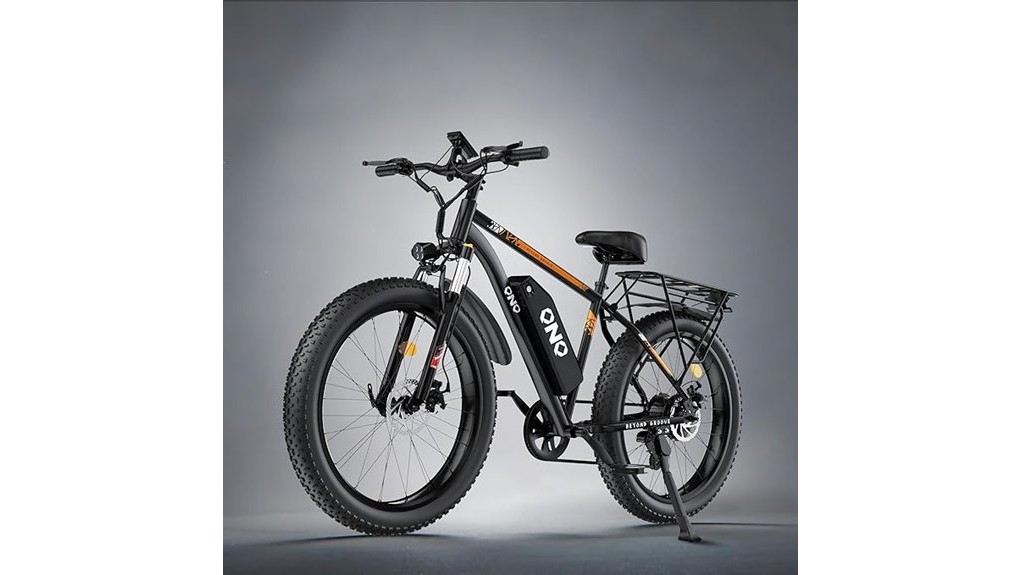
You’ll get a rugged, high‑power fat‑tire e‑bike with a 2000W peak motor and firm throttle that accelerates and climbs steep hills, but you’ll feel its 77 lb weight compared with lighter commuters. The 48V 15Ah (720Wh) battery gives about 36 miles typical range, up to ~60 miles with conservative PAS; 26×4.0 tires boost traction on sand and snow but raise rolling resistance. Brakes, display, and Shimano 7‑speed are straightforward. Keep going to learn specifics and tradeoffs.
Some Key Takeaways
- 2000W peak brushless motor delivers strong acceleration and a typical assisted top speed around 34 mph under ideal conditions.
- 48V 15Ah (720 Wh) removable battery gives about 36 miles typical range, up to ~60 miles with conservative PAS use.
- 26×4.0 fat tires and front lockable dual shocks provide excellent off-road traction and bump absorption, but increase rolling resistance.
- Dual mechanical disc brakes and Shimano 7-speed gearing offer reliable stopping and cadence control, though braking modulation is less refined than hydraulics.
- Heavy 77 lb frame favors durability and stability but reduces maneuverability compared with lighter commuter e-bikes.
Real-World Verdict: Is the Qnq Fat Tire Electric Bike Worth Buying?
Although it won’t suit every rider, the Qnq Fat Tire electric bike delivers strong value if you prioritize power and off-road capability: its 2000W peak motor and 4″ fat tires handle steep climbs and loose terrain better than most entry-level e-bikes, the 48V 15Ah (720 Wh) removable battery gives a practical 36-mile typical range (up to 60 miles in conservative PAS use), and a solid steel frame plus dual mechanical discs provide durable, confidence-inspiring performance—compare that to lighter, commuter-focused e-bikes which trade range and torque for agility and lower weight. You’ll appreciate long term durability from the high-carbon steel frame and robust components, which supports stronger resale value if maintained. User community support is modest but growing; third-party accessory ecosystem exists for racks, lights, and cargo solutions, letting you tailor the bike to specific needs without sacrificing core performance. The bike pairs especially well with purpose-built fat ebike tires for riders who enjoy outdoor activities.
Motor, Battery, and Range: What Performance Can You Actually Expect?
While the Qnq’s 2000W peak brushless motor and 48V 15Ah (720 Wh) removable battery deliver remarkably strong acceleration and hill-climbing for a consumer e-bike, real-world performance depends on how you ride: expect a top speed around 34 mph under ideal conditions, climbing capability up to about 30° when the battery is charged and load is moderate, and a typical assisted range near 36 miles (stretching to roughly 60 miles in conservative PAS-only use). You’ll notice firm throttle behavior with immediate response; PAS smooths power delivery and extends range. Battery longevity hinges on charge cycles, storage, and charging habits; conservative PAS use preserves capacity longer. For riders who want to push longer trips or extend battery life, consider using range extender options designed for e-bike batteries.
Ride Comfort and Handling: How Do Frame, Suspension, Tires, and Brakes Perform?
Having covered motor and battery behavior, let’s look at how the Qnq’s chassis and components turn that power into a usable ride. You’ll notice the high-carbon steel frame offers solid frame integrity; its triangular design resists flex under load, though the 77 lb curb weight affects maneuverability. 26×4.0 fat tires absorb bumps and improve traction across sand, snow, and gravel, but add rolling resistance compared with narrower tires. Front lockable dual shock absorbers smooth rough terrain; you can lock them for efficiency on pavement. Dual mechanical disc brakes provide predictable stopping; braking modulation is adequate but less refined than hydraulic systems. The bike pairs well with typical fat tire ebike accessories designed for outdoor riders, like racks and lights, which enhance utility on multi-terrain outings.
Features, Controls, and Daily Use: Display, Gears, Safety, Accessories, and Maintenance
Because the EB26’s cockpit groups most controls into a single, clear cluster, you’ll find setup and daily operation straightforward: the LCD shows power, TRIP/ODO, current/avg/max speed, and PAS level while a USB port lets you top up a phone on the go. You’ll use Shimano 7-speed gears and trigger shifter for climbs and flats; cadence feel compares well to midrange e-bikes. Dual mechanical discs and fat tires provide predictable stopping and traction. IPX4 and included bell, horn, reflectors aid safety. Maintenance is routine: check brake pads, tire pressure, and bolts. Keep the manual for display troubleshooting and consider accessory upgrades. Many outdoor riders prefer displays optimized for ebike display screens to enhance visibility and control on rugged trails.
Price, Warranty, and Final Buying Considerations: Who It’s Best For, Alternatives, and Where to Buy
If you’re weighing the EB26 against other fat-tire e-bikes, factor price and warranty into the value equation along with specs: the bike ships mostly assembled, includes a basic 180-day limited warranty, and offers UL2849-certified battery safety but only midrange aftercare compared with competitors that provide 1–2 year coverage or extended service plans. You’ll find competitive street pricing but mixed pricing transparency across retailers; compare bundled accessories, shipping, and return policies. If you want high power and rugged build but prefer longer protection, seek sellers offering extended warranty options or third-party plans. Best for budget-focused riders needing performance; consider branded alternatives for stronger aftercare. Our shop focuses on upgraded ebike batteries for outdoor riders and can help match high-capacity batteries to this bike.
Some Questions Answered
Is the Battery Removable for Airline or Vehicle Transport?
Yes — the bike has a removable battery, so you can take it out for airline transport or vehicle handling. Compared with integrated packs, this 48V 15Ah (720 Wh) removable battery is easier to carry and charge, but its energy (720 Wh) exceeds many airlines’ permitted limits for checked or carry-on lithium batteries. You’ll likely need airline approval or special shipping; for vehicle transport it’s convenient and safer detached.
Can I Add a Child Seat or Rear Passenger Carrier?
Yes — you can add a child seat or a passenger carrier, but you’ll need to choose compatible mounts and respect weight limits. The EB26 has installable load racks and a 330 lb max capacity (manufacturer lists 264 lb recommended), so compare rack designs for sturdy attachment to the triangular high‑carbon steel frame. Pick models rated for fat‑tire bikes, make sure rear‑rack mounting points, and confirm brakes and suspension handle the extra load safely.
Are Replacement Batteries or Spare Parts Readily Available?
Yes — replacement availability is moderate: the UL2849-certified 48V 15Ah battery and OEM parts can be obtained through the manufacturer’s support channels, though stock varies. Aftermarket compatibility is decent for common items (tires, tubes, brakes, Shimano 7-speed components), but proprietary battery/connectors may limit third-party swaps. You’ll want to compare vendor lead times, verify connector specs, and consider ordering a spare battery early if you rely on long-range riding.
What Are the Exact Assembly Steps and Required Tools?
You’ll follow a clear step sequence: unpack, attach front wheel and fork, mount handlebar and tighten stem, install seat and pedals, mount battery and racks, connect wiring and display, adjust brakes and gears, inflate tires, test ride and torque-check. Tool checklist: wrench set, Allen keys, Phillips screwdriver, pedal wrench, torque wrench, tire pump, cable cutters. Compare steps to manual; use torque specs and safety checks for best results.
Does the Bike Support Throttle-Only Operation Without Pedaling?
Yes — you can use the throttle for throttle-only operation without pedaling, but check throttle legality in your area. The 2000W peak motor supports full-power throttle; however motor cutout rules and local e-bike classifications may limit speed or require pedal assist. Compared to PAS-only bikes, this model offers greater standalone throttle control and hill-climb capability, yet you’ll need to balance range loss and legal compliance when riding throttle-only.