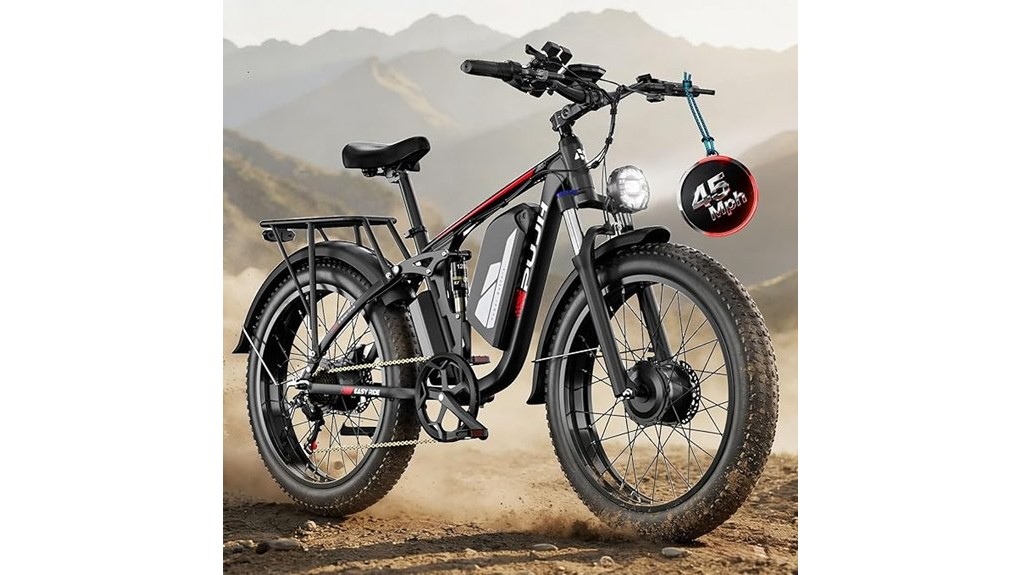
If you want raw speed and off-road grunt, the PU364’s dual 6000W setup and 45+ MPH capability will impress, though it’s best for experienced riders who can handle high power. The removable 60V (listed 1200Wh) battery and 7-speed drivetrain boost range flexibility, but real-world mileage and heat under sustained loads vary. Heavy 82.7 lb build and full suspension favor stability over nimble trail work. Keep legal limits and brake upgrades in mind—more specifics follow.
Some Key Takeaways
- Twin brushless motors deliver up to 6000W peak and strong acceleration, best for experienced riders.
- Top speed exceeds 45 MPH; verify local legal limits before street riding.
- Removable 60V battery is listed at 1200Wh, but real-world range varies and needs testing.
- 24×4.0 fat tires and seven-level suspension favor stability and off-road traction over nimble handling.
- At ~82.7 lb with 330 lb max payload, expect solid momentum; check brakes, cooling, and warranty before purchase.
Real-World Verdict: Performance, Value, and Who It’s Best For
Because this dual-motor e-bike pairs serious power with practical features, you’ll feel its performance right away: the twin brushless motors (peak 6000W, 200 Nm) deliver brisk acceleration and a top speed north of 45 MPH, while the 7-speed drivetrain and pedal-assist/throttle modes let you tailor effort and range. You’ll appreciate its stability, robust brakes, and suspension on mixed surfaces. For urban commuting it’s overbuilt but fast and reliable; for long distance touring its claimed range and removable battery promise flexibility, though weight and legal speed limits may limit practicality. Best for experienced riders seeking high-speed, versatile capability. This model also fits the needs of outdoor riders who prefer adventure-ready step-through ebikes.
Powertrain Deep Dive: Dual 6000W Motors, Battery, Torque, and True Range
When you dial into the dual-motor setup, the headline numbers—peak 6000W combined output and roughly 200 Nm of torque—translate into instant, wheel-hugging acceleration and high sustained power for climbs and hauling. You feel linear torque delivery across throttle and pedal-assist modes; the 7-speed drivetrain helps keep motors in efficient bands. The removable 60V battery lists 1200Wh but has inconsistent energy figures, so range accuracy requires real-world testing under load. Expect battery longevity to depend on charge cycles, storage, and heat. Thermal management is basic; prolonged high-output runs will raise motor and pack temperatures, nudging conservative use. This bike pairs well with outdoor riders focused on maintenance and reliability, so consider stocking essential ebike maintenance gear for longer rides.
Ride and Handling: Suspension, 24×4.0 Tires, Weight, and Off-Road Feel
As you push off, the 24×4.0 fat tires and full seven-level suspension package immediately mute trail chatter and boost confidence over loose or uneven terrain. You notice tire traction is excellent on sand, snow, and gravel; the wide contact patch bites and stabilizes cornering. Front fork and rear shock absorb big hits while the seat springs and up-to-6-inch seatpost travel preserve seat comfort on long runs. At 82.7 pounds the bike feels solid—momentum helps over obstacles but lowers nimbleness in tight singletrack. Overall, the setup favors stability and comfort for aggressive off-road riding rather than flickable agility. This makes the bike well-suited for riders who enjoy outdoor adventures on fat tire ebikes.
Safety and Controls: Brakes, Lights, Display, and Rider Ergonomics
Though the Dual Motor e-bike feels ready for rough terrain, its safety and control package is what keeps you in command: dual hydraulic discs deliver strong, modulable stopping power while turn signals, a brake-activated taillight, a 9W headlight and horn improve visibility and communication with others. You’ll notice confident brake modulation that resists fade at speed, paired with ergonomic grips that reduce wrist fatigue on long rides. The colorful LED display offers clear display readability in daylight and low light, though menu depth can distract. Adjustable bars, seat height and seatpost travel help you lock in a stable, efficient riding posture. For riders who frequent varied terrain, choosing the right pad compound and rotor size can significantly improve braking performance and longevity, especially when using ebike brake pads on demanding trails.
Buying Checklist: Fit, Legal Limits, Assembly, Warranty, and Final Pros/Cons
Because buying an electric bike is as much about fit and legality as performance, you should checklist key items before committing: confirm the 24″ wheel/4″ tire package and 5.3 ft minimum height suit your reach and standover, verify the 330 lb max payload covers you plus cargo, and check local speed/power restrictions since the dual motors can reach 45+ MPH and peak 6000W (likely requiring registration or limiting use on public trails). Use a fit checklist for ergonomics and seatpost travel. Review legal considerations, follow assembly tips for torque and brake setup, inspect warranty coverage, then weigh pros cons before buying. Consider investing in a sturdy lock designed for outdoor riders to protect your e‑bike during adventures.
Some Questions Answered
Can I Tow a Trailer With This E-Bike?
Yes — you can tow a trailer, but you should assess capacity and safety. You’ll attach via a sturdy trailer tongue rated for the bike’s 330 lb limit and make certain the hitch suits the 24″ frame. Expect altered braking dynamics: dual hydraulic discs help, yet added mass increases stopping distance and brake heat. Use lower assist, redistribute cargo, check tire pressure, and test short runs before heavier loads to confirm stable handling.
How Long Does the Removable Battery Take to Fully Charge?
You’ll fully charge the removable 60V battery in about 6–8 hours with the stock charger; a fast charger (if supported) can cut that to 3–4 hours. Charging time varies by charger and battery state. To preserve battery lifespan, avoid full discharges, use moderate charging speeds when possible, store at partial charge in heat-free conditions, and follow manufacturer cycles. Proper care keeps capacity higher over many cycles.
Are Replacement Batteries and Parts Readily Available?
Yes — you can usually find replacement batteries and parts, though availability varies. Battery availability is decent through the manufacturer, US support, and some aftermarket vendors; prices and specs sometimes differ. Aftermarket support covers common items (tires, brakes, chargers, displays) and some batteries, but quality varies, so you’ll want to check compatibility, warranty, and seller reputation. Keep spare wear parts and confirm battery specs before buying.
Is the Bike Compatible With Child Seats or Cargo Boxes?
Yes — you can fit a child seat or cargo rack, but you should be cautious. The bike includes a solid cargo rack and 330 lb max load, so lightweight cargo boxes and some child seats will mount, yet rear suspension, seatpost travel and 82.7 lb bike weight complicate secure installation. You’ll want a child seat rated for e-bikes, reinforced mounting hardware, and to check balance, legal limits, and warranty impact before carrying passengers.
Can I Pedal the Bike Effectively With Battery Removed?
Yes — you can pedal it with the battery removed, but don’t expect easy cruising. The dual motors and heavy 82.7 lb frame add crank torque resistance at low pedal cadence, so starting and steep climbs feel tough. Once you maintain higher pedal cadence and use the 7-speed drivetrain, you’ll move reasonably, though range and efficiency are moot without assist. For regular unassisted riding, it’s heavy and effortful compared to a normal bike.