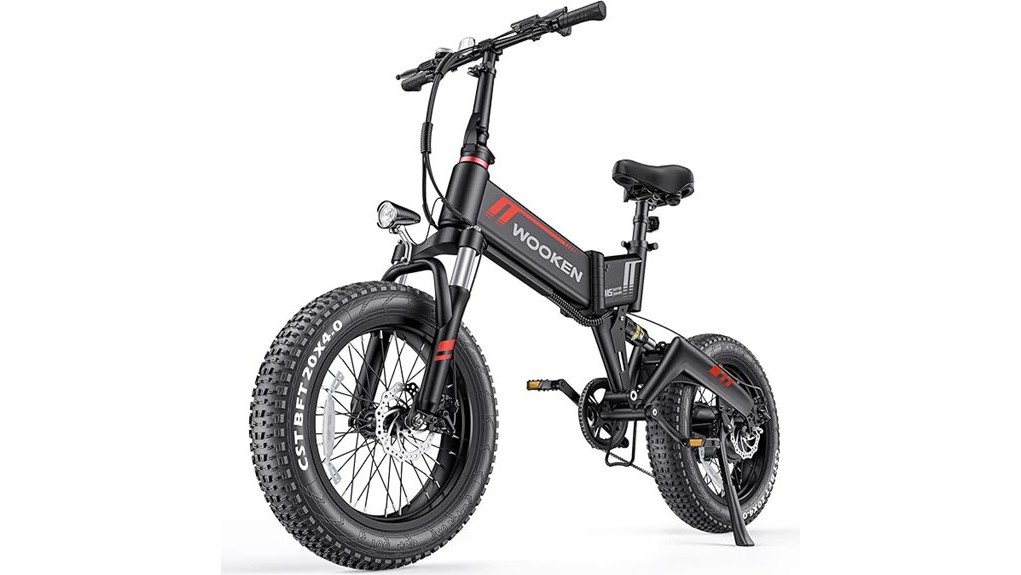
You’ll find the Wooken 20″x4.0 is a rugged folding e-bike that gives you strong 750W peak assist, smooth acceleration, and a real-world top speed around 20 mph. Its fat tires and lockable suspension soak up sand, snow, and rough pavement while dual discs stop predictably. The removable 48V 480Wh battery yields about 25–30 miles pure-electric or 50–60 with pedaling. It’s heavy but stable — keep going for full specs, range caveats, and accessory tips.
Some Key Takeaways
- 750W peak motor delivers smooth, stable acceleration with a real-world top speed around 20 mph.
- Removable 48V 480Wh battery provides about 25–30 miles pure-electric, 50–60 miles with pedal assist.
- 20″x4.0 fat tires and dual shocks offer traction and comfort on sand, snow, and rough pavement.
- Folding, adjustable frame fits riders ~5’7″–6’9″ but is heavy, affecting single-person handling.
- Dual disc brakes and predictable handling give confident stopping, though steering feels slightly slower.
Performance Snapshot: Motor, Speed, Range, and Real‑World Riding Results
While the Wooken’s 750W peak motor delivers strong, stable acceleration, you’ll find its real-world top speed capped at about 20 mph in mode 3—legal and predictable for urban riding. You’ll notice smooth torque delivery from launch through midrange, which helps on quick starts and commuter bursts. Acceleration tests show consistent response without sudden surges, and pedal-assist extends range efficiently. Battery yields 25–30 miles in pure e‑bike mode, 50–60 with pedaling. On hill climbs the motor sustains speed on moderate grades, though heavy loads slow you more. Overall, performance balances power, control, and practical range. This setup pairs especially well with durable outdoor gear and accessories designed for fat tire ebike riders, such as fat tire racks that improve cargo stability.
Ride Comfort and Control: Suspension, Tires, Brakes, and Handling on Snow, Beach, and City
Frequently, you’ll notice the Wooken’s suspension, fat tires, and brakes work together to deliver a composed, confidence-inspiring ride across snow, sand, and city streets. You benefit from lockable, adjustable front forks and a rear seat shock that absorbs chatter and supports heavy loads; suspension tuning is straightforward, letting you firm up for pavement or soften for dunes. The 20″x4.0 anti-skid tires provide excellent terrain traction, floating on sand and biting into packed snow while smoothing cobblestones. Dual disc brakes stop predictably with modulation. Handling stays stable at moderate speeds; steering is slightly slower due to tire volume but forgiving and secure. Riders who enjoy outdoor adventures will find the Wooken pairs well with fat ebike tires for enhanced grip and flotation.
Battery, Charging Options, and Practical Range: What to Expect Day‑to‑Day
Because the Wooken uses a removable 48V 480Wh lithium pack with IPX5 protection, you can tailor charging and range to your routine—charge it on the bike for convenience or snap the battery out to top up indoors. Expect 25–30 miles in full‑electric mode and 50–60 miles with pedal assist; real range depends on rider weight, terrain, and assist level. For longevity follow basic battery care: avoid deep discharges, store at partial charge, and keep contacts clean. Use sensible charging etiquette — charge in a ventilated area, don’t leave the pack plugged indefinitely, and use the supplied charger for best results. If you’re often riding off pavement, consider selecting replacement packs rated for outdoor activities to ensure durability and weather resistance.
Build, Ergonomics, Folding Design, and Fit for Different Riders
When you pick up the Wooken, its sturdy folding frame and adjustable contact points make the bike feel purpose-built for varied riders and storage needs. You’ll notice solid welds, beefy 20″x4.0 tires, and dual shocks that balance comfort with payload capacity. Adjustable ergonomics include a 36.61–40.55 in saddle and 46.46–51.18 in handlebar range, so you can dial fit for riders roughly 5.7–6.9 ft. Folding portability is effective: compact folded dimensions (14.16×21.24×11.64 in) simplify trunk or closet storage. Controls remain accessible when folded, though the bike’s weight affects one-person handling. Overall, fit and build feel professional. The Wooken is well suited for outdoor riders who prefer an adventure-ready step-through ebike.
Verdict and Buying Guide: Who This E‑Bike Is Best For, Common Tradeoffs, and Support/Parts Info
If you’re after a rugged, versatile commuter that doubles as a recreational rig, the Wooken delivers a lot for the price. You’ll get solid range options (25–30 mi electric, 50–60 mi pedal‑assist), a 750W peak motor, fat tires, folding convenience, and adjustable fit for 5’7″–6’9″ riders. It’s best if you want mixed‑terrain commuting, beach or snow weekend rides, and simple folding transport. Tradeoffs: weight, limited top speed (~20 mph), and modest suspension compared with full‑suspension eMTBs. Check warranty clarity before buying and confirm parts availability; customer service uses email/QR code for replacements. Consider adding a durable ebike battery case for outdoor rides to protect the battery on rough terrain.
Some Questions Answered
Does the Bike Come With a Warranty, and What Does It Cover?
Yes — you get a warranty; check the manual for warranty duration and coverage details. It typically covers manufacturing defects for the frame, electrical components, and motor, plus limited coverage on battery and drivetrain, but excludes wear items like tires, brake pads, and damage from misuse. You’ll need to contact customer service via the manual or QR code for claims, replacements, and technical guidance, and to confirm exact terms and claim procedures.
Can the Battery Be Upgraded or Replaced With Higher Capacity?
Yes — you can replace the battery, but upgrades are limited by battery compatibility and frame space. You’ll want a compatible 48V pack matching the bike’s connector, dimensions and BMS specs; aftermarket packs exist, yet may void warranty or lack IPX5 rating and UL certifications. Have a technician confirm charge/current limits and mounting clearance. Contact customer support for approved replacements or guidance before installing aftermarket packs to avoid damage or safety risks.
Is Assembly Required Out of the Box, and How Long Does It Take?
Yes — assembly required. You’ll unpack folded components, attach front wheel, handlebars, pedals, and mirror, reconnect the battery and adjust brakes and gears. Setup time typically runs 20–40 minutes if you’re handy; expect 45–90 minutes if you’re cautious or using only basic tools. You’ll want to check torque, tire pressure, and display calibration before riding. Keep the manual and customer support contact handy for tricky steps.
Are There Weight Limits for Cargo or Accessories Besides Rider Weight?
Yes — besides rider weight, the bike supports cargo capacity and accessory limits. You should assume accessory limits tied to rear rack and frame load; rear suspension notes ~1000 lbs support but that’s structural, not recommended cargo. Practically, keep cargo modest (bags, small panniers) to preserve handling and braking. Don’t exceed combined rider plus cargo that approaches structural ratings; contact customer service for specific accessory weight limits and replacement parts guidance.
Is There Smartphone App Connectivity or GPS Tracking Available?
No — it doesn’t offer Mobile app or GPS tracking built in. You’ll rely on the bike’s intelligent LCD for speed, battery and mileage data, plus standard controls. If you want app connectivity or real‑time GPS, you’ll need to fit an aftermarket Bluetooth tracker or GPS module and pair it to a third‑party Mobile app. That adds features like live location, ride history and anti‑theft alerts, but requires extra setup and power.