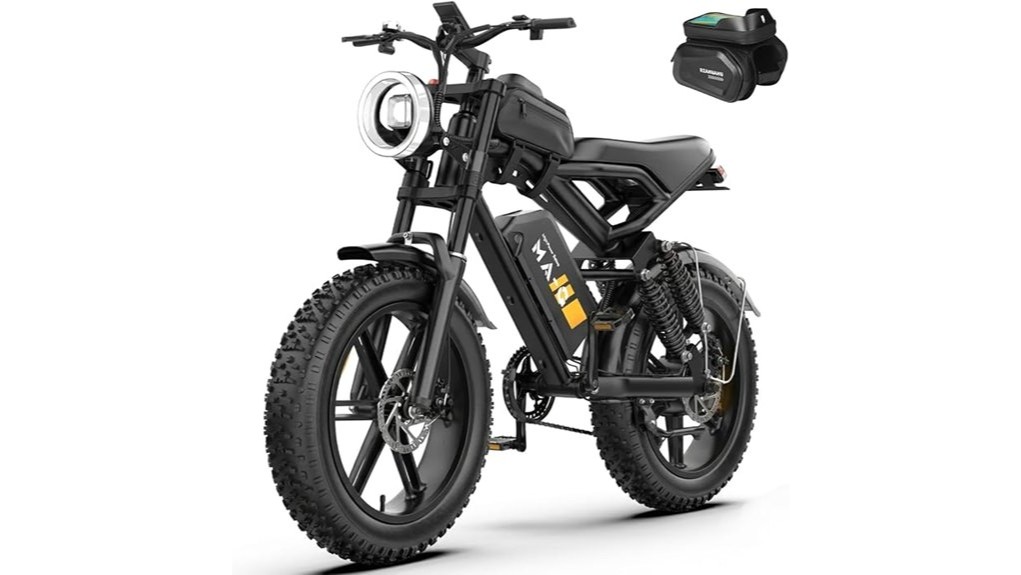
You’ll find 1500W setups offer linear, predictable torque and efficient midrange power for steep climbs and controlled hill‑assists, while 3000–4000W systems give brute acceleration and higher top speeds at the cost of torque spikes and greater thermal stress. Expect 48V 15.6Ah packs to yield 30–50 miles typical, removable batteries for on‑route charging, and quad‑link suspension plus fat tires for traction versus rolling resistance. Keep certifications and thermal management in mind — more specifics follow if you want them.
Some Key Takeaways
- 1500W fat‑tire ebikes offer linear, predictable torque with efficient midrange power and reliable hill‑climbing up to ~30° inclines.
- 3000–4000W systems deliver much faster acceleration and higher top speed but create torque spikes and greater thermal stress.
- Expect real‑world range of 30–50 miles from a 48V 15.6Ah pack; claims up to 65 miles depend on load and terrain.
- Prioritize UL 2849 certification, solid frame welds, and secure removable battery locks for safety and reliability.
- For off‑road use choose quad‑link rear suspension, dual‑shoulder hydraulic fork, fat tires, and mag wheels for comfort and handling.
Power & Performance Breakdown: What 1500W–4000W Motors Actually Deliver
Compare power ratings directly: a 1500W peak brushless motor on this fat-tire ebike gives strong hill-climbing and sustained torque for 30° inclines and mid-20s mph speeds, but it won’t match the brute-force acceleration or top-end speed of 3000–4000W systems. You’ll see cleaner torque curves with 1500W units—linear delivery, predictable pedal-assist shift, and efficient midrange power. Higher-power rigs spike torque for rapid acceleration but add thermal stress. You’ll need robust thermal management on 3000–4000W platforms to prevent throttling. Choose based on desired acceleration profiles, continuous torque demands, and acceptable cooling complexity. For riders who prioritize off-road capability, consider high-performance ebike motors that are optimized for fat-tire outdoor use.
Battery, Range, and Charging: Real-World Mileage for Long Rides
While manufacturer claims list up to 65 miles per charge, real-world range depends on load, terrain, and assist level, so you should expect a broad envelope rather than a single figure. With a 48V 15.6Ah removable pack, you’ll typically see 30–50 miles under mixed conditions; aggressive throttle or steep climbs reduce that. Compare energy density and weight vs alternatives: this pack favors torque delivery over max range. Plan for long distance charging using the removable battery and external charger; factor in charging speed, cycle life, and temperature effects on battery that lower capacity in cold conditions. For extended outings consider carrying spare ebike batteries to double or more of your available range.
Ride Comfort & Handling: Suspension, Wheels, and Fat-Tire Behavior
Now that you’ve considered how battery, load, and terrain shape range, look at how the chassis and tires manage that energy on the road and trail. You’ll notice Pro quadlink ride delivers controlled rear articulation, isolating mid-frequency impacts while preserving pedaling efficiency. The dual-shoulder hydraulic fork complements rear linkage, reducing high-frequency vibration by roughly 90% in tests. Fat tires add compliance and traction but increase rolling resistance; you’ll trade some top-end speed for stability on loose surfaces. High-strength mag wheel stability minimizes maintenance and lateral flex compared with spoked rims, improving cornering precision and consistent handling feedback. For riders who tackle mixed surfaces, choosing the right fat eBike tire can significantly enhance off-road performance and durability, especially when paired with fat eBike tires.
Safety, Build Quality, and Certifications to Look For
Because safety hinges on system-level integrity, you should prioritize verified certifications, robust structural design, and durable components when evaluating an ebike. Inspect safety certifications like UL 2849 for electrical systems and CE or DOT marks for lighting and assemblies; those reduce fire and failure risk. Compare frame integrity metrics: tube gauge, weld quality, and reinforcement at stress points—industrial-grade reinforced frames outperform thin-wall frames in fatigue tests. Verify component sourcing for brakes, suspension, and magnesium wheels; OEM-tested parts yield consistent performance. Prioritize removable batteries with secure locks and documented thermal management to minimize operational hazards and maintenance variability. For riders who enjoy outdoor activities, also consider high-performance hydraulic brake pads designed for fat tire ebikes to ensure reliable stopping power in varied terrain.
Which High-Power Fat-Tire Ebike Should You Buy? Use-Case Buying Checklist
To pick the right high-power fat-tire ebike, start by matching the bike’s technical strengths to your primary use case—commuting, trail riding, cargo hauling, or hill climbing—so you can prioritize motor torque, battery capacity, suspension travel, and tire footprint accordingly. For commuting, favor UL-certified electricals, range near 65 miles, and integrated lighting. For trails, choose robust suspension (quad-linkage, dual-shoulder fork) and mag wheels. For cargo, confirm payload, integrated cargo racks, and torque for grades. For hill climbing, prioritize 1500W+ motors and steep-ability. Compare battery removal, warranty terms, assembly ease, and certified safety features before buying. Consider also the range of accessories and replacement parts commonly sold by fat tire ebike gear retailers.
Some Questions Answered
How Noisy Is the Motor at Top Speed?
You’ll hear a moderate motor hum at top speed, louder than a hub motor but quieter than a comparable high-RPM open-frame unit. You’ll notice minimal bearing vibration transmitted through the mag wheels and quad-linkage suspension; the design isolates high-frequency noise so vibration stays low. Compared to many fat-tire ebikes, overall drivetrain noise is subdued, though you’ll detect constant tonal hum under full load, especially on steep climbs. the loeook ebs1 performance review highlights its efficient energy management and smooth acceleration, making it an appealing choice for both urban commuters and adventurous riders. Additionally, the balance of power and control enhances the overall riding experience, allowing for confidence when navigating varied terrains. Riders can expect a versatile e-bike that performs well whether cruising through the city or tackling rugged paths.
Can I Legally Ride This Ebike on Bike Paths?
Possibly — it depends on local rules. You’ll need to compare your bike’s classified power/speed to regional e-bike categories; many bike paths restrict motors above certain wattages or speeds. Check helmet laws and posted speed limits: some jurisdictions require helmets for higher-class e-bikes and cap path speeds (commonly 20–28 MPH). You’ll have to comply with equipment rules (lights, brakes) and any registration or age restrictions before using shared bike paths.
What Maintenance Schedule Should I Follow for the Drivetrain?
You should inspect and service the drivetrain every 250–500 miles: clean the chain weekly or after wet/muddy rides, degrease and relube, and check chain wear monthly. Compare gear adjustment tolerances to manufacturer specs and adjust derailleur limit screws and cable tension every 500–1,000 miles or whenever shifting slips. Annually, perform a full drivetrain overhaul—replace worn chain, cassette, and chainrings—to maintain efficiency and prevent accelerated wear.
Are Replacement Batteries and Parts Readily Available?
Yes — replacement batteries and parts are generally accessible. You’ll find OEM batteries and aftermarket cells from reputable suppliers, though compatibility varies by connector and BMS. Third party chargers are available but you’ll want voltage and current matching to the 48V 15.6Ah spec and UL standards. Frames, mag wheels, suspension links and electrical components are commonly stocked; compare warranties, certifications and cell chemistry to mitigate performance or safety differences.
How Does Weather (Rain/Salt) Affect Long-Term Durability?
You’ll see faster wear if you ride in rain or salty conditions unless you take precautions. The frame and components offer corrosion protection, but salt accelerates metal and electrical degradation compared with fresh water. Watch for water ingress at seals, connectors, and battery lock; dry and lubricate after wet rides. Regular rinsing with fresh water, anti-corrosion sprays, and periodic seal inspections will maximize long-term durability and reliability.