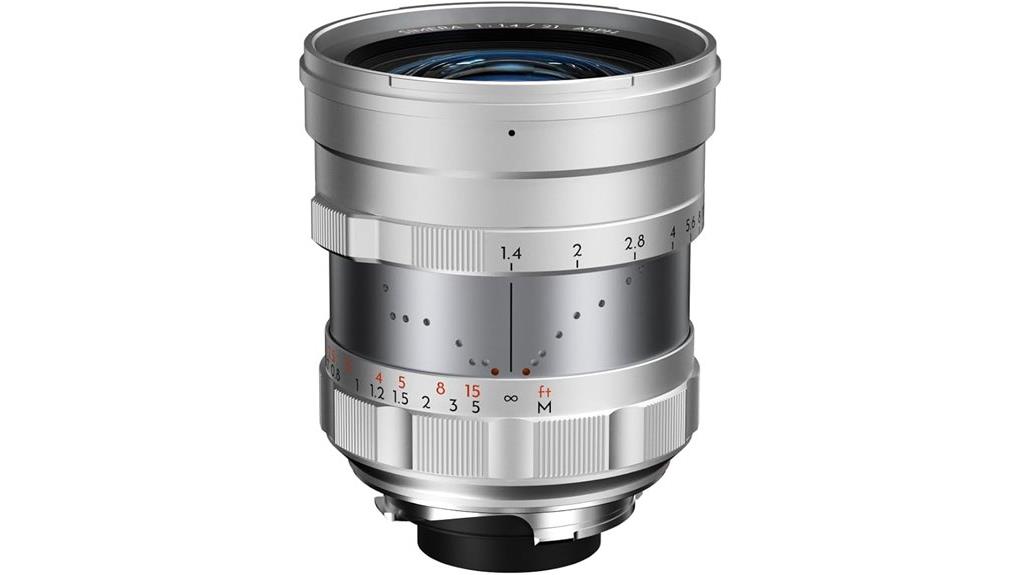
You’ll find the Thypoch Simera 21mm f/1.4 delivers immediate center sharpness and creamy f/1.4 bokeh while staying compact and rangefinder-friendly. You’ll get modest corner softening wide open, two-stop vignetting reduction by f/4, and very low lateral CA and distortion for clean landscapes and architecture. Close-focus to 0.23 m plus a 14-blade diaphragm makes dramatic foreground separation possible, and the clicked/de-clicked aperture suits stills or video—keep going and you’ll see how it stacks up in real shoots.
Some Key Takeaways
- Exceptional center sharpness from f/1.4 with fine detail resolving immediately, making it useful wide-open.
- Floating-focus design yields improved edge performance and modest corner softening only at maximum aperture.
- Minimal coma and restrained chromatic aberration suit astrophotography and night panoramas.
- Fast f/1.4, 14-blade diaphragm and 0.23 m close-focus deliver creamy bokeh and strong foreground separation.
- Solid all-metal build, balanced 428 g weight, and rangefinder-friendly design favor handheld and cinematic street use.
How the Thypoch Simera 21MM F/1.4 Performs Optically (Sharpness, Vignetting, Distortion)
Evaluating the Simera 21mm f/1.4 optically, you’ll find a lens that aims for modern wide-angle accuracy: center sharpness is excellent from f/1.4 with fine detail resolving immediately, while the floating focus design keeps edges markedly better than older wide-angle M lenses, though the extreme corners still soften slightly wide open. You’ll notice modest vignetting at f/1.4 that drops by two stops when stopped to f/4. Distortion is well-controlled for a 21mm; straight lines stay honest. Lateral chromatic aberration is minimal, and residual field curvature is present but subtle, correctable in-camera or in post. Perfect Portrait Lenses caters to photographers seeking portrait lens options and related gear.
Real-World Shooting: Landscapes, Astrophotography, Architecture, and Street Samples
When you take the Simera 21mm f/1.4 into the field it quickly shows where it excels: tack-sharp centers from wide open, controlled edges thanks to the floating focus system, and an ultra-fast aperture that opens creative possibilities in low light and shallow-depth wide-angle work. You’ll capture expansive landscapes with excellent corner detail stopped down, and frame night panoramas with minimal coma and restrained chromatic aberration. For architecture the lens renders lines clean with modest distortion; for cinematic street work it isolates subjects while keeping context. Environmental portraits benefit from close focus and pleasing bokeh, producing intimate yet locational images. It’s an ideal choice for photographers who specialize in wide-angle photography and want a fast, versatile optic for diverse shooting scenarios.
Build, Handling, and Manual-Focus Experience on Leica M Bodies
Slip the Simera 21mm f/1.4 onto an M-mount body and you immediately notice the solid, all-metal construction and balanced 428 g heft that keeps the camera stable without feeling front-heavy. You’ll appreciate rangefinder ergonomics: the lens clears viewfinder lines, keeps access to shutter and dials unobstructed, and pairs well with M handling for street work. The manual-focus ring is smooth with a firm, well-damped resistance; the generous focus throw lets you make precise adjustments, especially near infinity. Mounting feels secure, and the compact footprint preserves camera balance, making long handheld sessions less fatiguing and more controlled. This design makes the lens a natural companion for photographers using camera harnesses to shoot comfortably for extended periods.
Close-Focus, Bokeh, and Aperture Behavior (F/1.4 to F/16, Clicked Vs De-Clicked)
Because the Simera focuses to just 0.23 m, you can push in close for dramatic wide-angle foregrounds while still getting strong subject separation from the f/1.4 aperture, and that combination changes how you think about composition and background rendering. You’ll exploit close focus artistry to place prominent foregrounds against smoothly rendered backgrounds. The 14-blade rounded diaphragm produces creamy bokeh at f/1.4, with gradual highlight roll-off. Stopping down increases depth and sharpness; by f/5.6–f/8 you get edge-to-edge utility. The clicked/de-clicked switch alters tactile aperture mechanics for video or stills, letting you choose precise stops or seamless shifts. This lens is ideal for photographers who enjoy detailed close-ups and creative foreground-background interplay, especially those exploring macro lens techniques.
Who Should Buy It and How It Compares to Rival 21–24mm Fast Primes
If you need an ultra-wide, ultra-fast manual lens that balances compactness, build quality, and close-focus versatility, the Thypoch Simera 21mm f/1.4 is worth strong consideration. You’ll want this if your target audience is primarily landscape, astrophotography, architecture, or cinematic street shooters who value manual control, shallow depth, and near-focus capability. Compared with rival 21–24mm fast primes, the Simera trades autofocus and brand cachet for lighter weight, closer MFD, and a richer bokeh at f/1.4. In the competitive landscape it undercuts pricier legacy options while offering modern coatings, solid optics, and excellent value for manual-lens enthusiasts. This makes it an appealing choice for users who prioritize gear tailored to mirrorless camera systems.
Some Questions Answered
Is This Lens Compatible With Rangefinder Coupling on All Leica M Bodies?
Yes — you can use it with Leica M rangefinders, but check rangefinder calibration and coupling compatibility. You’ll mount the manual-focus Simera on Leica M bodies and the rangefinder mechanism will couple, yet wide-angle 21mm lenses can stress patch accuracy. You should verify coupling compatibility on your specific M model and test for front/back focus across distances. If you notice errors, service or micro-adjustment (if available) will restore precise rangefinder calibration.
Does the Lens Cover Full-Frame Digital Sensors Without Cropping or Vignetting?
Yes — it provides full frame coverage, so you won’t get cropping on full-frame Leica M sensors. You’ll still want to watch for mild corner light falloff wide open, but the floating focus design and optical elements preserve edge sharpness across the frame, especially stopped down. For critical wide-angle work stop to f/4–f/8 for prime corner detail and minimal vignetting; close-focus shots may show slightly different edge rendering.
What Accessories (Hood, Caps, Filters) Are Included or Available?
The lens ships with a Lens hood and Rear cap; you’ll also get a front cap to protect the glass. You can fit 82mm threaded filters via an optional adapter (sold separately) for ND, polarizers, or astro filters. A soft pouch, hard case, and third-party lens collars are available from aftermarket vendors. You’ll want a dedicated rear cap spare and a quality hood to minimize flare and protect the front element.
How Does Warranty Support Handle Shipping Costs and Repair Timelines?
You’ll find warranty logistics cover manufacturing defects for one year; shipping costs for returns are generally your responsibility unless the seller or platform offers prepaid labels. Thypoch’s support commits to a 24-hour response; the repair timeline typically runs from initial assessment to completion in 7–21 business days depending on part availability. You’ll get status updates via support email; insist on written estimates and tracking for any shipped repairs.
Can the Simera Be Adapted to Non‑M Mirrorless Cameras With an Adapter?
Yes — you can adapt the Simera to many non‑M mirrorless cameras using a proper mount adapter. Check flange distance compatibility: mirrorless bodies with shorter flange distances let you maintain infinity focus. You’ll lose electronic communication, so you’ll rely on manual focus and stop‑down metering or focus peaking. Use a quality adapter to guarantee solid mount alignment and avoid light leaks; expect fully mechanical operation without EXIF transfer.