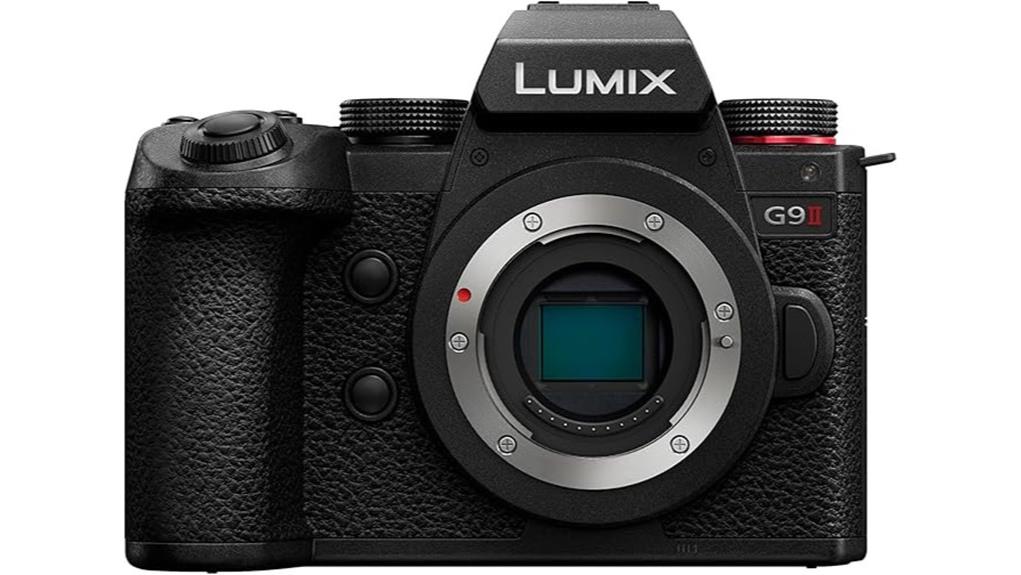
You’ll find the Panasonic LUMIX G9II is a compact Micro Four Thirds flagship that balances fast Phase Hybrid AF, blackout‑free bursts up to 60 fps, and 8‑stop IBIS for handheld tele and action work. Its 25.2MP sensor and tuned processing deliver usable high‑ISO performance and solid dynamic range for the class, while 10‑bit 4K/120p and robust codecs suit hybrid shooters. Keep scanning for detailed testing, workflow notes, and practical lens recommendations.
Some Key Takeaways
- 25.2MP Micro Four Thirds sensor with advanced processing delivers good detail, tonal gradation, and usable high ISO up to 12,800 with careful processing.
- Phase Hybrid AF with 779 phase-detection points and rapid AFC enables reliable subject tracking and blackout-free continuous shooting up to 60 fps.
- 8-stop in-body stabilization plus Dual I.S. 2 allows handheld telephoto and low-light shooting with significant motion reduction.
- Professional video: internal 10‑bit 4K up to 120p, 4:2:2 at 60p, Log profiles, and real‑time LUT support for grading workflows.
- Compact, durable body with dual UHS-II slots, recommended fast primes/stabilized teles, and accessory support for hybrid shooters.
Quick Verdict: Who the LUMIX G9II Is Best For
While the G9II's compact Micro Four Thirds body and advanced AF make it a clear choice for action and wildlife shooters who need high-speed tracking and blackout-free bursts, its 8-stop in-body stabilization and 10‑bit 4K/120p video also suit hybrid shooters and documentary videographers who work handheld in low light. You’ll find this camera ideal if you’re an enthusiast wildlife photographer requiring rapid AFC, high frame-rate capture, and robust IBIS for telephoto handholding. It’s equally strong for travel photography and hybrid video work where compactness, durable controls, and professional codecs accelerate workflow and reliability. Many users pair it with gimbal stabilizers to further master smooth handheld shots.
Image Quality, Sensor and Low‑Light Performance Explained
Because Panasonic paired a 25.2 MP Live MOS Micro Four Thirds sensor with advanced processing and Phase Hybrid AF, the G9II delivers a tight balance of resolution, dynamic range, and noise control that benefits both stills and video workflows. You’ll find sensor detail optimized for 4:3 and 3:2 crops, with demosaicing tuned to preserve edge microcontrast. High ISO handling is strong for its class: noise suppression is aggressive yet retains detail up to ISO 6400, usable to 12800 with careful processing. Shadow recovery and tonal gradation show respectable dynamic range for a MFT sensor, aiding low‑light exposure latitude. For photographers who want the most accurate on‑screen previews and post‑processing results, pairing the G9II with proper monitor calibration ensures what you see reflects the camera’s output.
Autofocus, Burst Shooting and Stabilization in Real Shoots
When you push the shutter in dynamic situations, the G9II's Phase Hybrid AF with 779 phase-detection points locks quickly and tracks subjects with consistent precision, translating to higher keeper rates in action work. You’ll rely on detailed Phase detection mapping to confine AF zones, prioritize eyes or bodies, and reduce hunting across the frame. Blackout-free continuous shooting at up to 60 fps with AFC pairs with a short AFC burst window; combine that with a Pre burst strategy to capture pre-motion frames for decisive moments. Sensor-shift 8.0-stop B.I.S. and Dual I.S. 2 deliver handheld stability for tele and low-light sequences. For shooters using heavy telephoto lenses or aiming for stable compositions, pairing the camera with a sturdy ball head can markedly improve control and framing.
Video Capabilities and Workflow (C4K/4K 10‑Bit up to 120p)
As you plan C4K/4K workflows, the G9II gives you 10‑bit internal recording up to 120p (100p) and 4:2:2 color at 60p, enabling greater grading latitude and cleaner motion rendering for slow‑motion and high‑frame-rate deliverables. You’ll capture 4320p/4K files to dual UHS-II cards with sustained V60/U3 throughput; set frame rates and bit-depths to match edit timelines. The camera includes REAL TIME LUT support and Log profiles to preserve highlights and extend dynamic range for grading. Expect efficient file handling, accurate HDMI output, and reliable color fidelity for professional 4K workflow integration. Consider pairing the G9II with an external monitor for improved framing and critical focus when recording external camera monitors.
Buying Checklist: Lenses, Accessories, Performance Tradeoffs and Value
If you’re building a shooting kit around the G9II, prioritize lenses and stabilization that exploit its Micro Four Thirds sensor and 8.0‑stop IBIS: fast primes (f/1.8–f/2.8) and stabilized telephotos will maximize low‑light and subject isolation while keeping overall system weight down. Evaluate the lens roadmap for native MFT optics and third‑party options; prefer UHS‑II‑friendly write speeds and V60 cards for high‑bitrate 4K. Check accessory compatibility—batteries, grips, cages, and gimbals—with the G9II body and dual SD slots. Weigh performance tradeoffs: smaller sensor and crop vs. portability, depth of field, and total system cost/value. Consider adding specialized accessories like cages and thumb grips to enhance handling and protect the camera, especially when using mirrorless camera kits.
Some Questions Answered
How Long Does the Battery Last During Mixed Photo/Video Use?
You’ll get roughly 350–450 shots or about 90–120 minutes of mixed photo/video per charge, so battery endurance fits all-day hybrid use. In real worldruntime tests with intermittent 4K recording, burst shooting and EVF use, expect around 3–4 hours of active operation before swapping batteries. Heavy continuous 4K/120p or extended EVF use will cut that to under 90 minutes; carrying one spare battery is recommended.
Is There In-Camera Charging via USB-C While Shooting?
Yes — you can use USB charging and pass through power, but with limits. The camera accepts USB-C power for battery charging and sustained operation, yet full in-camera charging while shooting is constrained: some functions (high-rate video, flash, heavy AF/burst) may prevent simultaneous charging or may slow charge. You should use a reliable PD charger and test your workflow; for uninterrupted high-demand recording, consider an external power bank or DC coupler.
Can the Dual Card Slots Be Configured for Backup or Overflow?
Yes — you can configure the dual card slots for Backup mode or Overflow mode. You’ll assign primary/secondary roles in the menu: Backup mode writes identical files to both cards for redundancy; Overflow mode fills the primary card first, then switches to the secondary when full. This lets you prioritize data safety or extended capacity. Make certain both cards match performance (UHS-II/V60 recommended) to avoid write bottlenecks during high-bitrate video or burst shooting.
Does the Camera Support Prores or External RAW Video Output?
No — you won’t get native ProRes support or true External RAW recording from the camera. ProRes support isn’t listed; internal recording is 10-bit MP4/C4K up to 120p. External via HDMI outputs 10-bit video but not confirmed as ProRes or RAW stream. You can record high-quality 4:2:2 10-bit externally if your recorder accepts clean HDMI, but External RAW and onboard ProRes aren’t provided.
What Weather-Sealing Level Does the Body Provide?
The body provides robust weather sealing: you get a magnesium alloy chassis with thorough weather sealing against dust and splashes, designed for pro outdoor use. You’ll benefit from sealed buttons, dials and compartments plus reinforced joints to resist moisture and particulate ingress; it’s not rated to a specific IP number publicly, so you shouldn’t submerge it. Overall, it’s engineered for reliable operation in adverse field conditions.