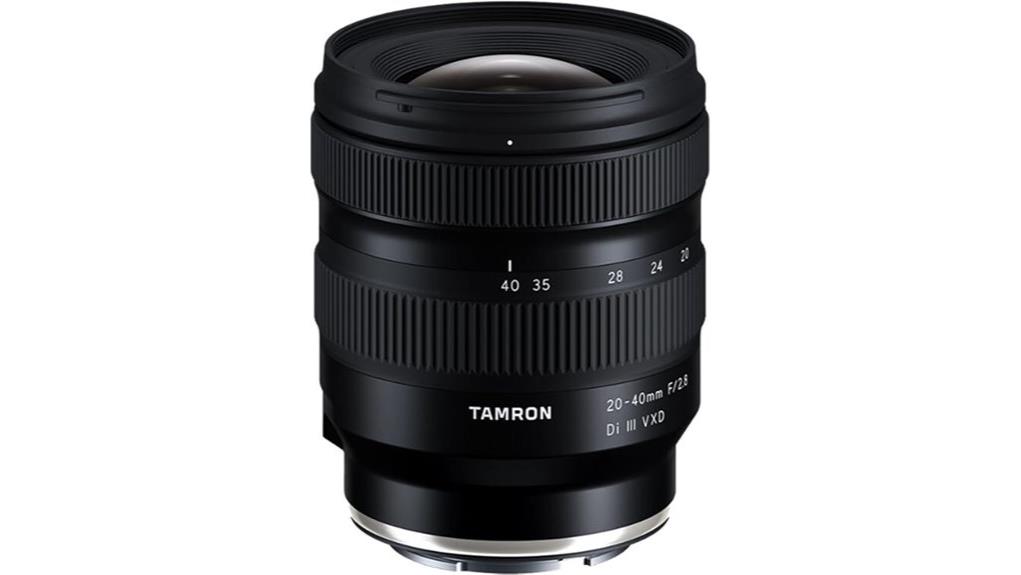
You’ll get a compact, pro-grade 20–40mm f/2.8 that’s sharp in the center, fast to focus with Tamron’s VXD linear motor, and useful for low-light run‑and‑gun work and vlogging. Expect modest edge falloff and correctable distortion, noticeable vignetting at f/2.8, minimal chromatic aberration, and solid flare control. There’s no in‑lens stabilization but excellent close‑focus macro (0.17 m, 1:3.8). Keep going and you’ll find detailed test results, comparisons, and real‑world takeaways. The Tamron 150500mm lens specifications reveal an impressive zoom range that can adapt to various shooting scenarios. Photographers will appreciate the lens's ability to produce sharp images across the focal length, making it ideal for wildlife and sports photography. Additionally, the weather-sealing provides peace of mind for outdoor shoots in challenging conditions.
Some Key Takeaways
- Compact, lightweight 20–40mm f/2.8 zoom offering pro-level optics and excellent center sharpness across the range.
- Fast VXD linear motor enables swift, quiet, and accurate autofocus suitable for run-and-gun and vlogging.
- Strong low-light performance at f/2.8 with close-focus macro (0.17 m, 1:3.8) for creative environmental close-ups.
- Shows modest edge/corner falloff and vignetting at f/2.8, improving significantly by f/4–f/5.6; distortion is moderate but correctable.
- No in-lens stabilization—rely on camera IBIS or gimbals; compare against native Sony options for weight, range, and price.
Tamron 20–40mm F/2.8 at a Glance: Quick Verdict and Who It’s For
Although it's compact and lightweight, the Tamron 20–40mm f/2.8 delivers pro-level optics and fast AF performance, making it a practical all-purpose zoom for creators. You’ll appreciate compact ergonomics that balance handling and portability for run-and-gun shooting, vlogging, and family video. The f/2.8 aperture and VXD linear motor give consistent low-light ability and swift, reliable focusing. Close-focus macro capability adds creative flexibility without switching lenses. Its price positioning targets enthusiasts and pros seeking value against native alternatives. You’ll find it a versatile, purpose-driven tool when you need a single, high-performance wide-to-normal zoom. It’s an especially good match for photographers using mirrorless cameras who want a lightweight, high-quality zoom option.
Optical Performance: Sharpness, Distortion, Vignetting, and Bokeh
Start with sharpness: the Tamron 20–40mm f/2.8 delivers high center resolution across the zoom range, yielding crisp detail from wide-open apertures with only modest edge and corner falloff at 20mm that tightens by 28–35mm and is largely controlled by f/5.6–f/8. You’ll observe strong edge sharpness once stopped down; microcontrast remains good. Distortion is moderate and correctable in raw conversion. Vignetting is noticeable at f/2.8, reduced by f/4–f/5.6. Longitudinal CA is minimal; lateral chromatic aberration is well managed. Color rendition is neutral and natural. Flare control is competent, delivering clean highlights and restrained contrast loss. This kind of lens suits photographers who favor versatility and zoom lens performance for travel and everyday shooting.
Autofocus, Stabilization, and Real‑World Speed for Video and Photos
While the lens owes its brisk tracking and low-noise operation to Tamron's VXD linear motor, you’ll notice consistently fast, precise autofocus for both stills and video, with smooth subject shifts and minimal hunting even in low-contrast scenes. You get responsive face/eye detection performance on Sony bodies and near-silent operation for run-and-gun shooting. The lens lacks in-body stabilization, so you’ll rely on camera IBIS or gimbals; handheld video at longer exposures benefits from those systems. Focus breathing is well controlled for modest framing shifts, and fast readout sensors minimize rolling shutter artifacts, yielding usable footage in practical scenarios. For timelapse and interval shooting, consider using an intervalometer remote to control exposures and capture consistent sequences.
Macro and Close‑Focus Capability: What 0.17 M MOD and 1:3.8 Magnification Deliver
Because the Tamron reaches a minimum object distance of 0.17 m and a maximum magnification of 1:3.8 at the wide end, you can capture subjects noticeably larger in frame than with typical wide-angle zooms without switching to a dedicated macro lens. You’ll compose tight environmental close-ups for close up storytelling, emphasizing context while isolating details. Shallow depths at f/2.8 permit subject separation but demand precise focus; use autofocus tricks like back-button AF and focus peaking for critical shots. Optical design maintains resolution near MOD, though working distance is limited—plan lighting and leverage the fast VXD AF for reliable close-focus performance. Consider pairing extension tubes to further increase magnification with macro extension tubes for greater close-up capability.
Should You Buy It? Mount Compatibility, Use Cases, and Alternatives
Considering whether the Tamron 20–40mm f/2.8 fits your kit, weigh its Sony E‑mount full‑frame optimization, versatile 20–40mm range, and fast f/2.8 aperture against your shooting needs. You’ll get high image quality from 12 elements/11 groups, VXD AF speed, and useful close‑focus for vlogs, family video, and run‑and‑gun work. If you use Sony E bodies, compatibility is native; adapters complicate autofocus and stabilization. Check weather sealing expectations versus pro all‑weather use. For alternatives, compare weight, focal range, and Price comparison with native Sony primes/zooms and other third‑party 20–40mm equivalents before buying. Gear Guide serves enthusiasts with camera-related products and buying advice, so consider its enthusiast focus when comparing kit choices.
Some Questions Answered
Does It Include Weather Sealing or Dust/Moisture Resistance?
No, it doesn't have full weather sealing; Tamron doesn't claim extensive weather resistance for this model. You can expect basic sealing at the mount and some moisture resistance, but it hasn't undergone manufacturer-verified sealing tests for harsh conditions. You should avoid heavy rain or dusty environments without additional protection. For reliable outdoor use in adverse weather, plan to use a rain cover or choose a lens explicitly rated and tested for robust weather resistance.
What Is the Filter Thread Size for Front Filters?
The front filter thread size is 67mm. You’ll mount front filters directly to the lens; thread size determines adapter compatibility with step-up or step-down rings. Be aware that using wide adapters can affect vignette and corner sharpness. Filter stacking is possible with multiple slim 67mm filters, but stacking increases chance of vignetting at 20mm and may reduce image contrast. For accessories, match 67mm threads or use compatible adapters.
Is a Lens Hood and Carrying Pouch Included in the Box?
Yes — you get a lens cap but not a dedicated carrying pouch; the retail packaging includes the lens, lens cap, hood, warranty card, and documentation. You’ll attach the supplied hood for flare control and use the lens cap for front-element protection. If you need a padded pouch for transport, you’ll have to purchase one separately. The box contents follow Tamron’s standard retail packaging for E-mount releases.
Does It Support In-Camera Lens Aberration Correction Profiles?
Yes — you’ll get in camera correction support; profile availability is present for most recent Sony bodies. The lens communicates correction data to the camera for distortion, chromatic aberration and vignetting correction. You should check your camera’s firmware and RAW processing software for updated profile availability, since full correction support depends on camera model and post‑processing application versions. This provides accurate automated aberration compensation.
How Long Is the Warranty and Who Services Repairs?
You get a two-year warranty covering manufacturing defects; Warranty length may vary by region and retailer, so check your purchase documents. Tamron-authorized Service centers perform repairs and warranty work; Service centers are listed on Tamron’s regional websites. You’ll be required to provide proof of purchase and follow their repair authorization procedures. Out-of-warranty repairs are also handled by the same Service centers, which use genuine Tamron parts and official diagnostic protocols.