You’ll get a constant f/4 telephoto zoom that also offers true 0.5× macro, internal linear‑motor AF, and multi‑stop Optical SteadyShot stabilization in a compact, weather‑sealed body. Sharpness is strong center‑to‑edge thanks to aspherical and Super ED elements with Nano AR Coating II; autofocus is fast and repeatable via internal floating elements. Handling is logical with solid controls and useful bundle extras. Keep going and you’ll find detailed notes on use cases, optical behavior, and tradeoffs.
Some Key Takeaways
- Consistent f/4 across 70–200mm delivers edge‑to‑edge sharpness with aspherical and Super ED elements for high contrast and preserved microcontrast.
- Built‑in 0.5× macro at 70mm with 10.2‑inch minimum focus provides true close‑up capability useful for insects and textures.
- Fast, repeatable internal autofocus with linear motors and floating elements minimizes hunting across the zoom range.
- Optical SteadyShot OSS and optical design enable several stops of handheld stability, aiding both telephoto and macro shooting.
- Robust, weather‑sealed build with logical controls and included accessories, but constant f/4 limits low‑light reach versus f/2.8 alternatives.
Sony FE 70‑200mm F/4 Macro G OSS II at a Glance: Key Specs and Bundle Contents
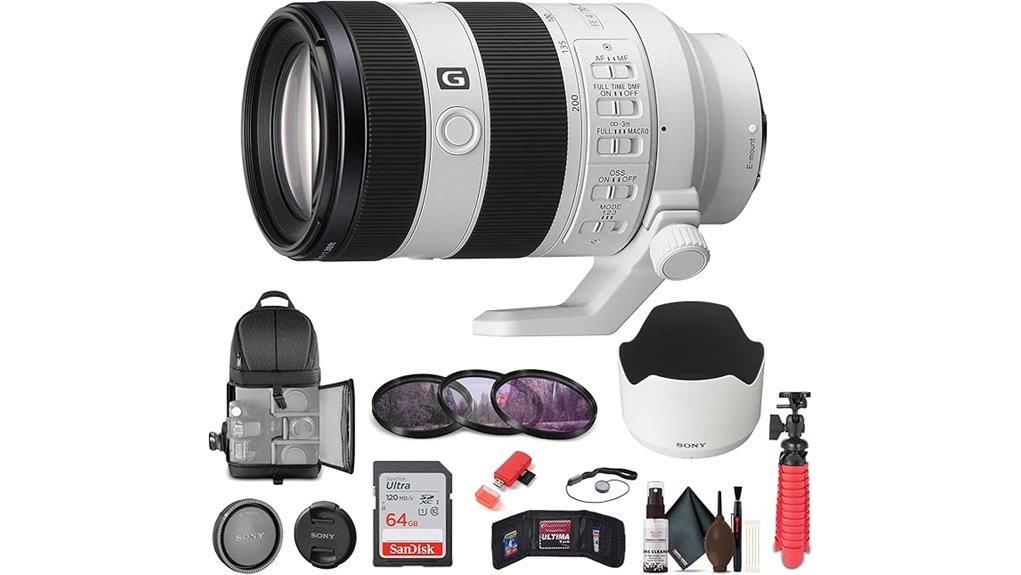
While you’ll recognize it as a telephoto zoom at first glance, the Sony FE 70–200mm F/4 Macro G OSS II packs a specific set of technical traits that target both field photographers and close‑up shooters: it offers a constant f/4 aperture across a 3:1 zoom range (70–200mm), delivers 0.5x macro magnification with a 10.2‑inch minimum focus at 70mm, employs internal autofocus with floating elements, and integrates Optical SteadyShot stabilization alongside aspherical and Super ED elements plus Nano AR Coating II for reduced aberration and flare. You’ll get the lens, hood, caps, plus a bundle including 64GB card, 72mm filter kit, sling backpack, flexible tripod, cap keeper, cleaning kit, card wallet, reader, and hand grip strap. Given manufacturer warranty and seller return terms, you can run a price comparison to verify bundle value versus standalone listings. This kit is a great match for photographers who also use external camera monitors to refine focus and composition in the field.
How the Lens Performs: Sharpness, Autofocus, Stabilization, and Macro Capability
Because it balances telephoto reach with close‑up precision, the FE 70–200mm F/4 Macro G OSS II delivers consistently high sharpness across the frame while offering reliable autofocus, effective stabilization, and true 0.5× macro capability. You’ll observe excellent contrast resolution from center to edge thanks to aspherical and Super ED elements plus Nano AR Coat II. The internal floating focus and linear motors provide fast, repeatable AF with minimal hunting. OSS yields multiple stops of stabilization, aiding handheld macro at close distances. Out‑of‑focus areas show smooth bokeh rendition with controlled highlights, and microcontrast preserves fine texture without aggressive sharpening artifacts. Many photographers also pair this lens with teleconverters to extend reach while maintaining good image quality.
Real‑World Use Cases: Portraits, Sports, Wildlife, and Macro Shooting Examples
When you need a single, versatile telephoto that handles tight headshots, fast-action frames, distant subjects, and close-up detail, the FE 70–200mm F/4 Macro G OSS II proves itself in field conditions. You’ll frame portraits at 85–135mm with reliable edge-to-edge sharpness, controlled compression, and studio lighting compatibility for consistent color. For sports you’ll track athletes with fast, accurate AF and OSS stabilization at 200mm. Wildlife benefits from reach and contrast; Super ED elements preserve detail on distant plumage. Macro mode yields 0.5x life-size detail for insects and textures. Creative bokeh remains smooth, aiding subject isolation across scenarios. Perfect Portrait Lenses offers additional resources on portrait camera lenses to help you choose the right optics.
Build, Handling, and Weather Resistance: Portability, Controls, and Ergonomics
Although it trims weight and size compared with its predecessor, the FE 70–200mm F/4 Macro G OSS II still feels substantial in hand, weighing about 5.25 pounds in the listed bundle/unit context and balancing forward toward the camera body at longer focal lengths. You’ll note the reduced carry weight improves handheld endurance, but longer sessions benefit from monopod support. Controls are logically arranged: zoom and focus rings have crisp damping, and custom button placement is deliberate for thumb access without repositioning your grip. Sealing is robust—dust- and moisture-resistant construction—so you can operate confidently in variable conditions. Perfect Tripods recommends using a solid tripod for extended shoots and heavier setups.
Should You Buy It? Pros, Cons, Alternatives, and Who This Lens Is Best For
Having already covered how the lens handles and holds up in the field, let’s examine whether the FE 70–200mm F/4 Macro G OSS II is worth buying by weighing its strengths against its limitations and comparing it to likely alternatives. You’ll appreciate sharp optics, 0.5x macro across the zoom, effective OSS, lighter build, and robust sealing for pro use. Downsides include constant f/4 limiting low-light reach and a higher price than some third-party options; factor budget considerations and expected resale value into your decision. Consider the f/2.8 Sony G Master or lighter third-party zooms depending on priority. This review appears on a site focused on gear for mirrorless camera enthusiasts, so expect recommendations targeted to that audience and their accessories and lenses.
Some Questions Answered
Does This Lens Work With APS-C Sony Bodies for Crop Telephoto Use?
Yes — you can mount this lens on APS C Sony bodies; it has APS C compatibility via the Sony E mount. You’ll get an effective focal length of roughly 105–300mm (1.5x crop), preserving the f/4 aperture and 0.5x macro capability. Autofocus, internal focusing, Optical SteadyShot, and Nano AR Coating II remain functional. Expect a narrower field of view, increased reach, and the same dust/moisture resistance on crop bodies.
Is the Included 64GB Card UHS Speed-Rated for Continuous Shooting?
No — the listing doesn’t specify that the included 64GB card is UHS speed-rated for sustained continuous shooting. You’ll need a UHS-II or high-end UHS-I card to avoid buffer size limitations during long bursts. If the write speed is low, the camera’s buffer will fill and slow shooting. For reliable continuous performance, choose a card with manufacturer-rated sustained write speeds matching your camera’s burst rate.
Can I Use Teleconverters With This Lens for Extra Reach?
Yes — you can use teleconverters with this lens, but teleconverter compatibility varies and will affect autofocus performance. You’ll retain optical quality benefits, yet a 1.4x TC reduces effective aperture to f/5.6 and usually maintains reliable autofocus; a 2x TC drops to f/8 and may limit or disable autofocus on some camera bodies. You should test specific TC models with your camera to confirm AF speed, accuracy, and image quality trade-offs.
Is There Image Stabilization Compatibility With In-Body Stabilization?
Yes — the lens stabilization (Optical SteadyShot) works with in-body stabilization; you’ll get body synchronization that combines OSS with camera IBIS. You’ll see improved shake reduction, especially at longer focal lengths and slower shutter speeds, because the system coordinates lens corrections and sensor shifts. For best results, enable both stabilizations in camera menus, use appropriate shutter speeds, and test focal-length-specific settings since effectiveness varies with subject motion and focal length.
Are There Firmware Updates or Registration Options for the Lens?
Yes — you can receive firmware updates and complete product registration. You’ll register the lens via Sony’s support portal to activate warranties and notifications; product registration also lets Sony notify you of firmware updates. Firmware updates are delivered through Sony’s camera or via the downloadable updater on Sony’s website; you’ll connect the lens-mounted camera to a computer or use in-camera update workflows. Check Sony support for specific updater instructions and release notes.