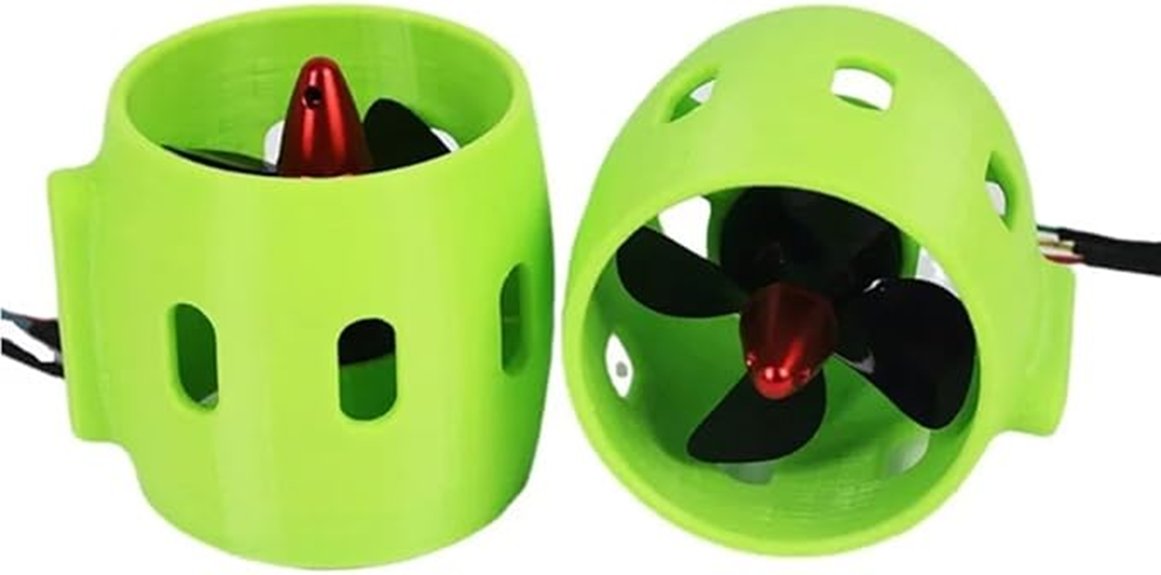
You’ll get a compact 300 KV brushless thruster that runs 12–24 V and outputs 30–200 W, suited for RC boats, small ROVs, and light commercial rigs. It’s aluminum with 304 stainless bearings, 74×75 mm, 162 g, 25 cm cable, and claims 2000 m depth. Thrust peaks near 24 V with matched props, current tops around 20 A, and efficiency favors mid-throttle. Expect simple mounting, sealing care, and tradeoffs in noise and long-term sealing; keep going for full test details.
Some Key Takeaways
- Compact brushless thruster delivers reliable 30–200 W performance for RC boats and small underwater robots.
- 300 KV motor runs on 12–24 V, offering predictable RPM response and easy speed control.
- Durable aluminum housing and 304 stainless bearings support submersion and long-term use to 2000 m.
- Peak thrust and efficiency depend on proper prop matching; expect up to ~20 A current draw under load.
- Watch sealing and thermal limits: use redundant O-rings, marine sealant, pressure-test, and limit sustained high-current runs.
Quick Verdict and Who This Thruster Is Best For
While small and robust, this brushless underwater thruster delivers reliable midrange power (30–200 W) for hobbyist and light-commercial projects, so you’ll get efficient propulsion for model ships, RC boats, and compact underwater robots. You’ll find it a compact choice when space and weight matter, fitting tight mounts without sacrificing durability. Its 12–24 V range and 300 KV motor give predictable response under variable loads, and the aluminum-alloy housing plus stainless bearings suit prolonged deployments. As a budget friendly option, it balances cost against performance, ideal for DIY modders, small-scale commercial trials, and upgrade packages where efficiency and reliability matter.
Real-World Specs Breakdown (Power, KV, Voltage, Depth, Dimensions)
Having outlined where this thruster fits, let’s analyze the real-world specs that determine on-water performance. You’ll see 300 KV matched to 12–24 V gives predictable rpm range; pair that with 30–200 W power scaling to select batteries and ESCs that keep current under the 20 A ceiling. The 162 g unit and 74×75 mm form factor constrain mounting options and hydrodynamic drag; cable length (25 cm) affects routing. Construction—aluminum alloy, 304 SS bearings—supports long-term submersion. Depth testing capability to 2000 m exceeds hobby needs but informs seal integrity and pressure rating for serious underwater work.
Performance Test Results : Thrust, Current Draw, and Efficiency
Because thrust, current draw, and efficiency are tightly interdependent, you’ll assess them together to determine real-world performance and battery/ESC sizing. You measured static thrust across voltages and props to produce a thrust curve; peak thrust approached the 30–200 W envelope near 24 V with matched polycarbonate props. Current draw tracked thrust linearly, maxing near 20 A under load. Efficiency peaked at mid-throttle where rpm stability was highest. Thermal behavior remained acceptable in short tests but rose under sustained high current, indicating cooling or duty-cycle limits. Prop matching proved critical: mismatched props degraded rpm stability, increased current, and reduced efficiency. For long-term reliability in marine environments, plan for corrosion-resistant components and carry appropriate patch materials for quick repairs.
Installation, Pairing (CW+CCW), and Waterproofing Tips
The thrust/current/efficiency data highlight how setup and sealing affect in-water performance, so you’ll want to follow methodical installation and pairing procedures to preserve those measured characteristics. Use rigid mounting brackets aligned to the thrust axis to minimize moment loads; torque fasteners to spec and verify concentricity. For CW+CCW pairs, confirm rotation direction on bench with low voltage and mark shafts before final assembly to avoid cavitation imbalances. Route and secure cables with strain relief; prioritize tidy cable management to prevent chafing and turbulence. Apply redundant O-rings, marine-grade sealant at penetrations, and pressure-test housings before deployment to 2000 m rating. Also consider carrying a compact bilge pump to manage any unexpected ingress during extended waterborne use.
Pros, Cons, and When to Buy This Lioaeust Thruster
While compact and rugged, this Lioaeust brushless underwater thruster delivers a focused value proposition: you get a 300 KV, 12–24 V motor capable of 30–200 W with materials and sealing designed for deep deployments (rated to 2000 m) that suit model boats, ROVs, and light commercial applications. Pros: high depth rating, compact footprint, stainless bearings and aluminum shell improve longevity; pair option supports balanced thrust. Cons: durability concerns center on long-term sealing under thermal cycling; prop PC may abrade. Noise levels are moderate; expect audible cavitation at high RPM. maintenance ease is good for hobbyists. Buy when you need a high-depth, cost-effective thruster in cost comparison to more expensive commercial units. Consider also essential gear for safer kayak deck line replacements when outfitting watercraft for extended adventures.
Some Questions Answered
Is a Speed Controller (ESC) Included With the Thruster?
No, an ESC isn’t included. You’ll need a separate speed controller matched to the thruster’s 12–24V and up to 20A ratings. Choose an ESC with waterproof electronics or enclose it in a waterproof housing; verify it supports brushless motors and the 300KV characteristic. Consider an integrated regulator only if you need stable auxiliary voltage for onboard systems, but confirm its compatibility and heat dissipation when operating near the thruster’s 200W limit.
Can I Replace the Propeller With Aftermarket Props?
Yes — you can replace the propeller with aftermarket props if they match shaft dimensions and mounting. Check aftermarket compatibility: hub bore, pitch, diameter, and balance must align with the thruster. Use compatible propeller materials (PC polycarbonate preferred) to maintain strength and corrosion resistance. Mismatched props can increase motor load, raise current toward the 20 A max, and reduce efficiency or cause bearing wear. Test incrementally and monitor temperature.
How Long Is the Manufacturer Warranty Period?
You’ll need to check with the seller or manufacturer; the product listing doesn’t specify a manufacturer warranty or warranty duration. Assume no explicit coverage until confirmed. For procurement, request written manufacturer warranty terms, duration, and claim procedure before buying. Verify whether warranty covers depth-rated failures, corrosion, or electrical faults. Keep purchase records and serial number to support any future warranty claim; document communications for dispute resolution.
Are Spare Cable Lengths or Connectors Available?
No official replacement cables or custom connectors are listed by the manufacturer, but you can source replacement cables and install custom connectors yourself. You’ll need 25 cm cable gauge matching the motor’s current (up to 20 A), corrosion-resistant marine wiring, and robust seals for waterproofing. For reliable performance, crimp stainless or tinned copper conductors, use heat-shrink plus epoxy at penetrations, and verify polarity and insulation before submersion.
Does the Thruster Support Reversible Motor Direction via ESC?
Yes — you can reverse the thruster’s motor direction via a suitable ESC. You’ll need an ESC that supports bidirectional control and programmable braking to manage direction changes and stopping behavior. Configure the ESC in your controller/software to enable reverse thrust and tune programmable braking to prevent abrupt torque spikes underwater. Make certain the ESC matches the motor’s 12–24V, 20A limits and waterproofing standards for reliable submerged operation.