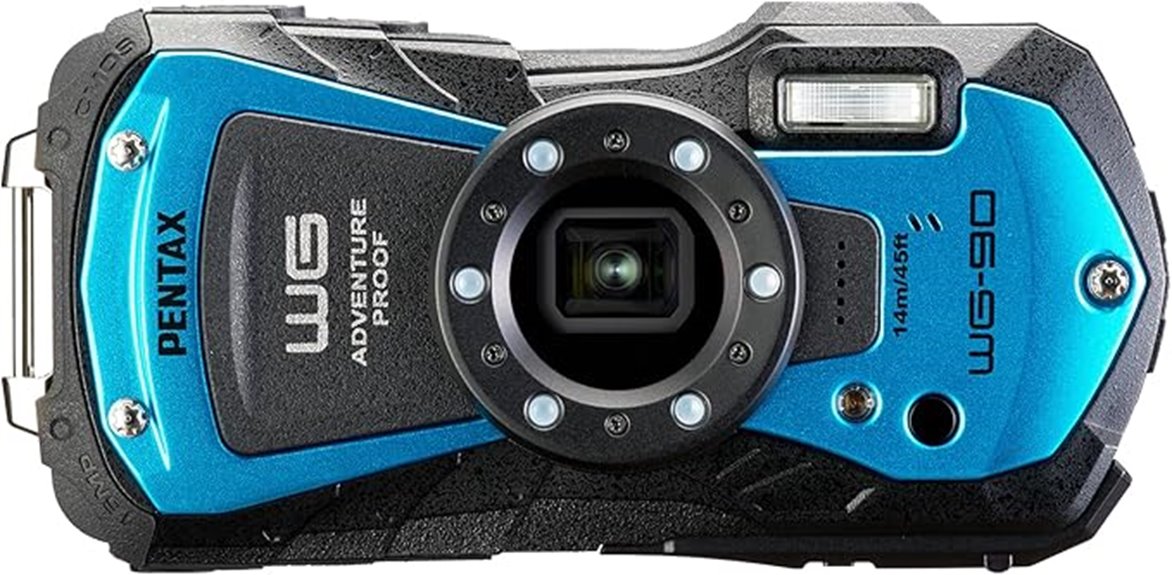
You’ll like the Pentax WG‑90 if you need a tough, take‑anywhere compact that favors reliability over low‑light finesse. It delivers crisp daylight JPEGs from a 16MP sensor, Full HD 30p video, and dedicated underwater, macro and microscope modes with practical tips for bracketing and lower ISO. It’s waterproof to 14 m, shockproof and freezeproof, with grippy controls and Wi‑Fi—battery life is modest so pack a spare. Keep going to see hands‑on tips and comparisons.
Some Key Takeaways
- 16 MP back‑illuminated sensor delivers accurate JPEGs and Full HD 1080p video, with clean results at moderate ISOs.
- Waterproof to 14 m, shockproof from ~1.6 m, and freezeproof to −10°C for serious rugged use.
- Underwater and Macro modes (six LED macro lights) improve color and close‑up results but can show reflections/backscatter.
- Compact 173 g body, tactile controls, Wi‑Fi, and ~2.5 hours battery life; bring a spare battery and float grip.
- Best for beginners and adventure travelers who prioritize toughness and simplicity over low‑light performance and zoom.
Performance Snapshot: Image Quality, Video, and Shooting Modes
While the WG‑90 won’t match larger-sensor cameras, it delivers solid everyday image quality: the 16 MP back‑illuminated CMOS and high‑performance engine produce clean results up to moderate ISOs (native sensitivity to ISO 6400) with good color and detail in well‑lit scenes. You’ll get reliable JPEGs, accurate color rendering in varied conditions, and usable Full HD 1080p video at 30 fps. Low light performance is limited by sensor size—expect noise at high ISOs—but the camera’s processing keeps images acceptable for casual use. Specialized modes (Underwater, Macro, Digital Microscope) add practical versatility without complicating shooting. For enthusiasts who handle their own gear, regular sensor maintenance with a quality cleaning kit helps preserve image quality and prevent spots from dust or moisture.
Built for the Outdoors: Waterproofing, Shock, Freeze, and Dust Resistance Tested
Built to handle rough conditions, the WG‑90 proves its outdoor claims in real-world tests: it survived full submersion to 14 meters for two hours, endured drops from about 1.6 meters without functional damage, and kept operating down to −10°C while resisting dust ingress. You’ll appreciate the thorough weather sealing and sturdy exterior; seals and locks feel robustly engineered. Impact testing showed no operational faults after repeated tumbles, and controls remained responsive with gloved fingers. Battery and image systems kept working under cold stress. For serious outdoor use, the WG‑90 delivers predictable, rugged performance with minimal compromise. Consider adding a dedicated camera rain cover to protect other lenses and accessories when shooting in heavy, prolonged wet conditions.
Macro, Underwater, and Microscope Modes: Real-World Shooting Examples and Tips
Plunge into the WG‑90’s specialty modes and you’ll quickly see how they reshape difficult close‑range and underwater scenes into usable, detailed images. You’ll use Macro for insects and textures; six LED macro lighting yields even macro lighting but watch reflections on wet subjects. In Underwater mode color and contrast get boosted—frame with negative space and foreground interest to improve underwater composition. Microscope mode pulls fine detail from small surfaces; steady hands or a tripod help since shutter tops at 1/30. Expose carefully, favor lower ISO for detail, and bracket shots when color shift or backscatter threaten image clarity. Keep silica gel packets in your camera bag to protect gear from moisture and prevent corrosion.
Ergonomics, Battery Life, Connectivity, and Mounting for Field Use
Because you’ll often handle the WG‑90 in wet, cold, or cramped conditions, its control layout and weight distribution matter as much as specs: the compact, grippy body and tactile buttons let you operate the key modes—Macro, Underwater, Movie—without fumbling, and the 173 g camera plus a 79 g battery keeps handheld fatigue low during multi‑hour shoots. You’ll appreciate grip comfort with gloved use and the textured back for stable framing. Power management is straightforward: a single lithium‑ion cell gives about 2.5 hours; bring a spare for extended outings. Wi‑Fi and a video‑out port simplify transfers and external monitoring. A lightweight float grip can improve handling and buoyancy during wet-field shoots.
Who Should Buy the Pentax WG-90 and How It Compares to Alternatives
Having covered ergonomics and battery life, let’s look at who should pick the WG‑90 and where it stands against rivals. You’ll want this if you’re beginners travelers or budget adventurers needing a rugged, waterproof compact that survives drops, cold and dust. Its 14m waterproofing, freezeproof and shockproof design, plus underwater modes and macro LEDs, suit active use more than image‑centric work. Compared to pricier rugged compacts, it trades low‑light finesse and zoom range for toughness and simplicity. If you need Wi‑Fi, Full HD video and reliable survival in harsh conditions, the WG‑90 is a pragmatic choice. It’s also ideal for photographers seeking guidance on protective gear, such as waterproof camera housings, to keep equipment safe during wet and rugged outings.
Some Questions Answered
Does the WG-90 Support RAW Image Capture?
No, it doesn’t support raw capture. You’ll get JPEG as the primary file format, with MP4 for video, meaning the sensor output is processed in-camera into ready images. That limits post-processing options since you can’t access unprocessed sensor data. You can still optimize JPEG shooting settings and use high ISO and imaging engine features, but if you need full raw processing options and maximum dynamic control, this model won’t provide them.
Can the Camera Accept External Lenses or Filters?
No — you can’t attach interchangeable external lenses to the WG-90; it uses a fixed 5x optical zoom lens. You can, however, use small accessory systems: some dedicated lens adapters exist for conversion filters and close-up attachments, but they’re limited. There’s no standard filter threads on the barrel for traditional screw-on filters, so third-party adapter housings or proprietary mounts are required. Verify compatibility before buying to avoid fit or waterproofing issues.
Is There Any Built-In GPS or Geotagging Feature?
No, it doesn't have built in geotagging or a GPS sensor, so you won't get onboard location stamps. You can add location via Wi‑Fi pairing with a smartphone app that supplies coordinates, but GPS accuracy then depends on your phone. That method works for basic geotagging but isn't as seamless or precise as integrated GPS. Overall, expect reliable location tags only when your phone's GPS has good reception and accuracy.
Does It Have Interval Shooting or Time-Lapse Functionality?
No, it doesn't offer a dedicated interval shooting mode, so you can't rely on built-in interval shooting for automated sequences. You can still create time lapse techniques manually by using continuous shooting (30 FPS bursts) or shooting single frames with manual timing via self-timer, but that's cumbersome and less precise. If you need true interval control for long-term time lapse, you'll want an external intervalometer or a camera with native interval shooting.
What Warranties and Repair Services Are Available Internationally?
You’ll get a limited warranty from the manufacturer covering defects in materials and workmanship; terms vary by country and typically exclude water damage from misuse. For international repairs you’ll use authorized service centers; coverage and turnaround depend on local policies and proof of purchase. You’ll pay for out-of-warranty repairs and shipping. Check Ricoh/Pentax regional warranty coverage and service centers before travel to confirm authorized repair options and exact warranty coverage limits.