You’ll find the Canon EOS Rebel SL3 gives you a compact, user‑friendly DSLR with a 24.1MP APS‑C sensor, DIGIC 8 speed, and a vari‑angle touchscreen that’s great for vlogging and travel. Stills show crisp detail and reliable JPEGs; high‑ISO and shadow recovery are competent but not class‑leading. Dual Pixel AF is steady in Live View; 4K is limited by a 1.6× crop and narrower AF coverage. Battery life and frame rates are modest — more specifics follow.
Some Key Takeaways
- 24.1MP APS-C sensor and DIGIC 8 deliver crisp images and reliable JPEGs with accurate color, good detail at base ISO.
- Dual Pixel CMOS AF and touchscreen provide fast Live View focusing and intuitive tap-to-focus recomposition.
- UHD 4K/24p video works but uses a 1.6x crop and has limited AF coverage and frame-rate options.
- Compact vari-angle body suits vloggers and travel shooters, though battery life and continuous shooting are modest.
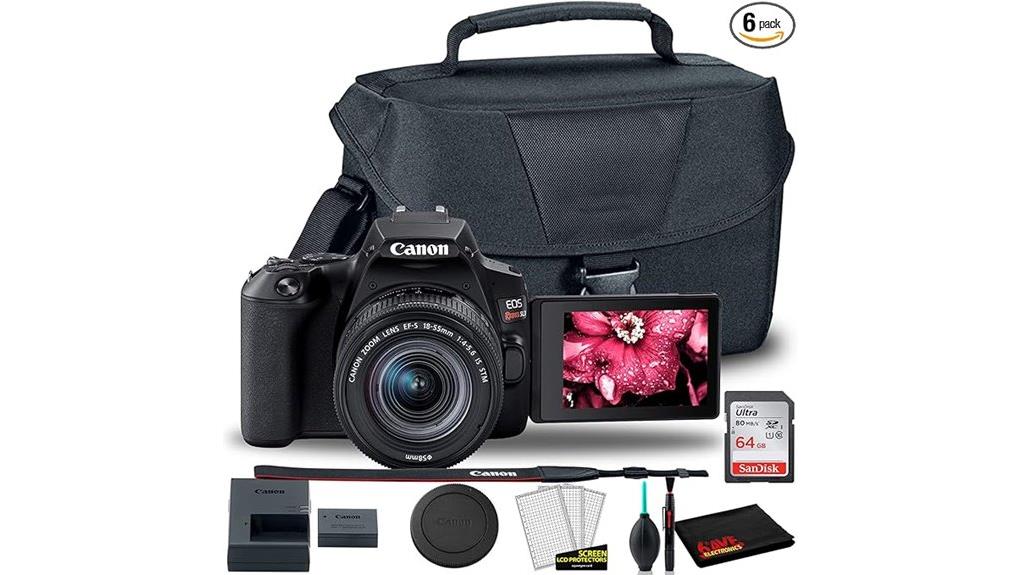
- Good starter kit includes 18–55mm lens, 64GB card, bag; add spare batteries and stabilization for serious video.
Canon EOS Rebel SL3 At a Glance : Key Specs and What’s in the Box
While compact and aimed at enthusiasts stepping up from a smartphone, the Canon EOS Rebel SL3 packs a 24.1 MP APS-C CMOS sensor and DIGIC 8 processor to deliver sharp stills and responsive handling. You get a 3.0" vari-angle touchscreen, UHD 4K at 24p, and sensible ergonomics that balance portability with usable controls. Included kit accessories—18‑55mm lens, EOS bag, 64GB SanDisk, clean kit—cover starter needs. Build quality is plasticky but well-assembled; grips feel secure. Battery life is modest for travel shoots. Price point sits competitively for beginners seeking DSLR features without excess complexity. For mirrorless camera enthusiasts, consider complementary accessories like spare batteries and protective cases to enhance your shooting experience and gear longevity essential gear.
Image Quality and Performance: 24.1MP Sensor, DIGIC 8, and Real‑World Results
Having covered the SL3's handling and kit, let’s look at how its 24.1MP APS-C sensor and DIGIC 8 engine combine in real-world shooting. You’ll get crisp 24MP files with accurate color and fine detail at base ISO; high-ISO noise control is competent rather than class-leading. Low‑light performance benefits from DIGIC 8’s noise reduction, yet shadow recovery shows limitations in aggressive pushes. In daylight the sensor delivers clean tonal gradation; a dynamic‑range comparison against newer sensors favours competitors with wider latitude. Overall image quality is reliable for enthusiasts; expect solid JPEGs straight from camera and usable RAWs with conservative processing. For the best on-screen evaluation of these results, consider calibrating your monitor using calibration tools to ensure true-to-life photo rendition.
Autofocus, Shooting Speed, and Handling: Touchscreen, Vari‑Angle Body, and Controls
Because Canon pairs a compact, vari-angle touchscreen with a straightforward control layout, you’ll get a hands-on shooting experience that’s both flexible and efficient. Autofocus uses Dual Pixel CMOS AF for reliable subject acquisition in Live View and through the touchscreen responsiveness you’ll tap to focus and recompose quickly. Continuous shooting tops out modestly; you’ll capture action but won’t match pro sports rigs. Vari angle ergonomics let you frame low or high comfortably, and buttons are logically placed for one-handed adjustments. Controls feel aimed at enthusiasts: precise, accessible, and balanced against the SL3’s compact footprint and performance limits. This kind of handling pairs well with stable support when using tripod heads for improved composition and steadiness.
Video and Creative Features: UHD 4K, Time‑Lapse, and Vlog‑Friendly Tools
The SL3's responsive touchscreen and vari‑angle body carry over into video work, where Canon packs a useful set of creative tools despite a few practical limits. You get UHD 4K at 24p for sharp footage, but note the 1.6x crop and modest autofocus coverage when framing. DIGIC 8 enables reliable exposure and decent low‑light performance; bitrate and rolling shutter are conservative. Built‑in 4K time‑lapse movie functions simplify interval shooting without post stacking. For vlogging, the flip screen, mic input and compatibility with common Vlogging accessories make setup straightforward, though external stabilization improves handheld results. Consider pairing the SL3 with an external camera monitor to enhance framing, focus accuracy, and on-set monitoring.
Who Should Buy the SL3? Use‑Case Recommendations, Pros/Cons, and Alternative Options
If you want a compact, entry‑level DSLR that balances stills and basic 4K video without a steep learning curve, the SL3 is a strong choice: its 24.1 MP APS‑C sensor and DIGIC 8 deliver clean images and responsive autofocus for everyday shooting. You’ll appreciate the vari‑angle touchscreen and included 18–55mm kit for vlogging and travel. Ideal for beginner vloggers and travel photographers who want DSLR ergonomics, simple menus, and long battery life. Cons: 4K crops and limited frame rates, modest autofocus in 4K. Alternatives: mirrorless EOS M/M50 series or used older full‑frame bodies for low‑light needs. For carrying and protecting your gear on shoots, consider essential DSLR accessories like sturdy camera bags to match the SL3’s travel-friendly design.
Some Questions Answered
Does the SL3 Have Built‑In Wi‑Fi and Bluetooth for Smartphone Pairing?
Yes — the SL3 supports Wi‑Fi pairing and Bluetooth connectivity for smartphone pairing. You’ll use Bluetooth for constant low‑energy link and quick remote shutter connections, and Wi‑Fi pairing for higher‑speed image transfer and remote Live View. The Canon Camera Connect app manages both; Bluetooth establishes initial pairing while Wi‑Fi handles bulk transfers or 4K preview needs. It’s reliable for casual tethering, though advanced studio workflows may demand faster wired solutions.
What Is the Battery Life in Cipa-Rated Shots per Charge?
You get about 1,070 CIPA‑rated shots per charge. You’ll find the battery longevity solid for a compact DSLR, and shooting endurance suits travel or event work without frequent swaps. With DIGIC 8 efficiency and moderate LCD/touch usage, real‑world counts may vary; heavy Live View or 4K video will cut endurance substantially. Bring a spare for long days or intensive video sessions to avoid interruptions.
IS the 18‑55mm Lens Image‑Stabilized (IS)?
Yes — the standard 18‑55mm kit lens includes image stabilization (IS). You’ll get Canon’s optical IS for handheld stills and video at normal focal lengths, though performance varies across lens variants and shooting conditions. It steadies low‑light and slower‑shutter shots effectively but won’t match in‑body stabilization systems. For critical work, consider higher‑end stabilized zooms or primes; for general use, the kit IS is a practical, capable solution.
Can the SL3 Accept External Microphones and Headphones Simultaneously?
Yes — you can connect an external mic but there’s no headphone jack on the body, so you can’t monitor and record simultaneously directly. You’ll plug an external mic into the camera’s 3.5mm input for better audio, but you’ll need an external recorder or a different camera/interface if you require live headphone monitoring. This limits on-camera audio monitoring workflows despite improved capture via the external mic input.
Does It Support Intervalometer/Remote Shutter Control Natively?
No, it doesn’t offer a built‑in external intervalometer function; you’ll need remote control to run interval shooting. The SL3 supports wired and compatible wireless third‑party remotes via its remote terminal and Bluetooth/Wi‑Fi features, but Canon’s native interval timer is limited compared with higher models. You can use an external intervalometer or third‑party remotes to achieve reliable interval shooting; verify compatibility and firmware before purchase.