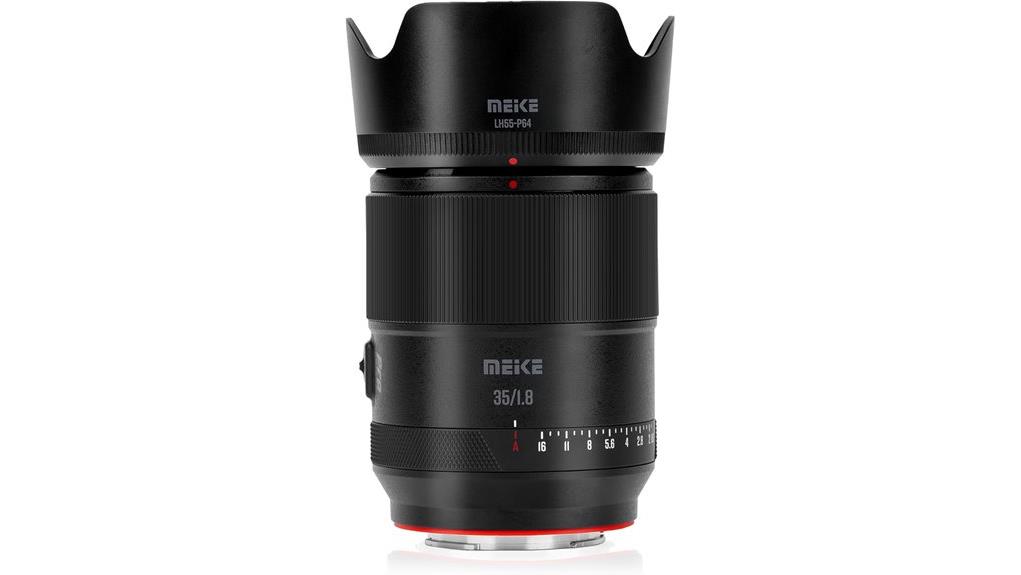
You’ll find the Meike 35mm f/1.8 AF STM is a compact, well-built Sony E-mount prime that gives you fast f/1.8 low-light performance, strong center sharpness, and creamy nine-blade bokeh. Autofocus is quiet and generally reliable on A7/A9 and select APS-C bodies, though occasional calibration may help. It lacks in-lens stabilization but benefits from sensor IS and firmware updates via Type‑C. It’s an excellent value for students and creators—keep going to see detailed tests and caveats.
Some Key Takeaways
- Fast f/1.8 aperture delivers strong low-light performance and smooth nine-blade bokeh, ideal for portraits and street use.
- Sharp center performance wide-open; edges improve by f/4–f/5.6 while corners remain softer at f/1.8.
- STM stepping motor provides quiet, smooth autofocus for photo and video, with occasional focus errors fixable via in-camera calibration.
- Solid metal construction and compact balance make it a durable, travel-friendly lens with a smooth focus ring.
- Affordable alternative to name-brand 35mm primes, firmware-upgradeable via Type-C, with one-year warranty and good value for enthusiasts.
What the Meike 35mm F1.8 Is and Which Sony Cameras It Fits
When you pick up the Meike 35mm F1.8, you get a compact wide-angle prime designed for Sony E-mount mirrorless bodies, offering fast f/1.8 performance and smooth background blur. You’ll find it's a full-frame AF STM lens that balances size and capability, giving you handheld comfort and low-light reach. Compatibility spans Sony full-frame A7/A9 series and select APS-C bodies like the A6000 line and ZV-E10 models, so you can swap bodies without losing focal identity. Mount variants are limited to Sony E, so check mount compatibility before buying; firmware updates keep autofocus reliable. It's a solid choice for enthusiasts building essential gear for mirrorless cameras mirrorless camera enthusiasts.
How the Lens Performs Optically: Sharpness, Bokeh, and Aberrations
Although modestly priced, the Meike 35mm F1.8 delivers impressively crisp center sharpness at wide apertures and cleans up toward the edges by f/4–f/5.6, so you'll get usable resolution for portraits and everyday shooting without stopping down excessively. You’ll notice good micro contrast that gives images pleasing midtone separation and punch. Chromatic control is solid thanks to extra-low dispersion elements and coatings, keeping lateral fringing minimal. Backgrounds render with a creamy bokeh and smooth gradations, aided by the 9-blade diaphragm. Edge sharpness is acceptable for the class once stopped down, though very wide-open corners remain softer than the center. This lens is a good option for photographers building a kit focused on portrait camera lenses and everyday versatility.
Autofocus, Stabilization, and Firmware: Real-World Reliability and Update Notes
Because Meike equipped the 35mm F1.8 with an STM stepping motor, you'll get quiet, smooth AF that's well-suited to both stills and video, with noticeably reduced hunting compared with older entry-level kits. In practice, autofocus is accurate on supported Sony bodies, though occasional front/back errors can appear on some copies; a quick focus calibration in-camera usually fixes them. Stabilization relies on your camera’s sensor-based IS (digital options only on some models), so don't expect in-lens IS. Firmware updates via Type-C improve compatibility; keep downloads from Meike's site handy in case you need firmware rollback after a problematic update. Handheld gimbal users will appreciate pairing the lens with a gimbal stabilization workflow to maximize smooth footage.
Build, Handling, and Shooting Use-Cases: Street, Portraits, Low Light
Having covered autofocus and firmware behavior, let's look at how the Meike 35mm F1.8 feels and performs in real shooting scenarios. You’ll appreciate its solid metal build and smooth focus ring; weight is balanced for compact handling and long walks. On the street it’s discreet, supports urban storytelling with natural perspectives and reliable AF for fast candid moments. For portraits you’ll get pleasant bokeh and nine-blade rendering at f/1.8 that flatters subjects. In low light the wide aperture and STM system keep shots usable and quiet for night portraits. Controls are straightforward, letting you concentrate on framing and timing. This makes it a practical choice for photographers who need durable, travel-friendly gear with consistent performance and tripod compatibility.
Value Verdict: Price, Warranty, and Who Should Buy This Lens
While it undercuts many name-brand 35mm primes on price, the Meike 35mm F1.8 still gives you a lot for the money: solid metal construction, a fast f/1.8 aperture, quiet STM autofocus, and firmware support via Type‑C, all backed by a one-year manufacturer warranty and typical retailer return options. For a budget comparison, it’s hard to beat the combination of optical elements and upgradeable firmware at this price. You should buy it if you’re a student, hobbyist, or content creator seeking value over flagship refinements. Pros who need ultimate sharpness or native-brand service might look elsewhere. Many photographers find that mastering zoom lenses improves overall technique and composition, and this lens can help with that learning curve by offering consistent performance and handling composition skills.
Some Questions Answered
Does This Lens Support Full-Time Manual Focus Override?
No — it doesn’t offer true full-time manual override. You can switch to manual focus and use the focus ring for fine adjustments, but the lens lacks a dedicated full-time override clutch. You’ll rely on the camera’s focus aid (peaking or magnification) for precision when adjusting AF-driven focus. If autofocus malfunctions, updating firmware may help; otherwise you’ll manually control focus via the ring with camera-assisted focus aid features.
Can I Use Filters on the Front Element, and What Filter Size?
Yes — you can use filters on the front element; the lens has filter threads. You’ll screw on standard threaded filters for creative filters and color effects to alter mood or correct color. Using screw-on polarizers, ND, or colored gels works fine; just watch vignetting at wide apertures on full-frame. Thread size isn’t listed here—check the lens barrel or product spec for the exact mm size before buying filters.
Is the Lens Weather-Sealed or Moisture-Resistant?
No, it’s not weather-sealed. You shouldn’t expect full weather sealing or enhanced moisture-resistant construction with this lens. The build materials are mostly standard plastics and metal mounts, so it’s durable for everyday use but not rated for heavy rain or dusty conditions. If you’ll shoot in wet or harsh environments, you’ll want additional protection like a rain cover or a fully weather-sealed lens/body combo to avoid damage and maintain reliability.
Does the Lens Come With a Carrying Pouch or Hood Included?
No, the lens doesn’t include a dedicated hood or carrying pouch in the standard retail packaging; included accessories typically consist of the lens, front/rear caps, and documentation. You’ll want to buy a compatible hood or protective pouch separately if you need extra protection or flare control. That said, check the specific retailer listing—some sellers bundle third‑party hoods or cases, and returns/warranty terms still apply through Meike and the retailer.
Are There Third-Party Accessories or Adapters Recommended for This Lens?
Yes — you can use third-party grips, lens hoods, filters and adapters to improve handling and versatility; just check Sony E compatibility. You’ll want a quality UV/ND/PL filter and a dedicated lens hood for contrast and flare control. If you use electronic adapters, verify they support AF and don’t interfere with firmware updates. Keep firmware updates current to fix AF issues; third party grips should avoid blocking USB-C for future updates.