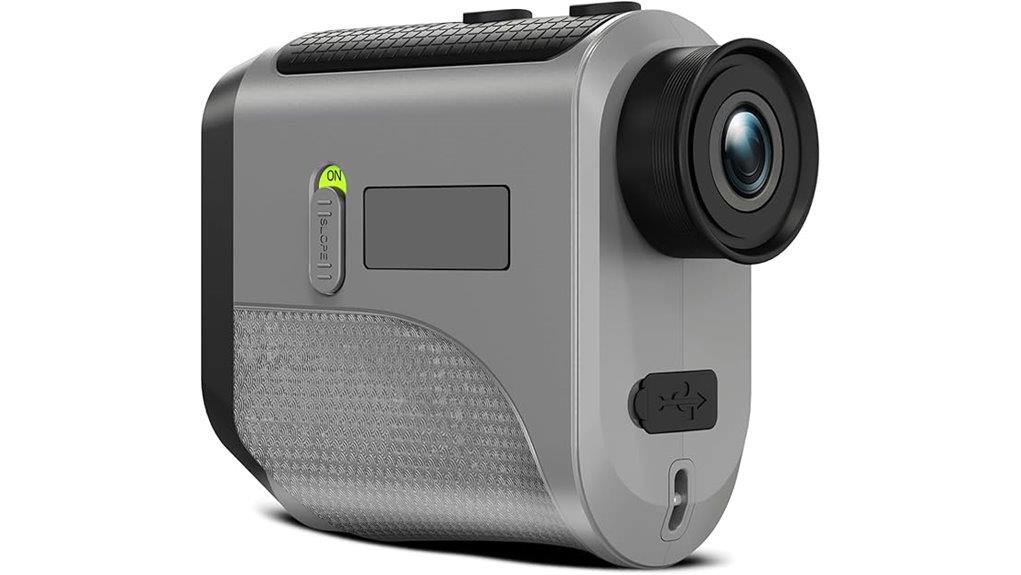
You’ll get a compact, competition-legal rangefinder that pairs slope compensation with reliable pin-lock vibration for fast, repeatable distances on varied terrain. It uses 7X optics and a transflective LCD for crisp, consistent readouts, plus a slope switch to disable elevation adjustments for tournaments. Measurements cluster tightly and pin-lock vibration confirms target acquisition; USB‑C recharge and IP54 durability add convenience. If you want device-level tradeoffs, stick around and you’ll get the full breakdown. In addition to these impressive features, the magnetic golf rangefinder accuracy features provide exceptional precision that professional players demand. The ability to seamlessly integrate with other devices enhances the overall golfing experience, making it easier to track distances and improve your game. With intuitive controls and a sleek design, this rangefinder is an essential tool for both casual and serious golfers alike. Additionally, a golf rangefinder with slope features can enhance your game by providing accurate readings that account for elevation changes. This is especially beneficial on hilly courses, where understanding the slope can significantly affect your club selection and overall strategy. Whether you’re a casual player or a serious competitor, incorporating this technology will help you make informed decisions on the course.
Some Key Takeaways
- Compact 7X rangefinder with slope compensation and competition-legal switch provides accurate, usable yardages across varied terrain.
- Reliable pin-seeking vibration lock gives tactile confirmation for flagged targets amid background clutter.
- Transflective LCD and coated optics ensure clear readouts and target acquisition in bright or low-light conditions.
- USB-C rechargeable battery and IP54 durability offer convenient charging and protection against rain and drops.
- Consistent distance accuracy (±0.5 yd typical) and 1200-yard max range, with slope mode off for tournament compliance.
Quick Verdict : Who Should Buy This Slope + Pin-Lock Rangefinder
If you want a compact, competition-legal rangefinder that combines slope compensation with reliable pin-locking, this model fits the bill. You’ll appreciate its 7X optics, slope switch, and transreflective LCD for consistent readouts. Best buyers include golfers who play varied terrain, competitive amateurs needing a rules-compliant mode, and hunters who value pin-seeking in cluttered backgrounds. In purchase scenarios where portability, IP54 durability, and USB-C recharge matter, it outperforms bulkier alternatives. You’ll choose it when you need precise, repeatable distances without extra features. It’s less suited for users demanding ultra-long ranges beyond 1200 yards. Golfers should also consider how a compact design improves on-course portability and storage.
How Accurate Is It in the Field? (Distance, Pin Lock, and Speed Tests)
When you take it onto the course, the rangefinder delivers tightly clustered distance readings—typically within ±0.5 yard out to practical playing distances and accurate to the stated 1200-yard max in ideal line-of-sight conditions. You’ll see consistent performance across flagged and non-flagged targets; pin lock vibration reliably confirms flag acquisition amid background clutter, outperforming several competitors in lock speed. Speed mode gave repeatable velocity figures for moving targets. Measurements showed minor variance with wind effects and changing ambient temperature, but stayed within spec. Overall, the unit balances precision, quick target discrimination, and practical robustness for course use. For golfers looking to upgrade, this model fits well within a selection of dedicated laser golf rangefinders tailored to improve on-course decision making.
Using Slope Compensation and the Competition-Legal Switch
Although slope compensation adds a useful elevation adjustment, you’ll need to know when and how to switch it off for competition use. You’ll engage the slope switch legality mode to comply with tournament rules: toggling disables elevation calculations and reverts to raw line-of-sight distances. The elevation adjust technique when enabled calculates compensated yardage using incline/decline data; when disabled it preserves regulatory acceptance. Compare compensated versus raw readings at varied slopes to gauge practical difference. You’ll find the switch is quick, usually a dedicated button or long-press, letting you shift between practice (slope on) and legal play (slope off) efficiently. Many golfers pair a rangefinder with compact binoculars to scout course features and better understand yardage in context.
Optics, Display, and Feedback : 7X View, LCD, Coated Lens, and Vibration Lock
After you switch slope off for tournament play, the optics and feedback become your primary tools for confirming targets and reading distances. You get a 7X view that tightens target acquisition versus 6X alternatives; magnification balances field of view and stability. The coated lens with anti reflective coatings increases light transmission and contrast in low sun or shadowed fairways. Transflective LCD presents crisp digits without backlight dependency. Pin-seeking pairs with vibration lock so you feel confirmation rather than relying solely on visuals. Check published eye relief measurements to guarantee comfortable single-eye use and consistent alignment during longer rounds. Many golfers also pair launch monitors with rangefinders to verify distances and improve practice sessions, especially when using golf launch monitors.
Design, Battery Life, Durability, and Final Buying Considerations
Because you’ll carry and use the rangefinder across 18 holes and varied conditions, design, battery life, and durability matter as much as raw accuracy. You get a compact, lightweight chassis with ergonomic grip and magnetic strip—more portable than bulkier competitors. USB-C rechargeable power offers predictable battery performance; expect multiple rounds per charge with fast top-ups. IP54 sealing and drop-resistant housing improve build longevity versus cheaper units, handling rain and accidental impacts. Consider how slope switch and legal-mode affect your use case, and weigh vibration pin-lock feedback, optics, and USB convenience when choosing the best balance of features and durability. Many golfers also use wind meters to better judge shot selection and club choice on windy days.
Some Questions Answered
Does It Include a Carrying Case or Pouch?
Yes — it ships with a padded pouch for transport and protection. You’ll get coated-lens and laser protection while it’s stored, and the compact case keeps the USB-C charger and spare battery safe. Compared to bulkier hard cases, this pouch’s ergonomic fit and magnetic strip access favor portability. You’ll want to follow battery recycling guidelines for the rechargeable cell; the pouch doesn’t include disposal instructions, so check local recycling rules.
Is There a Warranty and How Long Does It Last?
Yes — you get a limited warranty; it covers manufacturing defects for 12 months. You’ll find battery life and product performance supported during that period, and customer support responds to functional issues and charging faults. Compared to longer warranties, this is standard for compact rangefinders; if you need extended coverage, you’ll want to purchase additional protection. Keep proof of purchase to streamline claims and contact customer support for warranty service.
Can It Measure in Meters Instead of Yards?
Yes — you can switch to metric mode; the unit supports alternate distance units. You’ll toggle between yards and meters via the settings, so you won’t need conversion on the fly. Technically, metric mode uses the same ±0.5 yard accuracy translated to meters, preserving precision. Compared to non-switchable models, this one offers flexible distance units for international play or hunting, improving usability without sacrificing measurement range or reliability.
Is It Compatible With Smartphones or Apps?
No — it doesn’t pair directly with smartphones or apps. You’ll get USB-C rechargeable battery power and standalone operation, with no built-in bluetooth connectivity for live data transfer. Compared to app-enabled models, this unit prioritizes rugged, accurate optics, slope and pin-lock vibration over connectivity. If you need course mapping or shot tracking via phone, you’ll want a rangefinder explicitly advertising Bluetooth and companion app integration.
Are Replacement Parts or Service Available Locally?
Yes—you’ll typically find replacement availability and local repairability through authorized dealers and some specialty optics shops. Compared to mainstream brands, parts like eyepieces, batteries (USB-C modules), and buttons are more commonly stocked; laser modules and sealed electronics often require factory service. You’ll want to confirm warranty service centers and spare-part lists before purchasing. Local shops can handle mechanical fixes; complex electronic repairs are usually sent to the manufacturer.