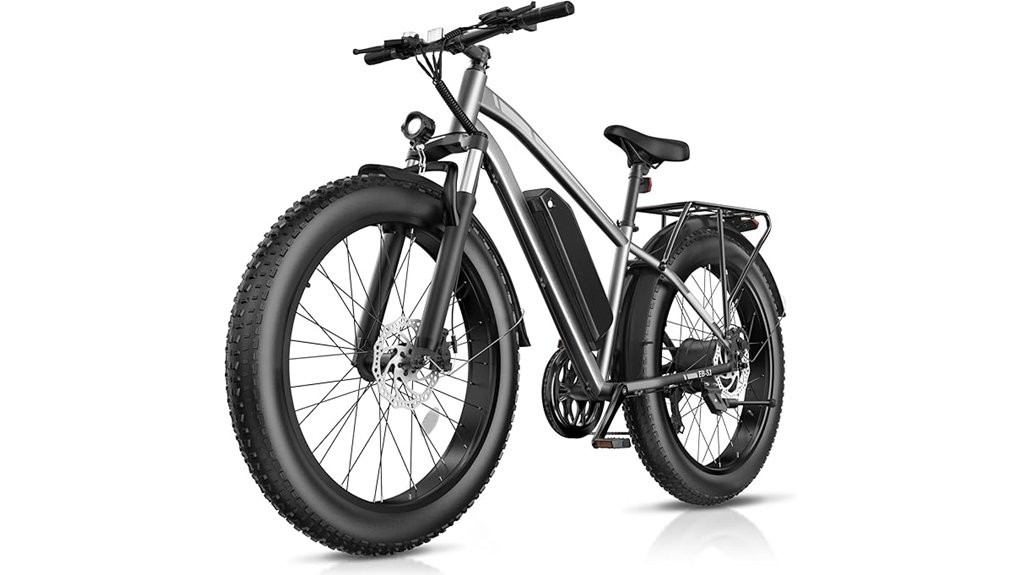
The Loeook EB‑S1 is a rugged 68.3 lb fat‑tire e‑bike with a 500W continuous (1,000W peak) hub motor that favors steady, high‑torque cruising over nimble handling. You’ll hit about 20 MPH in ideal conditions and see ~28–30 miles full‑electric or 55–60 miles with pedal assist depending on terrain and effort. Throttle use and hills raise consumption and heat; battery is removable IPX5. Keep going and you’ll get detailed takeaways on fit, components, and trade‑offs.
Some Key Takeaways
- Powerful 500W continuous (1,000W peak) hub motor offers high-torque cruising and a booster mode for steep, low-speed climbs.
- Real-world range ~28–30 miles full-electric, and 55–60 miles with pedal assist, depending on terrain and rider input.
- Heavy 68.3 lb frame and 26″×4.0″ fat tires favor stable, momentum-focused rides across snow, sand, gravel, and pavement.
- Removable IPX5 battery, five PAS levels, throttle, integrated lights, rack, and 7-speed drivetrain support versatile commuting/adventure use.
- Tradeoffs: conservative thermal management, firm braking effort, limited display customization, and only a 1-year warranty.
Performance and Range Tested: Real-World Speed, PAS, and Battery Life
Although the EB-S1’s specs claim a 20 MPH top speed and 55–60 miles on pedal-assist, real-world testing shows those numbers depend heavily on mode, terrain, and rider input. You’ll see 20 MPH only in favorable conditions with throttle or high PAS; full-electric range drops to ~28–30 miles. Measured consumption rises on hills and soft surfaces, accelerating battery degradation if you habitually run high power or fast charging. Throttle cutoff engages under overcurrent or low-voltage protection, preserving cells but interrupting propulsion. Overall, expect variable performance: efficient in PAS economy, punitive when using throttle or demanding terrain. For riders who do a lot of off-road miles, choosing the right replacement ebike battery can make a significant difference in range and longevity.
Handling and Comfort: Ride Feel, Suspension, Brakes, and Fat-Tire Traction
Kick into berms or plow through sand—the EB-S1’s heavy 68.3 lb frame and 26″ x 4.0″ fat tires give it a planted, momentum-focused ride that favors stability over nimble responsiveness. You’ll feel compliant traction from the fat tires; they absorb chatter and improve float on soft surfaces. The front suspension fork provides limited travel—good for bumps, not big drops—so you should manage speed accordingly. Dual disc brakes deliver predictable stopping power but require firm lever input due to weight. Seat comfort is adequate for medium rides; consider a thicker saddle for long days. Handlebar vibration is damped but noticeable at higher speeds. Built for outdoor riders who prioritize rugged trails and soft-surface capability, the EB-S1 pairs well with fat eBike tires designed for adventure.
Build, Components, and Features: Motor, Drivetrain, Display, Lights, and Accessories
Tap into the EB-S1’s powertrain and you’ll notice it’s built for steady, high-torque cruising rather than sprinty acceleration: a 500W continuous (1,000W peak) brushless hub motor pushes the 68.3 lb frame to a 20 MPH top speed while supporting throttle and five PAS levels, plus a Booster mode for low-speed climbing. You’ll monitor motor heat via conservative power delivery; thermal management is adequate but heavy use raises temperatures. The 7-speed drivetrain and twist shifter shift cleanly. Cable routing is tidy along the frame. Display customization is limited but clear. Saddle comfort is average; accessories include rack, fenders, integrated lights. This setup suits riders who want reliable off-road performance with high-performance ebike motors and durable components.
Who This Ebike Is For: Commuting, Off-Road, Snow/Sand, Rider Height and Weight Limits
When you need a versatile, heavy-duty ride for mixed commuting and off-road use, the Loeook EB-S1 fits those needs: its 500W continuous (1,000W peak) hub motor, 26″ x 4.0″ fat tires, front suspension, and 7-speed drivetrain deliver stable traction and torque across pavement, gravel, snow, and sand while the throttle and five PAS levels let you choose pedal-assist intensity for range versus speed. You’ll get solid commuter practicality for city streets and light cargo, excellent terrain adaptability on soft or loose surfaces, clear height compatibility for 5’3″–6’1″ riders, and firm weight restrictions at a 330 lb max load. The bike also pairs well with a variety of fat tire ebike gear useful for outdoor riders.
Pros, Cons, and Buying Verdict: Warranty, Assembly, Price Considerations, and Who Should (or Shouldn’t) Buy
Although the EB-S1 packs strong specs for mixed-terrain riding, you should weigh its trade-offs—especially warranty coverage, assembly demands, and price—before buying. You’ll get robust range, 1000W peak power, fat tires, integrated lights and rack—good for commuting and off-road. Pros: versatile assist modes, removable IPX5 battery, UL certifications. Cons: 1-year warranty limitations may leave you exposed on electronics and frame after first year; assembly complexity (85% pre-assembled) still requires tools and mechanical skill. Verdict: buy if you’re mechanically competent and need rugged versatility; skip it if you want long-term warranty peace of mind. Consider also securing your battery with an ebike battery lock when taking the EB-S1 on outdoor adventures.
Some Questions Answered
Does the Ebike Support Pedal Power Meters or Cadence Sensors?
No — it doesn’t natively support cadence compatibility or power meter integration via standard sensor inputs. You’ll rely on the bike’s factory PAS, throttle, and LCD readouts only; there’s no documented ANT+ or Bluetooth sensor port or crank-based power interface. You can retrofit third-party cadence sensors or pedal-based power meters independently, but they won’t integrate with the onboard display or controller without custom wiring or a separate head unit that supports sensor pairing.
Can I Install a Child Seat or Tow a Trailer?
Yes — you can install a child seat and tow a trailer, but with limits. Child seat compatibility depends on rear rack strength and 330 lb max load; use a rack-mounted seat rated for e-bikes and follow weight distribution rules. For Trailer towing, guarantee trailer tongue attaches to axle or rack and keep combined weight under the bike’s payload. Verify brake capacity, secure wiring, and consult manufacturer for explicit approvals and mounting hardware specifications.
Is the Bike Compatible With 3rd-Party Racks or Panniers?
Yes — you can fit many 3rd-party racks and side panniers, but check mounting and weight. The included heavy-duty rear rack provides standard rack eyelets and platform spacing, so you’ll be able to attach most pannier hooks and trunk bags. Verify pannier rail compatibility and clearances for fat tires and fenders. Respect the 330 lb max load and rack weight limit; use robust hardware and torque settings to avoid frame or rack failure.
Are Replacement Batteries or Charger Models Available Separately?
Yes — you can buy replacement batteries and replacement chargers separately. You’ll want the OEM 48V 13Ah lockable pack or a certified equivalent that meets UL 2271; chargers should match voltage/current specs and compliance. Check battery warranties: the bike includes a 1-year warranty, but aftermarket cells may void that. Inspect connectors, IP rating, and manufacturer support; prioritize UL-certified parts to guarantee safety and longevity.
What Theft-Deterrent Features or Serial Number Registration Exist?
The bike doesn’t include built-in GPS tracking or formal serial registration service; you’ll rely on the stamped frame serial and UL-certified battery labels for identification. You can register that serial registration with local police or third-party databases and add aftermarket GPS tracking (hidden tracker, smart lock). For deterrence, use a heavy-duty U-lock, alarmed cable, or removal of the removable battery to reduce theft risk and aid recovery.