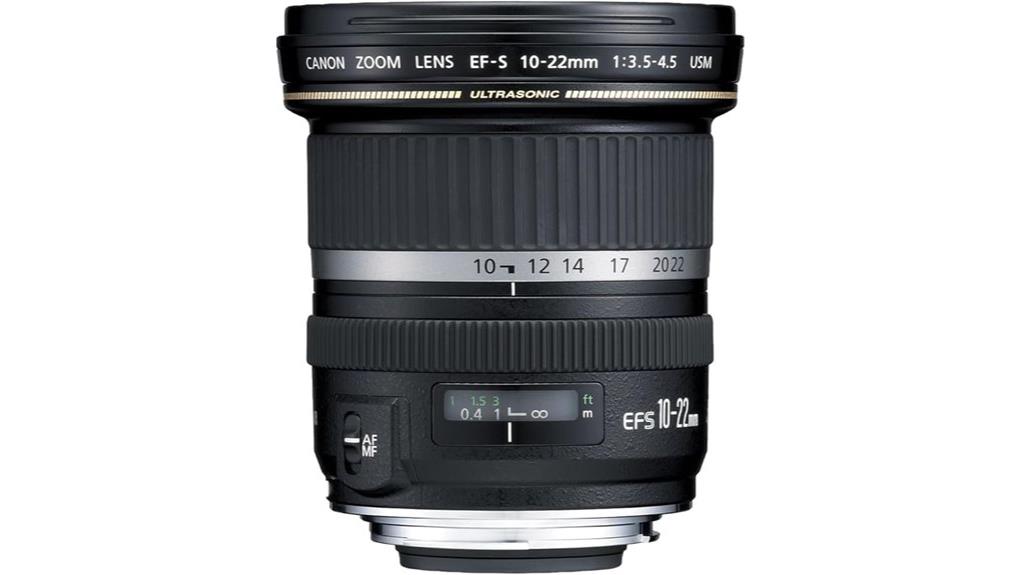
You’ll get a compact, travel-friendly ultra-wide for Canon APS-C bodies with the EF-S 10–22mm f/3.5–4.5 USM: center sharpness is excellent, AF is fast and quiet, and the close-focus lets you emphasize foregrounds. Expect noticeable corner softening at the extremes, pronounced barrel distortion at 10mm, visible vignetting wide open, and no weather sealing. It’s a strong value if you’ll stay on APS-C, and the full review explains handling, corrections, and alternatives.
Some Key Takeaways
- Excellent center sharpness, especially between 11–16mm; corners need f/8–f/11 to match.
- Ultra-wide APS-C coverage with compact, lightweight design ideal for travel and architecture.
- Ring-type USM provides silent, reliable AF with quick manual-focus override.
- Pronounced barrel distortion at 10mm, vignetting wide-open, and some chromatic aberration manageable in RAW.
- EF-S mount limits bodies to APS-C, no weather sealing or stabilization; good value used or new.
Quick Verdict: Who Should Buy the Canon EF-S 10-22MM F/3.5-4.5 USM
If you shoot on an APS-C Canon and need a reliable ultra-wide that balances optical quality with portability, the EF-S 10-22mm f/3.5-4.5 USM is a strong choice. You’ll appreciate its compact footprint, fast ring-type USM focusing, and close-focus ability for travel photography where weight and versatility matter. For architecture shoots you’ll get expansive framing and controlled perspective shifts, though you’ll need careful composition to manage edges. For landscape perspectives it’s flexible from sweeping panoramas to tighter foregrounds. Vlogging utility exists but is limited by field-of-view on some rigs; stabilization and weather sealing are absent, so plan accordingly. It’s a practical option for mirrorless camera enthusiasts seeking essential, lightweight ultra-wide coverage for varied shooting situations.
How It Performs: Sharpness, Distortion, Vignetting and Chromatic Aberration
When you push the EF-S 10-22mm into real-world use its strengths and limits become clear: center sharpness is excellent across the range—especially between 11–16mm—while corners soften noticeably at 10mm and at the longest focal lengths unless you stop down to f/8–f/11. You’ll find edge sharpness improves with modest stopping down, but residual astigmatism and field curvature leave peripheral detail less resolute than the center. Barrel distortion is pronounced at 10mm but correctable in raw converters with minimal quality loss. Vignetting control is decent stopped down; wide-open shots show light falloff. Chromatic fringing appears on high-contrast edges, though it’s manageable in post. This lens is a favorite among photographers who prefer prime lenses for their optical characteristics.
Handling, Autofocus and Real-World Usability on EOS DSLRs
Beyond sharpness and optical quirks, handling and autofocus behavior determine how usable the 10-22mm feels on an EOS body in real shooting. You’ll notice fast handling thanks to light zoom throw and balanced front-heaviness on most Rebels and mid-level EOS bodies. The ring-type USM delivers silent autofocus that snaps to contrast-rich subjects reliably, though low-light AF can hunt compared with newer STM designs. Ergonomic controls are straightforward: a firm zoom lock absence aside, rings and switches sit logically for quick adjustments. You’ll appreciate quick manual focus override for fine-tuning; it’s precise, though travel is modest. For photographers looking to learn more about working with zooms, consider resources on mastering zoom lenses to improve technique and results.
Compatibility, Size/Weight and Practical Limits (Closest Focus, Filters, Weather)
Although the EF-S mount limits the 10-22mm to APS-C Canon bodies, you'll find it physically compact and light—about 16 ounces—so it balances well on Rebels and mid-range EOS cameras without feeling front-heavy. You can exploit the 9.5-inch closest focus for strong wide-angle foreground emphasis; frame fill at close distances is impressive for environmental detail but expect perspective distortion. The 77mm filter thread gives broad filter compatibility for grads and polarizers, though bulbous front elements limit stacked filters. The lens lacks weather sealing, so you’ll need caution or protection in damp conditions; durability under harsh use is limited. This makes it a practical choice for travel and landscape shooters who want a lightweight, wide-angle option with compact handling.
Value and Alternatives: Price, Warranty, and Lenses to Consider Instead
If you're weighing cost against performance, the EF-S 10-22mm delivers strong wide-angle capability and reliable USM autofocus for a modest price, and Canon's one-year manufacturer warranty plus many sellers' 30-day return policies give reasonable post-purchase protection. You’ll find the lens competitively positioned amid current pricing trends: used examples often undercut new units, while demand for APS-C wide angles keeps values steady. Assess total cost including filter needs and lack of weather sealing. For alternative mounts consider third-party ultra-wide zooms for EF-S, or full-frame EF options if you plan to upgrade bodies later. Also consider matching this lens to a sturdy tripod from a specialty retailer like Perfect Tripods for improved stability with wide-angle compositions tripod selection.
Some Questions Answered
Can This Lens Be Used With Full-Frame Canon Cameras?
No — you can't mount this EF-S lens natively on full frame bodies; compatibility is limited to APS-C Canon DSLRs. You could consider mirrorless? adaptation, but that requires an EF-S-to-full-frame adapter and even then you'll face vignetting or cropped/APS-C-mode shots because the image circle is small. Critically assess whether adapting suits you: optical compromises, potential loss of edge sharpness, and limited coverage often make true full-frame lenses a better choice.
Does It Come With Lens Caps and a Hood Included?
No — the standard box contents list the EF-S 10-22mm lens, instruction book, and one-year warranty card; original front/rear lens caps and hood aren’t guaranteed in every listing. You’ll want to verify the seller’s description, since some listings omit caps/hood or supply aftermarket accessories instead. If caps and a hood aren’t included, plan to purchase genuine or compatible aftermarket items; check fit (77mm thread) and build quality before buying.
Is the Lens Compatible With Third-Party Teleconverters?
No — you won’t get reliable teleconverter compatibility with this EF-S 10-22mm lens. Teleconverters are designed for longer prime or tele zooms; adding one introduces pronounced optical limitations here: reduced sharpness, vignetting, and loss of effective aperture that strains AF. Physically, EF-S rear element geometry and flange distance often block proper coupling. If you need reach, you’re better off using a longer native lens or cropping rather than forcing a teleconverter.
How Does It Perform for Astrophotography at Wide Apertures?
It struggles for astrophotography at wide apertures: you’ll get usable low light sensitivity but noticeable coma and edge softening. Star tracking helps with longer exposures, yet coma correction is limited by the optical design, so stars near the frame edge bloom. You’ll see vignetting control issues that require heavy post-processing and careful flat frames. Fringe reduction is moderate; chromatic aberration appears on high-contrast stars, demanding correction in software tools.
Can I Use the Lens for Video Autofocus on Canon DSLRS?
Yes — you can use it, but don’t expect flawless video AF. The ring-type USM gives fast, silent autofocus, so autofocus reliability is good for initial pulls and short moves. Continuous tracking on many Canon DSLRs is limited because bodies use contrast-detection or slower hybrid systems in Live View/video, so tracking can hunt with complex motion. You’ll get usable results for simple pans, but manual focus is often preferable for precise cinematic work.