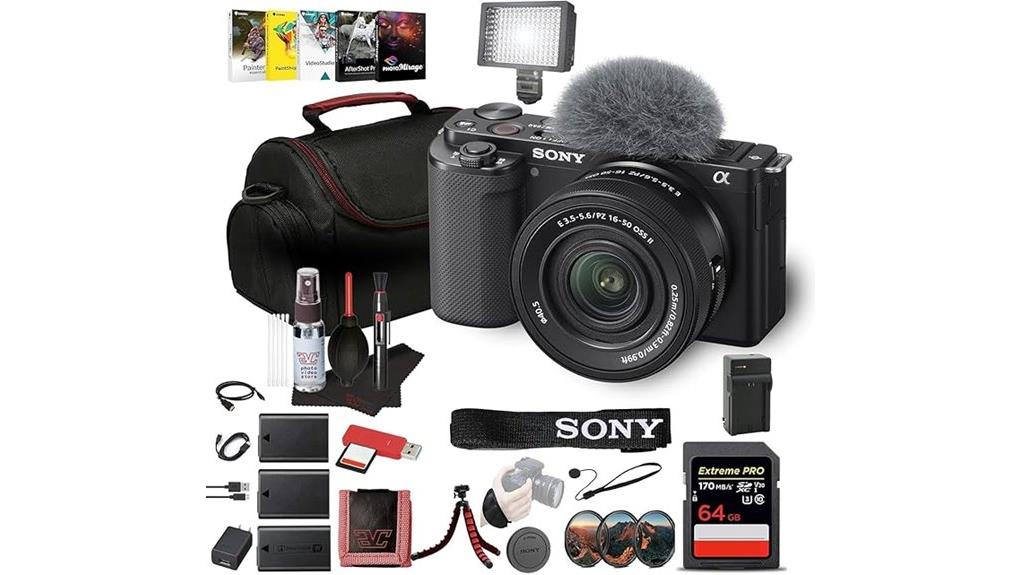
You’ll like the Sony ZV‑E10 kit if you want a pocketable APS‑C mirrorless that makes polished vlogs and usable stills with minimal fuss. It pairs a 20MP sensor and 16–50mm OSS kit zoom with reliable real‑time AF, a directional built‑in mic plus mic input, and 4K/30p or 1080/60p options. Image quality holds to ISO 1600, stabilization helps handheld shots, and dual batteries plus a 64GB card keep you shooting—keep going to see detailed strengths, trade‑offs, and accessory picks.
Some Key Takeaways
- Compact APS‑C mirrorless kit aimed at solo creators, balancing portability with improved image quality over compact vlogging cams.
- 20MP sensor delivers sharp stills and natural color; clean up to ISO 1600 and usable detail to ISO 3200.
- 4K (30/24p) and 1080p60 video, with kit 16–50mm PZ OSS lens providing useful stabilization for handheld shooting.
- Strong, consistent AF with real‑time tracking and reliable eye AF, ideal for single‑operator workflows.
- Creator‑friendly features include built‑in directional mic, mic input, vari‑angle screen, dual batteries, and included 64GB card.
Who This Review Is For and the Sony ZV‑E10’s Core Promise
While it borrows sensor and autofocus chops from Sony’s more advanced mirrorless models, the ZV‑E10 is clearly aimed at solo creators who want a compact, easy-to-use rig for vlogging, tutorials, travel, and product demos. You’ll find the target audience includes vloggers, reviewers, educators, and small-business owners who need good image quality without heavyweight gear. The core promise is straightforward: deliver polished video and usable stills with minimal setup and learning curve. Compared with bulkier mirrorless rigs, it trades advanced pro features for portability, simplicity, and creator-focused tools like a directional mic and vari-angle screen. It’s a strong option for enthusiasts who prefer gear focused on mirrorless cameras and creator-friendly accessories.
Key Specs at a Glance: Sensor, Lens, Video, Audio, and Storage
Because the ZV‑E10 packs a large APS‑C CMOS sensor and Sony’s strong autofocus into a compact body, you’ll get noticeably better image quality and subject tracking than most entry-level compact cameras. You get 20MP stills, 4K/1080p video at up to 60fps, and natural color rendering ideal for vlogs and travel. The kit 16–50mm PZ lens offers convenient reach; judge lens sharpness as average for a kit zoom but stabilized with OSS. Built‑in directional mic and mic input give flexible audio options. Dual batteries in the kit improve battery longevity, and a 64GB SD card handles your files. The site also offers a range of accessories for camera enthusiasts, including digital cameras and lenses.
Real‑World Performance: Image Quality, Autofocus, and Low‑Light Results
If you want reliable everyday image quality, the ZV‑E10 delivers—its 20MP APS‑C sensor produces sharp, detailed stills with pleasing natural colors and a dynamic range that holds highlights and shadow detail better than most compact‑sensor vlogging cams. You’ll notice clean files up to ISO 1600, usable detail to 3200, and respectable night performance when you expose carefully or use the included OSS lens. AF consistency is strong for portraits and moving subjects, with real‑time tracking and eye AF rarely losing lock. Motion handling favors smooth subject shifts, outperforming many entry mirrorless competitors in practical shooting. It’s also an excellent choice for creators who need portable gear that pairs well with product photography boxes for controlled lighting and consistent results.
Video Workflow Tested: 4K/1080p Settings, Stabilization, and Color Profiles
When you switch the ZV‑E10 into 4K 30p or 24p, you get crisp, high‑detail footage that rewards careful exposure and stabilization choices; 1080p at 60p is a solid alternative for smoother motion and smaller file sizes. You’ll run codec comparisons between MP4 H.264 and H.265 workflows to balance quality, editability, and storage. Stabilization testing shows the OSS lens helps handheld work, though gimbals still outperform for aggressive movement. Use Natural or S-Log like profiles sparingly: Natural offers ready‑to‑use color, S-Log gives grading latitude but increases noise and post workload. Perfect Tripods recommends choosing a sturdy tripod to maximize sharpness and reduce camera shake during long takes, especially when shooting in 4K stability and sharpness.
Kit Accessories That Matter: Batteries, Mic, Tripod, Filters, and Software
Don’t skimp on power and peripherals: the ZV‑E10 kit’s two NP‑FW50 batteries and charger give you a decent starting run time, but you’ll likely want spares or a USB power bank for all‑day shoots. Monitor battery health with periodic full cycles and a spare rotation. The included directional mic is fine for run‑and‑gun, but upgrade to dedicated external microphones for interviews or noisy environments. The flexible 12" travel tripod is handy, though a sturdier travel tripod improves stability for timelapses and low light. Use the bundled creative software for quick edits, but consider more advanced NLEs as needs grow. Consider carrying a few extra NP‑FW50 spare camera batteries so you can keep shooting through extended sessions.
Strengths and Trade‑Offs for Creators, Vloggers, and Travel Shooters
Now that you’ve covered power, audio, and stabilization basics, consider how the ZV‑E10 actually performs for creators, vloggers, and travelers: it pairs a compact APS‑C body with a versatile 16–50mm PZ lens and strong autofocus, giving you reliable subject tracking, natural colors, and 4K video in a pocketable package. You’ll appreciate lens versatility and accessory compatibility for mics, lights, and tripods, making shoots flexible. Trade‑offs include modest battery longevity with the supplied NP‑FW50 cells and potential sensor heat during extended 4K takes. Overall, it balances portability and performance better than many entry alternatives. If you plan to shoot more pro-level footage, consider adding a video light kit to improve lighting and image quality.
Buying Guidance: Value, Alternatives, and Final Recommendation
Although compact, the ZV-E10 delivers strong value for creators who want a pocketable APS-C camera with reliable AF, natural color, and 4K video at a modest price, especially when bundled with the 16–50mm PZ lens and accessories in this kit. If you prioritize vlogging and run‑and‑gun shooting, this package saves you buying accessories separately. Consider budget alternatives like older A6000-series bodies or entry Canon/Nikon mirrorless models if you need savings over features. Factor resale value—Sony bodies hold demand well—so upgrading later is easier. My recommendation: buy this kit if you want ready‑to‑shoot versatility and future trade‑in potential. A quality camera backpack can help protect your kit and make it easier to carry on location, especially for photographers who favor camera backpacks and frequently travel.
Some Questions Answered
Does the Kit Include a Warranty and How Is Support Handled?
Yes — the kit includes warranty coverage; you’ll rely on the manufacturer warranty link and seller return policy for repairs or replacements. For customer support, you’ll contact Sony for hardware/service issues and the seller for purchase or return questions. Compared to some bundles, this one bundles software and accessories but still channels warranty claims through Sony and retailer support. You’ll want to register the product and keep receipts to streamline service.
Can the 16-50MM Lens Be Swapped for Third-Party Lenses?
Yes — you can swap the 16-50mm for third party lenses because the ZV-E10 uses Sony E-mount. You’ll find broad third party support, but check lens compatibility and autofocus performance before buying. Mount adapters expand options to DSLR and vintage glass, though aperture control and AF may be limited or manual depending on adapter and lens. Compare supported features and image quality to native E-mount lenses for best results.
How Long Does Battery Life Last With the Included NP-FW50 Batteries?
You’ll get roughly 45–80 minutes of continuous shooting per NP-FW50 battery depending on settings; in real-world runtime testing you’ll typically see about 60 minutes of mixed photo/video use. Battery longevity drops with 4K recording, frequent AF, and LCD use, while lower frame rates and power-saving modes extend it. Compared to newer higher-capacity batteries, these NP-FW50 cells run shorter but remain adequate for short shoots or as hot-swappable spares.
Is the Camera Compatible With External Microphones via Hot Shoe Adapters?
Yes — you can use external mics via hot shoe compatibility and microphone adapters. The ZV-E10 has a multi-interface shoe that works with many hot-shoe microphones and wireless receivers; you’ll need microphone adapters for models using proprietary plugs or XLR boxes. Compared to cameras with XLR inputs, you’ll rely on adapters or shoe-mounted preamps for pro audio, but plug-and-play shotgun mics and compact wireless units work well for vlogging and interviews.
Are Firmware Updates Easy to Install and How Often Are They Released?
Yes — firmware updates are generally easy to install: you’ll download Sony’s updater, connect the camera via USB or use an SD card, and follow clear on-screen steps. Firmware usability is straightforward compared with many rivals, with user-friendly installers and step-by-step guides. Update cadence is irregular but steady: Sony issues bug fixes and occasional feature upgrades every few months to a year, so you’ll want to check quarterly.