You’ll get a straightforward, budget-ready DSLR that’s ideal if you’re starting out or need a capable travel backup. The 24.1MP APS-C sensor with DIGIC 4+ produces reliable JPEGs and 14‑bit RAWs; low‑light and dynamic range are modest by modern standards. Autofocus is a basic 9‑point system and video tops out at 1080p/30fps. The renewed kit’s 18–55 and 75–300mm lenses cover most situations but inspect for haze; more details follow for buying and use. the canon eos rebel t7 features overview includes a variety of shooting modes that cater to different photography styles, ensuring that beginners can experiment and grow their skills. Additionally, the built-in Wi-Fi and NFC connectivity make it easy to share images right from the camera, enhancing your overall experience. With its lightweight design and robust build, it's a great choice for anyone looking to capture memories on the go.
Some Key Takeaways
- Entry-level DSLR with a 24.1MP APS-C sensor delivering solid stills and 14-bit RAW for beginners.
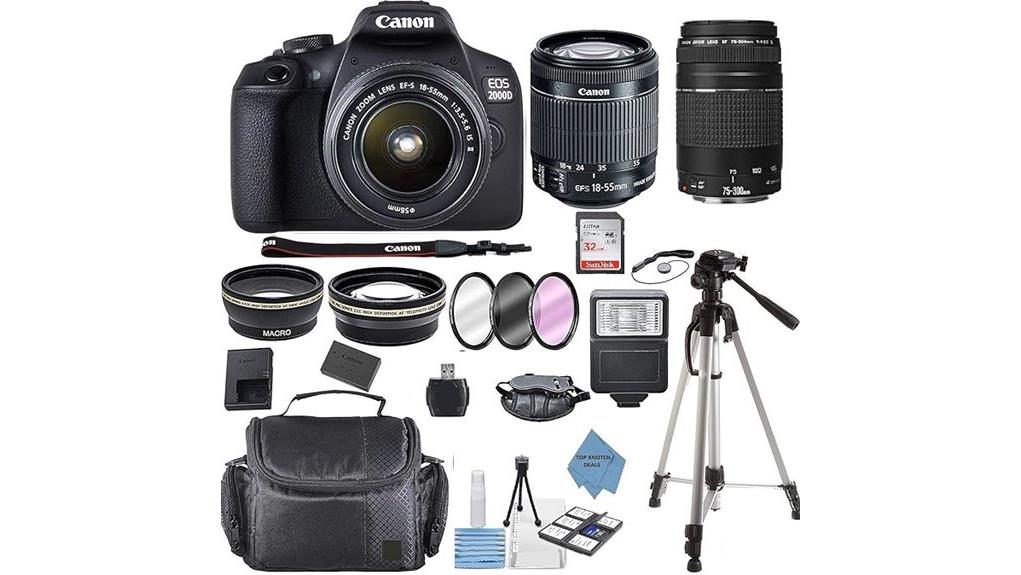
- Kit includes EF‑S 18‑55mm and EF 75‑300mm lenses, offering flexible 18–300mm focal coverage for walkaround and distant shots.
- 9‑point AF (central cross‑type) and 3 fps burst limit action performance and fast subject tracking.
- Video is basic 1080p/30fps with modest rolling-shutter and no advanced codecs or in-body stabilization.
- Renewed bundles often lack batteries, may have limited warranty, and require lens inspection for haze or focus play.
Real-World Summary and Who This Canon EOS 2000D Kit Is Best For
Although the 2000D (Rebel T7) is an entry-level DSLR, it delivers a practical, full-featured kit for beginners who want straightforward stills and basic Full HD video. You’ll get a 24.1MP APS-C sensor, 14-bit RAW, reliable JPEG output, and basic 1080p/30fps recording. Autofocus and 3fps continuous shooting limit fast-action use, but are adequate for travel, portraits, and web content. You’ll appreciate lens coverage from 18–300mm for versatility. This package suits beginner photographers, budget travellers, entry level vloggers, and casual enthusiasts seeking low-cost, serviceable image quality and straightforward operation. It’s a great starting system for those focused on mirrorless camera accessories and learning core photography skills.
What’s in the Renewed Bundle and How Each Item Performs
The renewed Canon EOS 2000D kit comes with two primary lenses (EF‑S 18‑55mm f/3.5‑5.6 III and EF 75‑300mm f/4‑5.6 III), a camera bag, basic filters, a cleaning kit, and a TopKnotch Deals cloth, and each item performs to expected entry-level standards for general-purpose use. You’ll find the 18‑55mm adequate for walkaround work and the 75‑300mm serviceable for distant subjects; inspect lens condition closely for element haze or focus play. The bag and cloth meet protective and maintenance needs. Verify accessory authenticity and warranty scope; filters are basic, cleaning kit is functional, batteries not included. Consider pairing the kit with a travel tripod to improve stability and framing for outdoor photography with compact tripods.
Image, Autofocus, and Video Performance You Can Expect
While it's an entry-level body, the 24.1 MP APS‑C sensor paired with Canon's DIGIC 4+ processor delivers detailed stills and usable low‑light performance within the camera's native ISO 100–6400 range (expandable to 25600). You'll get 14‑bit RAW, accurate color rendering, and JPEG fine compression suitable for moderate cropping. Autofocus relies on a 9‑point AF system with a central cross‑type; tracking is basic and contrast‑detection assists in Live View. Face detection accuracy is reasonable for casual portraits but not reliable for fast action. Video is limited to 1080p/30fps with modest rolling‑shutter and no advanced codec options. For photographers looking to fine-tune sharpness and focus across their gear, consider using lens calibration tools to perfect performance.
Strengths and Limitations Compared to Alternatives in 2026
Given today's baseline for entry-level cameras, the renewed Canon EOS 2000D (Rebel T7) still delivers solid image quality and a useful lens range, but you should expect clear limitations versus 2026 alternatives: its 24.1MP APS‑C sensor and DIGIC 4+ produce good JPEGs and 14‑bit RAW for static subjects, yet slow 3 fps burst, a modest 9‑point AF, and 1080p/30fps video fall short of modern competitors that offer faster processors, advanced autofocus (wide-area phase-detect and subject tracking), higher continuous rates, and 4K/60 or high-bit-rate recording—making the 2000D best suited for beginners on a budget or as a backup body rather than for action, advanced hybrid workflows, or demanding video projects.
You’ll notice sensor aging in noise performance and dynamic range versus newer chips. Feature gaps include no phase-detect AF on sensor, limited video codecs, and modest connectivity speeds. If you prioritize low-cost optics and basic stills, it’s reasonable; if you need speed, tracking, or video quality, modern mirrorless or recent DSLRs outperform it. External monitors can significantly improve composition and focus with the 2000D’s limited rear LCD by offering larger, clearer previews and focus peaking external camera monitors.
Should You Buy This Renewed Rebel T7 Kit? Practical Buying Checklist
If you’re weighing this renewed Rebel T7 kit, focus on core trade-offs: you get a reliable 24.1MP APS‑C sensor, two versatile EF/EF‑S zooms (18–55 and 75–300mm), and basic connectivity at a low price, but you’ll sacrifice modern AF performance, fast continuous shooting, and 4K video—so buy it only if you prioritize affordable still-image quality, a broad focal range, and kit completeness over speed, advanced autofocus, or high-end video features. Checklist: confirm battery checklist (batteries not included), inspect lens elements and aperture blades, test AF points and 3 fps drive, verify accessory list, and review warranty considerations (90‑day limited). Also check spare battery options and compatibility with your camera to keep shooting longer with extra power.
Some Questions Answered
Does This Kit Include Batteries and an AC Charger?
No, the kit doesn’t include batteries or an AC charger. You’ll need to supply a compatible lithium-ion battery and check charger compatibility before use. Practice battery removal on a powered-down camera to avoid contact damage. Use Canon-approved chargers or third-party units rated for the camera’s battery chemistry and voltage. For travel, confirm charger input range and carry spare charged batteries; incompatible chargers can harm the battery or camera electronics.
Are Lens Caps and Body Cap Provided in the Bundle?
Yes — the renewed bundle typically includes lens caps and a body cap. You’ll get front and rear caps for the EF‑S 18‑55mm and EF 75‑300mm lenses, plus a body cap for the camera mount to protect the sensor when no lens is attached. Confirm with the seller before purchase, since accessory inventory can vary with renewed packages; request photos or a packing list to verify presence of lens caps and body cap.
Is the Camera Eligible for Canon Manufacturer Warranty Registration?
No — you aren’t eligible for Canon manufacturer warranty registration for this renewed bundle because Ultimate Deals supplies a 90-day limited warranty. For warranty eligibility, you’ll need an original Canon retail purchase with manufacturer warranty documentation. For registration process, you’d normally register via Canon’s website with product serial and proof of purchase. Since this item is renewed/resold by Ultimate Deals, follow their warranty claims procedure instead of Canon’s registration.
Can the 2000D Shoot Timelapse or Intervalometer-Controlled Sequences?
Yes — you can create timelapse sequences, but the 2000D lacks a built-in intervalometer. You’ll need an external intervalometer or use Wi‑Fi remote apps that mimic interval timing. For long exposures you can use Bulb with an external intervalometer; true bulb ramping isn’t supported natively, so you’d need an external controller or post‑processing to achieve smooth exposure shifts. Make certain firmware and remote compatibility before purchase.
Are Firmware Updates and Download Instructions Included With the Renewal?
No — the renewed kit doesn’t include firmware access or download guidance in the package. You’ll need to obtain firmware files and update instructions from Canon’s official support channels. Check Canon’s website for the latest firmware, follow the posted update schedule, and use provided step‑by‑step guidance. If you need help, contact Canon support channels or consult community forums; they’ll provide technical details and troubleshooting for the update process.