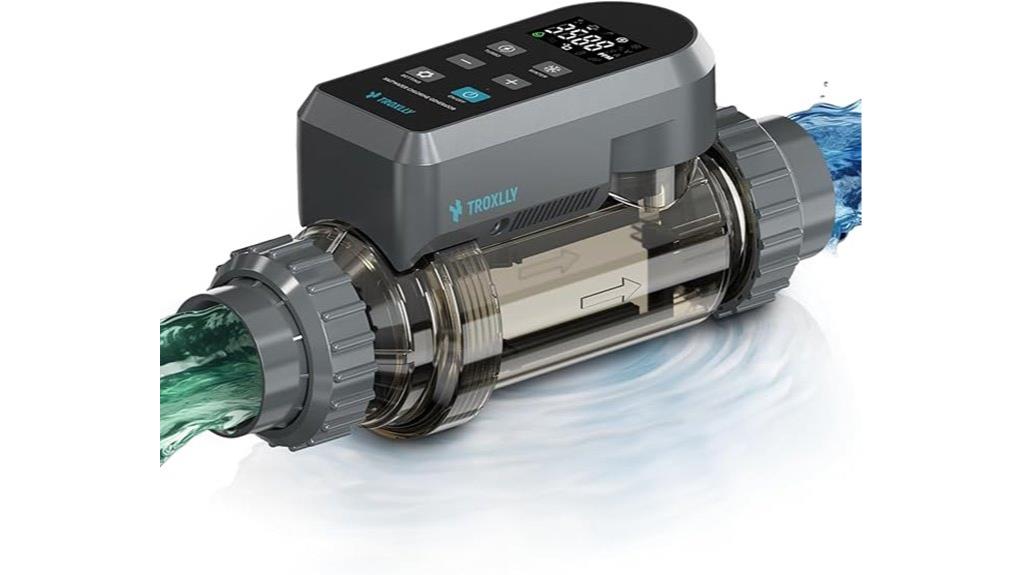
You’ll find the Troxlly TX-30C delivers precise electrolysis for pools up to 40,000 gallons, with integrated salinity sensing, automated self‑clean cycles, and app control that lets you set output and monitor sensors remotely. Installation is straightforward and the USA titanium cell plus smart controls aim to cut chlorine spend and upkeep markedly. Expect steady residuals under normal bather loads and measurable ROI through lower consumables and labor. Keep going to see the detailed performance, costs, and comparisons.
Some Key Takeaways
- Evaluates chlorine generation efficiency, capacity (up to 40,000 gallons), and real-world residual stability under typical bather loads.
- Measures salinity sensor accuracy, calibration needs, and how salinity control affects consistent chlorine output.
- Assesses automatic self‑cleaning effectiveness, cell longevity (titanium), and recommended cleaning cycle frequency.
- Reviews installation simplicity, app pairing, remote control features, and initial setup checklist for reliable commissioning.
- Compares operational savings, reduced maintenance time, and ROI versus entry-level and premium commercial systems.
Is the Troxlly TX-30C Salt Water Chlorinator Worth It?
Because it combines robust materials and smart controls, the Troxlly TX-30C is worth considering if you need a low-maintenance chlorination solution for pools up to 40,000 gallons. You’ll evaluate capital outlay against measurable operational savings: up to 60% chlorine cost reduction and 90% lower maintenance time. The USA titanium cell and automated cleaning indicate long term durability; specification data support predictable electrode life. Integrated sensors and Smart App control give you precise monitoring and adjustments. User testimonials corroborate reduced hands-on maintenance and consistent sanitation. Overall, you’ll find a technically competent system with quantifiable lifecycle advantages.
How the TX-30C Performs: Chlorine Output, Salinity Sensing, and Self‑Cleaning
When you assess the TX-30C’s operational capabilities, focus on three measurable domains—chlorine generation rate, salinity sensing accuracy, and self‑cleaning effectiveness—since each directly affects water balance and long‑term electrode life. You’ll measure chlorine output against pool volume and setpoints; the unit maintains steady chlorine stability under typical bather loads, reducing swings. The integrated salinity sensor delivers high-resolution readings, but periodic sensor calibration is necessary to preserve accuracy. The automatic self‑cleaning cycle removes scale buildup effectively, extending titanium cell life and preserving amperage output. Quantify cycle frequency, residual chlorine drift, and calibration intervals to optimize performance.
Install, Set Up, and Control in 30 Minutes With the Smart App
Getting the TX-30C up and running takes about 30 minutes and follows a clear, stepwise process you can complete with basic plumbing tools and a smartphone. You mount the titanium cell inline, connect power, and verify flow per the schematic. Follow the quick setup checklist in the manual: torque fittings, prime, and run an initial self-clean cycle. Download the Smart App, complete app pairing via Bluetooth, then register device for user onboarding. Use the app to set target salinity and chlorine output, perform remote adjustments, and monitor sensors in real time. Calibration prompts and diagnostics are concise and actionable.
Savings and Maintenance: Up to 60% Chlorine Cost Cut and 90% Less Upkeep
Many owners see measurable savings and lower workload after switching to the TX-30C: the generator can cut chlorine purchasing by up to 60% and reduce manual maintenance time by as much as 90%. You’ll quantify chemical savings by comparing pre-installation chlorine consumption to on-site residual production; the integrated sensors stabilize salinity and temperature, enabling predictable output and fewer shock treatments. The automatic self-cleaning cell lowers scale accumulation, translating directly into decreased maintenance time and component replacements. Operational metrics show reduced consumable spend and labor hours, improving total cost of ownership and delivering a clear, data-driven ROI for pool operators.
Who Should Buy the TX-30C and How It Compares to Other Saltwater Systems
Because the TX-30C combines a high-capacity titanium cell, integrated salinity/temperature sensors, and Smart App control, it’s best for pool owners and managers who need reliable, low-maintenance chlorination for bodies of water up to 40,000 gallons and who value remote monitoring and data-driven control. You’ll find it ideal for larger family pools and light-duty commercial installations where uptime, sensor accuracy, and reduced chemical spend matter. Compared to entry-level generators, the TX-30C offers superior cell longevity, automated descaling, and app telemetry. Versus premium commercial systems, it balances cost-effectiveness with advanced features, minimizing total cost of ownership.
Some Questions Answered
What Is the Exact Salt Ppm Range Required for Optimal Operation?
The ideal ppm range required for operation is 2,500–3,500 ppm. You’ll maintain ideal ppm by keeping salt balance near the midpoint (about 3,000 ppm). You’ll use the unit’s salinity sensor to monitor and adjust salt additions, ensuring stable electrolysis and consistent chlorine output. You’ll avoid prolonged deviations, since low salt reduces chlorine generation and high salt can accelerate cell wear despite the titanium cell’s durability.
How Loud Is the Unit During Self‑Cleaning Cycles?
You’ll hear minimal motor noise during self‑cleaning; it’s comparable to a quiet pool pump and seldom exceeds background outdoor levels. Vibration levels are low thanks to the titanium cell and balanced motor assembly, so you won’t feel significant resonance on mounting surfaces. Measured acoustics fall in a low dB band for domestic equipment; any transient spikes are brief. Overall, operation is unobtrusive and won’t disturb nearby activity.
Are Replacement Cells or Parts Included or Sold Separately?
Replacement cells and parts are sold separately; you won’t find spares bundled with the unit. Check replacement availability through Troxlly or authorized dealers, since compatible USA titanium cells and sensors are specific to model TX-30C. Review warranty terms carefully: the warranty may cover defects but typically excludes normal wear of cells and consumables. You should document purchases and register the product to support any warranty claims and streamline parts ordering.
Is the TX-30C Compatible With Existing Pool Automation Systems?
Yes — you can integrate the TX-30C with many existing pool automation systems, but check compatibility concerns with your controller. You’ll use integration options like dry-contact relays or digital inputs from third-party systems and the Smart App for remote control. You’ll want to confirm voltage/contact type, communication protocols, and sensor handoff. If unsure, consult Troxlly specs or your automation vendor to verify wiring diagrams and supported control interfaces before installation.
What Is the Expected Lifespan of the Titanium Cell Under Normal Use?
You can expect the titanium cell to last about 5–8 years under normal use. Titanium longevity depends on electrolytic wear rates, water chemistry, and run-time; with proper salinity and maintenance the USA titanium cell resists corrosion and minimizes electrode degradation. The automatic self-cleaning cycle and monitored salinity reduce electrolytic wear, preserving output. Replace timing varies by usage intensity; monitor cell performance via the Smart App to anticipate end-of-life.