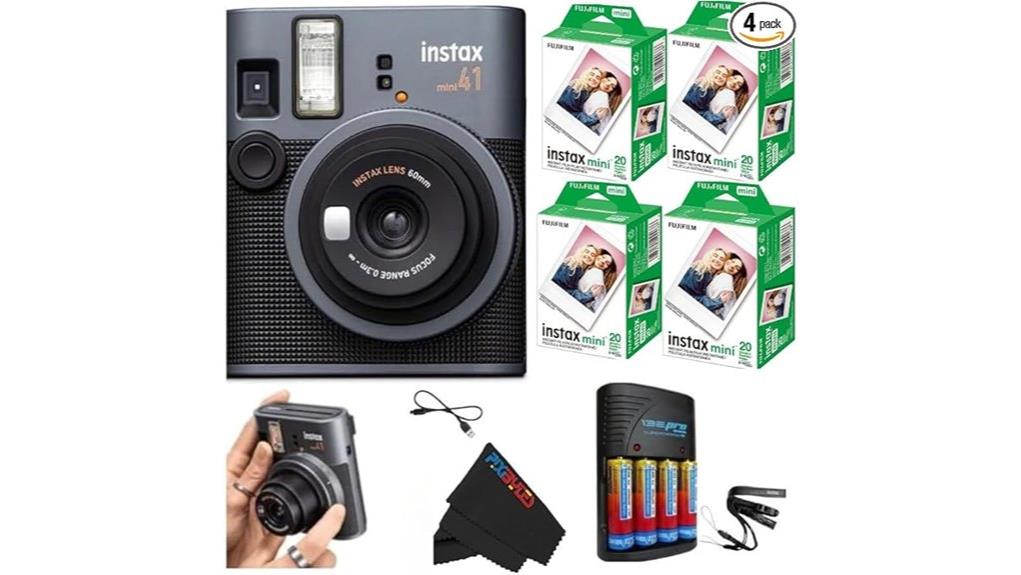
You’ll get a compact, pocketable Instax that’s tactile and easy to use, with restrained metallic accents and a twist-on selfie/close-focus lens that corrects parallax. Exposure and flash are automated for consistent, contrasty prints with pleasing skin tones but limited dynamic range and clipped highlights. AA power is convenient; expect several dozen shots per outing and keep spare film and a battery. It’s ideal for casual shooters and travelers — continue for full performance, workflow, and alternatives.
Some Key Takeaways
- Compact, pocketable body with tactile finish and metallic accents offers comfortable, stylish handling for casual shooters.
- Simple, sparse controls and twist-on lens enable quick Selfie Mode and close-focus framing with parallax-corrected viewfinder.
- Automated exposure and built-in flash deliver bright, contrasty prints with pleasing skin tones but limited dynamic range and clipped highlights.
- f/12.7 lens and electronic shutter reduce fine detail and increase motion blur risk, suited for static subjects and casual use.
- AA battery power and reliable flash make it travel-friendly; bring spare film packs and at least one extra battery.
Design, Controls, and Build: What the Mini 41 Feels Like and How It Works
While it's compact enough to slip into a jacket pocket, the Instax Mini 41 feels solid and deliberate in hand: its streamlined, slightly rounded body and tactile finish give you grip and confidence, while metallic-like accents lend a restrained premium touch. You operate it with minimal learning: clearly marked buttons, a twist-on lens for Selfie Mode and close focus, and an optical viewfinder aligned for parallax correction. Tactile ergonomics prioritize repeatable handling and steady framing. Controls are intentionally sparse, trading manual exposure for simplicity. Accessory compatibility is limited but practical—strap mounts and a tripod thread support travel and social use. The camera pairs naturally with casual shooters who appreciate camera straps that balance comfort and style.
Exposure, Flash, and Image Quality: Real-World Photo Performance
Because the Mini 41 automates exposure and flash, you get consistent, usable prints with minimal fuss—bright, contrasty images straight from the camera but limited in dynamic range and fine detail. You’ll find color accuracy generally pleasing for skin tones and saturated scenes, though highlights clip and shadows lose subtlety. The built-in flash fires reliably within its 7.2 ft effective range; flash recycling is adequate for casual bursts but slows if you shoot repeatedly. The f/12.7 lens and electronic shutter constrain depth and sharpness; watch for motion blur in low light or fast subjects. Overall, predictable instant results with technical limits. For keeping those prints and lenses pristine, consider proper lens cleaning as part of your kit.
Selfie & Close-Up Features: Using the Selfie Lens, Mirror, and Parallax Fix
Flip the lens forward to engage Selfie Mode and you’ll get a dedicated 35 mm-equivalent framing that’s optimized for near subjects. You’ll use the built-in mirror placement beside the lens to align faces precisely; it’s small but positioned for accurate selfie framing without guesswork. Close-up mode shifts focus to 11.8–19.7 inches and applies parallax correction so what you see matches the print composition. Twist-to-activate controls are tactile and quick. Evaluate: results are predictable, composition errors drop, and close portraits retain sharpness given the f/12.7 aperture. Limitations: shallow control over depth and fixed exposure remain. This kind of hands-on, accessory-friendly approach complements shooting with wide-angle phone lenses to expand creative framing options.
Practical Use: Battery Life, Film Speed, and Daily/Travel Workflow
Typically, you'll get dependable runtimes from two AA batteries—enough for several dozen shots on a day trip—so you won't be constantly hunting for a charger. You’ll appreciate clear battery longevity estimates: alkaline cells deliver reliable sessions, while NiMH rechargeables give cost-effective cycles. Film speed is fixed by Instax chemistry, so you’ll adapt exposure expectations rather than settings; low-light reliance on flash is predictable within the 7.2 ft range. For daily and travel workflow, pack spare film packs and batteries, pre-frame with the optical viewfinder, and sequence group/selfie shots to minimize wasted exposures and optimize prints per roll. Keep Shooting also recommends carrying a spare battery for extended outings to avoid downtime spare camera battery.
Who Should Buy the Instax Mini 41 and Which Alternatives to Consider
Armed with predictable battery behavior and a fixed film sensitivity, you can now judge whether the Mini 41 fits your shooting habits and needs. If you want reliable point-and-shoot prints, rapid 90-second development, and simple selfie/close-up tools, the Mini 41 serves casual shooters, travelers, and social users. Choose it if you value AA-powered convenience and minimal setup over manual exposure control. Budget buyers will appreciate its accessible price and consistent results. If you need manual control, larger negatives, or true mechanical charm, consider vintage alternatives or modern models with advanced exposure options and interchangeable lenses. The Instax ecosystem also offers a range of accessories and film formats to expand your instant photography options, including Instant Camera Gear for analog photography lovers.
Some Questions Answered
Does the Mini 41 Support Exposure Compensation or Manual Controls?
No — you won't get exposure compensation or a manual override on the Mini 41. It uses automatic exposure control with no dedicated exposure lock or manual exposure settings. You can influence results indirectly (flash on/off, close-up/selfie mode, composition), but there’s no true exposure lock or manual override to set shutter/aperture. Expect predictable, point-and-shoot output geared toward simple, reliable instant prints rather than manual control.
Can You Attach External Accessories Like Straps or Tripods?
Yes — you can attach a neck strap to carry it, and there’s a tripod mount option for stability. You’ll find standard strap lugs for a neck strap, letting you secure and access the camera quickly. The tripod mount is compatible with common small-tripod threads, though balance can be front-heavy due to the lens and film pack. Overall, accessory support is practical but limited to lightweight setups.
Is Double-Exposure or Multiple-Exposure Supported?
No — the camera doesn’t support double exposure or multiple exposure. You’ll be limited to single-frame exposures with automatic exposure control and a fixed electronic shutter. If you want layered effects, you’ll have to use manual film-cover techniques or digital editing before printing. That’s a practical limitation for creative users: the Mini 41 emphasizes simplicity and reliable single prints rather than in-camera exposure blending or experimental multi-exposure workflows.
What Film Types or Special Films Are Compatible Beyond Standard Instax Mini?
Only standard instax mini film and compatible specialty cartridges work reliably; you won’t use other instant film sizes. Instant film variants include color, monochrome, and limited-edition borders/patterns from Fujifilm and third-party specialty cartridges designed for instax mini packs. You should avoid non-instax formats (Wide, Square) and improvised films. Evaluate compatibility by matching the mini cartridge form factor, ISO, and developer chemistry to guarantee exposure and development remain consistent.
Does the Camera Include a Self-Timer or Remote Shutter Option?
Yes — you get a self timer but no dedicated remote shutter. You’ll enable the self timer via the camera’s built-in control (useful for group shots and delayed exposures); it provides a short delay before the electronic shutter fires. There’s no wireless or infrared remote option, so you can’t trigger the shutter remotely. For remote control you’ll need third-party mechanical workarounds or external solutions that physically press the shutter.