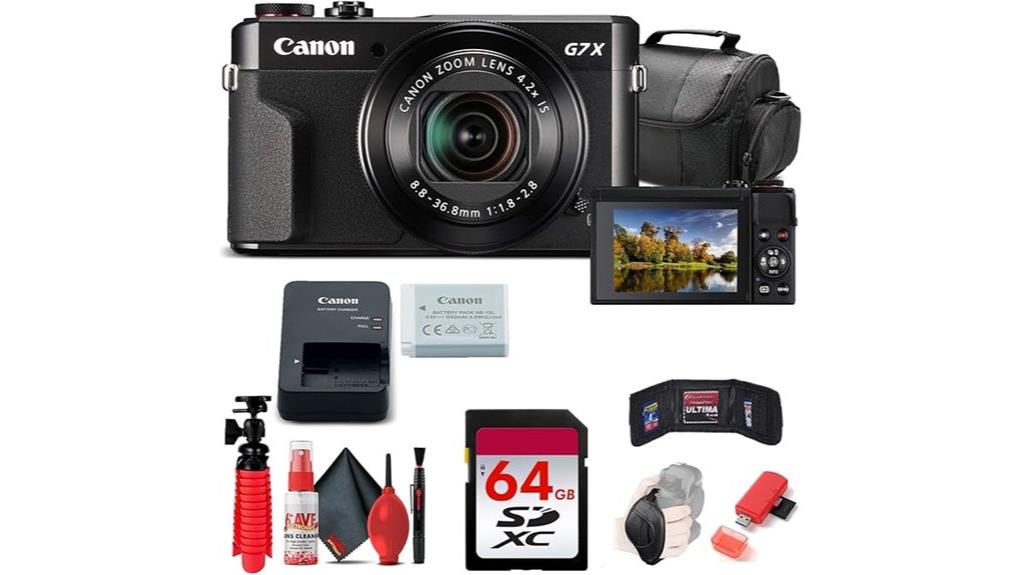
You’ll get a compact, travel-ready camera that pairs a large 1.0" sensor with a fast 24–100mm f/1.8–2.8 lens, giving detailed daytime images and usable low-light performance to ISO 1600. DIGIC 7 keeps noise manageable, Intelligent IS steadies handheld shots, and full manual controls plus a tilting touchscreen suit advanced users. Battery life is modest, so pack spares. If you want specifics on performance, ergonomics, and whether the bundled accessories add real value, keep going.
Some Key Takeaways
- Excellent compact for enthusiasts: 1.0" 20.1MP sensor plus DIGIC 7 delivers superior image quality for a pocketable camera.
- Fast 24–100mm f/1.8–2.8 lens provides great low-light performance and shallow depth-of-field in a travel-friendly zoom.
- Intelligent IS and 8 fps burst help handheld shooting, though slow shutter needs tripod for very low-light scenes.
- Usable up to ISO 1600 with modest noise; image softness and luminance noise increase noticeably beyond ISO 3200.
- Strong value in bundles for travelers and creators, but bring spare batteries and weather protection for longer outings.
Real-World Verdict: Is the Canon PowerShot G7 X Mark II Worth Buying?
Cutting to the chase, the PowerShot G7 X Mark II delivers a compelling blend of image quality, handling, and portability for advanced enthusiasts and serious travelers. You’ll appreciate its large 1.0" sensor and fast lens for low-light work, and the DIGIC 7 processing keeps noise manageable. Expect modest battery life for long shoots—carry spares if you shoot all day. Ergonomics and responsive controls let you work quickly; connectivity simplifies transfers. Given steady demand for compact advanced cameras, resale value remains reasonable if you maintain condition. Overall, you get a capable, portable tool that balances performance and practicality. For enthusiasts who shoot mirrorless or compact systems, consider essential accessories like extra batteries to get the most from your outings.
What the G7 X Mark II Offers: Core Specs and Usability Highlights
You’ll find the G7 X Mark II packs a potent mix of imaging hardware and usability features into a pocketable body: a 20.1MP 1.0" CMOS sensor paired with DIGIC 7 processing, a bright 24–100mm (35mm equiv.) f/1.8–2.8 lens with 4.2x optical zoom, and Intelligent IS for stabilized stills and video. You get full manual controls including a tactile control ring, 8 fps burst, ISO up to 12800 (Program), and Full HD 60p recording. The 3.0" tilting touchscreen aids framing and menus. Build quality feels solid for travel use; battery life is modest—carry a spare for extended shoots. This site also carries essential accessories for DSLR enthusiasts like spare batteries, straps, and protective cases to complement your gear essential accessories.
Image, Low‑Light and Video Performance: Results and Sample Takeaways
Although the G7 X Mark II's 1.0" 20.1MP sensor and DIGIC 7 processor generally deliver detailed daytime images with good color and contrast, its real strengths and limits emerge in low‑light shooting and video capture. You’ll get usable results to ISO 1600 with modest noise and retained detail; high ISO performance degrades beyond ISO 3200 where luminance noise and softening become noticeable. Intelligent IS aids handheld stills but can’t replace slower shutter needs. Video at 1080p60 is stable for casual use, though rolling shutter behavior appears under quick pans and fast-moving subjects, producing skewing artifacts. Consider using high-performance CFexpress cards when recording extended video to maximize reliability and write speeds.
Controls, Ergonomics and Touchscreen: How It Handles Day‑to‑Day
After testing image quality and low‑light behavior, it's worth looking at how the G7 X Mark II's controls and ergonomics affect everyday shooting. You get compact layout with logical button placement: mode dial, control ring, and rear buttons are reachable without shifting your grip. Grip comfort is modest; the body is smooth and small, so you’ll prefer the included hand strap or case for longer shoots. Touchscreen responsiveness is reliable for menu selection and touch-to-focus, though some menus remain button-driven. Thumb reach to rear controls is generally good for average hands, but larger hands may find extended use slightly fatiguing. For carrying the camera and accessories comfortably on outings, consider a dedicated camera backpack designed for photographers.
Who Should Buy This Bundle and How It Compares by Price/Value
When evaluating whether this G7 X Mark II bundle fits your needs, consider that it pairs a competent 1.0" sensor camera with a generous accessory kit—64GB card, case, tripod and cleaning tools—that reduces immediate add-on costs and makes it a ready-to-shoot travel or vlogging package. You should buy this if you’re a budget travelers or content creator who values compact image quality, manual controls, Intelligent IS and Full HD 60p video without investing in lenses. The bundle’s value beats standalone body purchases plus aftermarket accessories. Compare prices: if bundled discount exceeds typical accessory expenditure, it’s a pragmatic, cost-effective choice. A lightweight camera rain cover can protect your gear and keep you shooting in wet conditions.
Some Questions Answered
Does the Bundle Include a Spare Battery or Charger Adapter?
No — the bundle doesn't include a spare battery or a separate battery charger adapter. You get the camera and accessories listed, but only the camera's standard OEM battery and the bundled items (64GB card, case, tripod, etc.). For charging, you'll rely on the camera's USB charging or purchase an external battery charger separately. Check accessory compatibility with the NB-13L battery and official Canon chargers or reputable third-party chargers.
Can the Camera Shoot RAW and JPEG Simultaneously?
Yes — you can shoot RAW/JPEG simultaneously using the camera’s Dual Capture settings. You’ll enable RAW recording in the image quality menu and choose the paired JPEG size/quality; the G7 X Mark II will save both files per exposure. This preserves maximum tonal latitude in the RAW file while giving you ready-to-use JPEGs. Be aware storage and write speed demands increase, so the included 64GB card and card reader help manage files.
Is There a Built-In Flash and How Far Does It Reach?
Yes — it has a built in flash. You’ll get a pop-up flash with a reported flash range of about 0.5–8.0 meters (ISO 100) in Program mode for typical coverage. You can use flash exposure compensation, and the camera handles slow‑sync and red‑eye reduction modes. For longer reach or more control you’ll need an external light source, since the built in flash is intended for fill and short‑range illumination.
Does the Touchscreen Work for Video Autofocus During Recording?
Yes — you can use the touchscreen for touch focus during video recording, but autofocus behaves limitedly. You’ll tap to set focus and the camera will lock or shift, though continuous face tracking is basic and may not smoothly follow fast moves. For steady results you’ll rely on Intelligent IS and careful framing; don’t expect advanced subject tracking like hybrid phase-detect systems in higher-end models.
Is the Camera Compatible With External Microphones or HDMI Output?
No, it doesn't support an external microphone input, and HDMI output is limited. You can't plug in an external microphone; audio must come from the built‑in mic. The camera provides a micro‑HDMI (Type D) port for clean-ish Full HD video output to monitors or recorders, but simultaneous external mic input isn't available. You'll need an external audio recorder or a rig that captures audio separately if you require higher quality sound.