You’ll find the Canon RF 24–70mm f/2.8 L IS USM a professional-grade standard zoom that delivers excellent center sharpness at f/2.8, smooth bokeh, well‑controlled distortion, and low chromatic aberration thanks to ASC and fluorine coatings. Nano USM AF is fast and quiet, IS gives up to five stops and pairs well with in‑body stabilization, and the build is weather‑sealed and robust. It’s heavy and costly for casual use—continue for a full breakdown of strengths and trade‑offs.
Some Key Takeaways
- Exceptional center sharpness at f/2.8 with improved corner performance by f/4–f/5.6, delivering professional image quality.
- Smooth, pleasing bokeh and controlled highlights with low chromatic aberration and preserved micro contrast from ASC coatings.
- Fast, quiet Nano USM autofocus with reduced focus breathing makes it excellent for both stills and video.
- Up to five stops optical IS, robust weather sealing, and solid build quality suit demanding professional use.
- Heavy and premium-priced compared to lighter alternatives; buy new for warranty or used after thorough optical and AF checks.
Canon RF24-70mm F2.8 L IS USM at a Glance: Key Specs & What’s in the Box
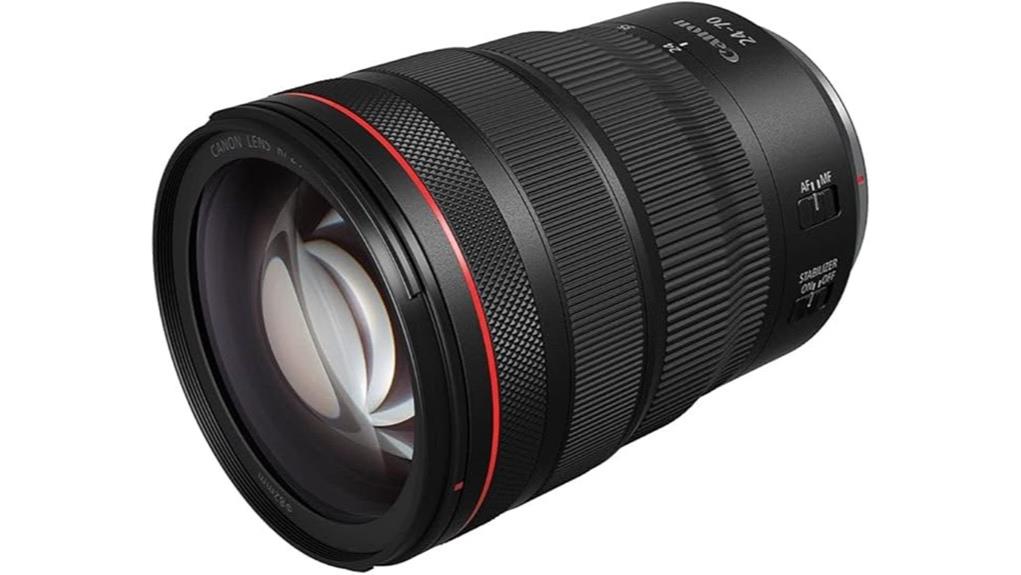
Explore the Canon RF24-70mm F2.8 L IS USM: a professional-grade, constant-aperture standard zoom for RF-mount cameras (EOS R, RP, R5, R6) offering 24–70mm focal range, a bright f/2.8 maximum aperture, 9-blade diaphragm, 84° angle of view, and Nano USM autofocus with up to 5 stops of optical image stabilization. You get an 82mm filter thread, reduced focus breathing, and minimum focus distances of 0.21–0.38m. Build quality emphasizes weather sealing and durable materials; a control ring provides tactile parameter adjustment. Front element receives fluorine coating for protection. Included: lens, caps, EW-88E hood, LP1222 case, and documentation. This lens is an excellent choice for mirrorless camera enthusiasts seeking essential gear to cover a wide range of shooting situations.
Real-World Image Quality: Sharpness, Bokeh, Distortion, and Coatings
Sharpness across the frame is excellent for a standard zoom, with center resolution hitting its peak wide open at f/2.8 and only modest corner falloff that tightens noticeably by f/4–f/5.6; you’ll get crisp detail for portraits and landscapes without needing to stop down aggressively. You’ll observe smooth, pleasing bokeh from the nine‑blade diaphragm with controlled highlights and minimal onion‑ringing. Distortion is well-managed in-camera and easy to correct in RAW; lateral chromatic aberration is low. Coatings (ASC and fluorine) improve flare resistance and maintenance, preserving micro contrast and neutral color rendition under mixed lighting. Using a polarizing filter can further enhance sky contrast and reduce reflections when shooting outdoors, especially with circular polarizers.
Autofocus, Stabilization, and Handling: Performance on Canon RF Bodies
When mounted on Canon RF bodies, the RF 24-70mm F2.8 L IS USM delivers fast, precise autofocus and effective stabilization that let you concentrate on composition rather than technical limitations. You’ll notice Nano USM-driven AF responsiveness: focus locks quickly across the focal range with minimal hunting, reduced focus breathing, and quiet operation suitable for stills and video. Optical IS rated up to five stops provides Stabilization consistency when shooting handheld or during short pans; it pairs well with in-body stabilization in R-series bodies. Build and ergonomics support rapid framing—smooth zoom ring, tactile control ring, and robust weather-sealing for professional use. For photographers adapting lenses or experimenting with different systems, mastering lens mount adapters can expand creative possibilities.
Who Should Buy This Lens? Use Cases, Strengths, and Limitations
Although it’s a professional-grade standard zoom, the RF 24-70mm F2.8 L IS USM suits a wide range of users—from event and wedding photographers who need fast, consistent f/2.8 performance across a useful focal range to portrait, travel, and commercial shooters who value reliable autofocusing, up to five stops of optical IS, and robust weather sealing; videographers will also appreciate Nano USM’s quiet, smooth focus shifts and reduced focus breathing. You’ll find it ideal for wedding coverage, event photography, portrait sessions, or a travel documentarian kit. Strengths: constant aperture, stabilization, build quality, minimal breathing. Limitations: weight and cost for casual shooters. Many photographers pair this lens with sturdy tripod heads for improved stability and precise composition when shooting at slower shutter speeds or in low light tripod heads.
Alternatives and Value: How the RF24-70mm F2.8 Compares and Buying Advice
Curious how the RF 24-70mm F2.8 L IS USM stacks up against other options? You’ll find its optical stabilization, Nano USM AF, and robust build make it a benchmark versus competing zooms from third parties and Canon’s own lineup. If you prioritize low-light capability, autofocus speed, and weather sealing, it’s worth the premium. Consider smaller, lighter alternatives for travel or tighter budgets; they sacrifice aperture, IS, or build. Factor resale value—L-series glass retains value well. Buy new for warranty and peak performance; buy used only with optical and AF checks, and prefer reputable sellers. For close-up work, pairing the lens with dedicated macro techniques and accessories can significantly improve your results, especially when mastering macro lenses.
Some Questions Answered
Is This Lens Compatible With Third-Party Teleconverters?
No — you shouldn’t expect reliable teleconverter compatibility. Third-party teleconverters generally aren’t recommended for this RF 24–70mm f/2.8 L; mechanical and electronic coupling can be inconsistent, and AF performance may degrade. Even if a third-party TC mounts, you’ll likely see reduced image quality, slower autofocus, and increased aberrations. For best results use Canon-approved extenders (if available) or stay within the native focal range to preserve sharpness and AF reliability.
Can It Be Serviced or Repaired Under Canon Warranty Globally?
Yes — you can have the lens serviced under Canon warranty, but warranty transferability and regional exclusions apply. Canon’s one-year warranty covers defects for the original purchaser in the region of purchase; transferred ownership or cross-region service may be limited or denied. You’ll need proof of purchase and serviceable location-specific authorization. Contact Canon regional service for eligibility, authorized repair centers, and any fees if your case falls outside the original region.
How Well Does the Lens Resist Flare in Extreme Backlight?
You handle extreme backlight well; flare is controlled but not entirely eliminated. The lens’ Air Sphere Coating and fluorine coating deliver strong coating durability and reduce ghosting, yielding crisp contrast and usable sunstar quality at smaller apertures. In severe angles you may still see veiling flare and mild contrast loss, but Nano USM focus and sealed construction keep artifacts predictable. Stop down for best starbursts and maximum suppression.
Are There Firmware Updates for the Lens or Control Ring?
Yes — Canon can issue firmware updates that affect the lens and its control ring behavior. You should check Canon’s support site for firmware updates and update history; updates mainly address compatibility, control ring mapping, and AF performance. User feedback often drives these releases. Install via compatible EOS R camera or service tool following Canon instructions, and record your system’s update history and any observed behavior changes after each firmware update.
Does the Lens Support In-Camera Correction Profiles on All RF Bodies?
Yes — most RF bodies apply in-camera correction profiles for this lens automatically. You’ll get consistent color rendition and optimized optical corrections (distortion, vignetting, chromatic aberration) on current EOS R models, which preserves autofocus performance. Older or third-party bodies might lack full profile support, so you should verify firmware and camera compatibility. If needed, update camera firmware to make certain the latest lens profiles and best autofocus performance alongside color rendition consistency.