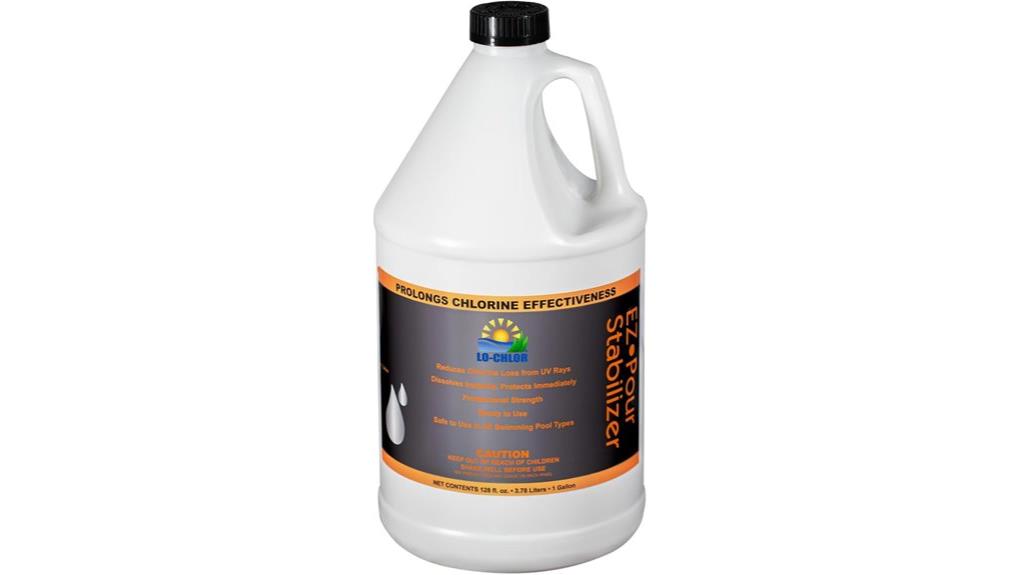
You’ll get fast, mess‑free cyanuric acid dosing that predictably raises stabilizer levels and shields outdoor chlorine from UV degradation. One gallon boosts CYA ~32 ppm per 10,000 gallons, dissolving cleanly without residue and working with all chlorine types and salt systems. It’s non‑acidic, gentle on liners, and enables precise, repeatable dosing for routine maintenance. Expect steadier free chlorine and less frequent shocks; keep tests and small weekly top‑ups. Continue for practical dosing and troubleshooting guidance.
Some Key Takeaways
- Liquid cyanuric acid raises CYA predictably (1 gal ≈ +32 ppm per 10,000 gal), making dosing simple and repeatable.
- Non-acidic formulation dissolves cleanly, avoiding residues, lumps, or filter clogs and works with salt systems.
- Effectively reduces UV-driven chlorine loss, keeping free chlorine stable for days instead of hours.
- Best for outdoor pools needing precise, quick CYA correction; liquid cost higher than bulk granular alternatives.
- Recommended routine: test CYA first, pour in front of a return jet while circulating, and maintain 40–100 ppm.
Quick Verdict and Who Should Buy Lo‑Chlor EZ‑Pour Chlorine Stabilizer
If you want a fast, mess-free way to protect outdoor pool chlorine from UV degradation, Lo‑Chlor EZ‑Pour delivers: its liquid cyanuric acid raises stabilizer levels predictably (1 gal → +32 ppm per 10,000 gal), dissolves cleanly without residues, and works with all chlorine types and salt systems, making it ideal for owners who need reliable, regular dosing to keep CYA between 40–100 ppm. You’ll find it suited to Pool owners managing outdoor pools, operators supervising Beginner swimmers, and anyone needing steady sanitizer retention. Dose predictably, monitor CYA, and top up per use; it’s efficient, non-acidic, and maintenance-friendly.
How Lo‑Chlor EZ‑Pour Works: Liquid Cyanuric Acid and Stabilizer Benefits
Stabilizing outdoor pool chlorine, Lo‑Chlor EZ‑Pour delivers liquid cyanuric acid that binds UV light and slows free chlorine degradation, so your sanitizer stays effective longer. You’ll rely on a non‑acidic stabilizer formulation that’s compatible with all chlorine types and saltwater systems; it provides targeted UV protection without etching surfaces. The liquid medium dissolves uniformly, avoiding residues, lumps, or filter clogs, and raises stabilizer concentration predictably for controlled pool chemistry. By sustaining recommended cyanuric acid ranges, you’ll reduce chlorine demand, optimize sanitizer performance, and extend Pool longevity through consistent, measurable reduction in photodegradation.
Dosing, Application, and Maintenance: How Much to Use and When
Now that you know how EZ‑Pour protects chlorine, let’s cover how to dose and maintain proper cyanuric acid levels. You’ll calculate volume: one gallon raises CYA ~32 ppm per 10,000 gallons. Test current CYA; target 40–100 ppm. For initial fill, add measured gallons to reach target, pouring in front of a return jet while circulating. For maintenance, implement weekly scheduling: test and add small doses to replace dilution or bleed-off. Apply seasonal adjustments—increase checks during high sun months and reduce in colder periods. Shake before use, avoid over‑stabilization, and record readings for controlled dosing.
Performance in Real Pools: Effectiveness, Compatibility, and Common Results
When you run Lo‑Chlor EZ‑Pour in a properly circulating pool, it consistently maintains cyanuric acid within the 40–100 ppm window, reducing UV-driven chlorine loss and keeping free chlorine stable over days rather than hours. You’ll observe predictable stabilization: one gallon adjusts ~32 ppm per 10,000 gallons, so dosing calculations are straightforward. Its non‑acidic, liquid formulation integrates with existing pool chemistry and all chlorine types, including salt systems, without surface or equipment impact. User testimonials report faster recovery after shock, no residue or filter clogging, and extended sanitizer life. Monitor CYA and free chlorine to confirm target results.
Pros, Cons, and When to Choose Lo‑Chlor EZ‑Pour Over Other Stabilizers
Although many stabilizers do the same basic job, Lo‑Chlor EZ‑Pour stands out when you need precise, no‑fuss CYA control. You get rapid, predictable increases (32 ppm/gal per 10,000 gal), clean dissolution, and non‑acidic chemistry that’s gentle on liners and compatible with salt systems and all chlorine types. Pros: precise dosing, no residues, reduces UV degradation, simple application. Cons: liquid cost per ppm can exceed bulk granular CYA; storage space and shipping weight. Choose EZ‑Pour when you prioritize dosing accuracy, quick correction, and Stabilizer economics favors reduced waste and labor over lowest material cost.
Some Questions Answered
Is Lo‑Chlor Ez‑Pour Safe for Pets if They Drink Pool Water?
No, occasional small sips likely won’t cause acute harm, but you shouldn’t let pets drink treated pool water. The liquid stabilizer (cyanuric acid) can contribute to elevated chemical exposure; pet exposure may cause gastrointestinal upset. Pets often develop taste aversion and avoid large intake, yet repeated ingestion risks cumulative effects. Prevent access, provide fresh water, and consult your veterinarian if you notice vomiting, lethargy, or other symptoms after drinking.
Can I Store Opened Gallons Outdoors or Does Freeze Damage Occur?
You shouldn’t store outdoors; freeze damage can occur. The liquid cyanuric acid solution is sensitive to freezing, which can cause container rupture or product separation that reduces efficacy. Keep opened gallons in a cool, shaded area above freezing (recommended 40–80°F/4–27°C), tightly sealed and upright. Avoid direct sunlight and temperature cycling. If freeze damage occurs, dispose per local hazardous-waste guidance and replace the product.
Does Ez‑Pour Affect Pool pH or Alkalinity Readings?
No — it won’t directly change pH or total alkalinity readings when dosed per instructions. You’ll avoid pH drift because the liquid cyanuric acid is non‑acidic and formulated not to alter water chemistry. However, monitor for apparent Alkalinity masking: stabilizer additions can obscure true buffering capacity, so test both pH and alkalinity after dosing. Adjust alkalinity with proper buffers only if tests indicate deviation from target ranges (80–120 ppm).
Is It Compatible With Mineral or Non-Chlorine Sanitizers?
Yes — you’ll find Mineral compatibility is good; the liquid cyanuric acid won’t react negatively with mineral systems. You’ll also see minimal Non chlorine interactions: it’s formulated to be compatible with all chlorine types and saltwater, and it won’t interfere with mineral or non‑chlorine sanitizers’ chemistry. Dose as directed, monitor stabilizer ppm, and maintain target 40–100 ppm to preserve sanitizer efficacy without causing residues or filter issues.
How Long After Adding Can Swimmers Re-Enter the Pool?
You can let swimmers re-enter immediately after adding; no extended wait times are required for this liquid stabilizer. Still, follow safety precautions: shake well before dosing, pour in front of a return jet, avoid splashing concentrated product on skin or eyes, and ventilate if working in enclosed spaces. Monitor stabilizer levels after dosing to confirm they reach the target range (40–100 ppm) and maintain sanitizer effectiveness over time.