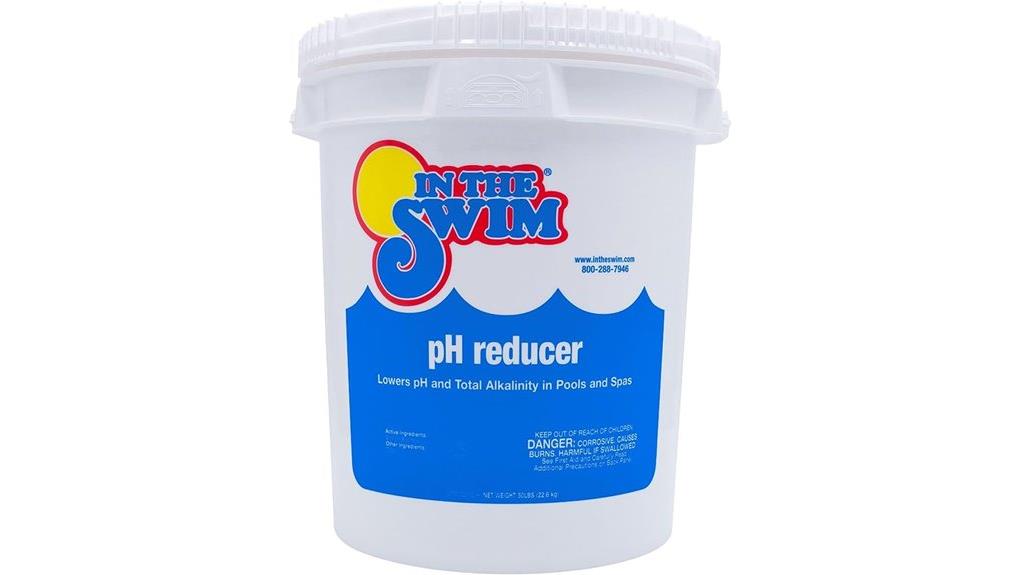
If you maintain a pool, spa, or hot tub and need predictable pH and alkalinity control, In The Swim pH Reducer is a 90% active granular sodium bisulfate sold in 50 lb bulk that reliably lowers pH and TA when dosed per label. You’ll measure current values, add small increments near returns or pre-dissolve, wait 1–4 hours, and retest to reach 7.2–7.6 while monitoring free chlorine and corrosion risk. Continue for full usage, safety, and value details.
Some Key Takeaways
- Sodium bisulfate granules (90% active) in a 50 lb bag reliably lowers pH and total alkalinity for large pools.
- Dose based on current pH/alkalinity; add increments, wait 1–4 hours, then retest to reach 7.2–7.6.
- Improves chlorine efficacy and clarity once pH is corrected, but monitor free chlorine after dosing.
- Pros: low cost per dose and high active content; cons: heavy shipping weight and dusty granular handling.
- Follow PPE, avoid inhalation, store sealed/dry, and compare price to smaller packages for small tubs.
Who This Review Is For and the Main Question Answered
If you maintain a pool, spa, or hot tub and need a reliable way to lower pH and total alkalinity, this review is for you. You’re responsible for pool maintenance and want a product that delivers predictable pH adjustments, preserves chlorine efficacy, and minimizes corrosion risk. This piece answers the main question: does In The Swim pH Reducer provide consistent, controllable reductions while supporting chemical safety protocols? You’ll get technical evaluations on performance, dosing practicality, handling precautions, and suitability for pools, spas, and hot tubs. Use this to decide if the product fits operational needs, safety procedures, and water-balance targets.
What In The Swim pH Reducer Is (Ingredients, Size, and What It Does)
Because you need precise control over pool chemistry, In The Swim pH Reducer is a granular sodium bisulfate formulation (90% active) sold in a 50-pound container (item weight listed as 53 lb; unit count 800 oz; model Y7135, UPC 803354120826, ASIN B072F81SMF). You’ll get a single, concentrated product whose chemical composition is primarily sodium bisulfate with inert carriers, designed to lower pH and total alkalinity. It improves sanitizer efficacy, reduces cloudiness, and protects surfaces and skin. Product sizing supports extended seasonal use. Clear dosage guidance is provided on-label for pools, spas, and hot tubs; follow measured additions and allow full dissolution.
How to Use In The Swim pH Reducer Safely and Get Your pH to 7.2–7.6
When you need to bring pool, spa, or hot tub pH into the target 7.2–7.6 range, measure current pH and alkalinity, calculate the required dose, and add In The Swim pH Reducer in small, controlled increments. You’ll wear PPE, avoid inhalation, and follow chemical handling protocols. Use accurate test kits, then perform dosage calculations based on volume and delta pH. Broadcast granular sodium bisulfate near return jets or pre-dissolve per label. Wait 1–4 hours between additions, retest, and repeat until pH stabilizes. Store product sealed, dry, and away from incompatible chemicals. Keep records of doses and readings.
Real-World Performance: Effectiveness, Speed, and Impact on Chlorine and Water Clarity
Although granular sodium bisulfate works predictably, you’ll want to judge effectiveness by how quickly pH falls per calculated dose and by any downstream effects on chlorine and clarity. You’ll see In The Swim’s 90% sodium bisulfate lower pH within hours in typical pool volumes; response scales linearly with dose. Monitor free chlorine because acid dosing can temporarily increase measured free chlorine activity via improved active species equilibrium — note chlorine interaction when retesting. Clarity improvement follows as balanced pH optimizes sanitizer performance and reduces particulate binding. Measure before and after dosing to confirm target 7.2–7.6 and maintain sanitizer residual.
Pros, Cons, Buying Tips, and Value (Price, Pack Size, Reviews, Returns)
Having seen how In The Swim’s sodium bisulfate affects pH, chlorine readings, and clarity, you can now weigh practical buying factors like pack size, cost per dose, review volume, and return policy. Pros: high 90% active ingredient, 50 lb bulk reduces cost per dose, widely reviewed (757 reviews) confirms consistency. Cons: heavy 53 lb shipping weight, granular dust requires careful handling, not convenient for small tubs. Buying tips: run a price comparison versus smaller packages, buy during sales, check seller warranty and Amazon’s 30-day return. Value hinges on usage: large pools benefit most. Follow storage tips: dry, cool, sealed.
Some Questions Answered
Is This Product Safe for Vinyl Pool Liners?
Yes — you can use it on vinyl pool liners if you follow instructions. The granular sodium bisulfate lowers pH/alkalinity without directly damaging vinyl when dissolved and dosed correctly. You’ll prevent localized bleaching or surface stress by pre-dissolving, broadcasting solution into deep water, and maintaining recommended pH 7.2–7.6. Monitor pool surface regularly, avoid concentrated contact with the liner, and include liner care in routine chemical checks to protect material longevity.
Can I Use It Around Plants or Grass if It Spills?
No — you shouldn’t let it contact plants or grass if it spills. The granular sodium bisulfate can cause plant damage and root burn by sharply lowering soil pH. If a spill occurs, you’ll remove granules immediately, dilute and neutralize the area with plenty of water to flush watering runoff away, and test soil pH before replanting. Wear gloves and avoid runoff into sensitive landscaping to prevent harm.
Does It Have a Strong Odor During Application?
You shouldn’t notice a strong smell during normal application; sodium bisulfate is low-odor. However, if you handle large quantities in confined spaces or inhale dust, you may experience respiratory irritation. Always add granules to water, avoid creating dust clouds, wear a dust mask and eye protection, and work outdoors or with ventilation. Follow label directions to minimize exposure and potential irritation.
How Should I Store Leftover Granules Long-Term?
Store leftover granules in airtight containers to prevent exposure. You’re going to keep them cool, dry, and away from sunlight; maintain moisture control with desiccant packs or silica gel. Label containers with product name and date, and store off the floor in a ventilated area away from acids or bases. Check periodically for clumping; if granules cake, dispose per local regulations. Keep out of reach of children and pets.
Is It Compatible With Saltwater Chlorine Generators?
Yes — it’s compatible with saltwater chlorine generators when used correctly. Sodium bisulfate lowers pH without adding calcium, so it won’t directly harm the cell. You should monitor pH and salt levels frequently; avoid overdosing which can accelerate electrode corrosion by creating acidic, chloride-rich conditions. Maintain pH in the 7.2–7.6 range and follow manufacturer dosing and cell maintenance schedules to minimize corrosion and guarantee reliable saltwater compatibility.