You’re getting a pro-grade DX sports camera that pairs a 20.9MP sensor and EXPEED 5 engine with a 153-point Multi-CAM 20K AF system to deliver 10 fps bursts and industry-leading subject tracking. You’ll appreciate usable ISO to roughly 12,800, strong highlight recovery, and conservative sharpening that preserves tight detail. 4K/30p, a tilting touchscreen, and robust connectivity aid modern workflows. Handling, buffer depth, and dual cards support long runs with big lenses, and more specifics follow.
Some Key Takeaways
- 20.9MP DX sensor and EXPEED 5 deliver sharp images with strong highlight recovery and usable ISO roughly 6400–12,800.
- 10 fps continuous shooting (up to 200 frames) and long buffer suit sports and wildlife action sequences.
- Multi-CAM 20K 153-point AF (99 cross-type) with Group Area AF provides dense, reliable high-speed subject tracking.
- 4K UHD video at 30 fps, tilting 3.2" touchscreen, and built-in Wi‑Fi/Bluetooth/NFC support basic video workflows and remote control.
- Includes dual EN-EL15 batteries, 64GB card, tripod, and accessories—good out-of-box value for pros and advanced enthusiasts.
What the Nikon D500 Delivers for Action and Wildlife Shooters
Hit fast and track accurately: the D500 pairs a 20.9MP DX sensor with the EXPEED 5 engine to give action and wildlife shooters rapid, high-quality results, delivering 10 fps continuous shooting for up to 200 frames while its Multi-CAM 20K 153-point AF system (99 cross-type) and Group Area AF maintain focus on erratic subjects. You’ll exploit high speed tracking via dense AF coverage and a 180k-pixel RGB metering sensor that informs exposure and subject recognition. Buffer depth and dual card options sustain long bursts, and the DX crop enhances telephoto reach for distant subjects, minimizing lag and maximizing keeper rates. Gear Guide for Enthusiast Photographers and Camera Fans highlights the D500 as a top choice for dedicated camera fans seeking action-ready DSLRs.
Real-World Image Quality: Stills, Low‑Light, and Dynamic Range
Beyond its speed and AF prowess, the D500’s imaging hardware and processor define what you actually get in your files: the 20.9MP DX CMOS sensor paired with EXPEED 5 produces tightly resolved stills with fine detail retention across a broad ISO range, while the 180k-pixel RGB sensor helps maintain accurate exposure and color in complex scenes. You’ll see excellent color fidelity out of camera, with conservative sharpening and noise suppression that preserves texture rendering at base and mid ISOs. In low light the sensor/processor combo yields usable ISO performance to 6400–12,800; highlight retention and recoverable shadow detail remain strong for DX-class sensors. This makes it a great choice for photographers who want reliable results and value user guides that help them master their gear.
Video, Screen, and Connectivity: 4K, Touchscreen, and Streaming/Workflow
While the D500 is primarily celebrated for stills and autofocus, its video, touchscreen, and connectivity features form a capable and workflow-friendly package for hybrid shooters. You get 4K UHD at 30 fps with clean color and usable detail from the EXPEED 5 pipeline; crop and bitrate limitations mean you'll plan framing and recording duration. The 3.2-inch tilting touchscreen controls speed menu navigation, focus point selection, and playback inspection but lacks full touchscreen exposure control in some modes. Built-in Wi‑Fi, Bluetooth and NFC enable rapid image transfer, remote control, and basic 4K streaming workflows via HDMI output and tethered apps. For many photographers, pairing the D500 with an external monitor can improve framing and monitoring with larger, brighter displays.
Handling, Autofocus, and Burst Performance for Fast Shooters
After covering the D500’s video, touchscreen, and connectivity capabilities, it's worth looking at how the camera handles in fast-paced shooting scenarios. You’ll find ergonomic controls with purposeful button placement that lets you change settings without shifting your eye from the viewfinder. The substantial grip comfort supports long handheld runs; weight balance across the body and a long lens minimizes torque. The Multi-CAM 20K 153-point AF with 99 cross-type points and Group Area AF locks quickly on erratic subjects. At 10 fps and buffer depths up to 200 frames you’ll capture extended sequences reliably, with consistent tracking and minimal dropouts. Consider pairing lenses with lens filters to enhance image quality and control in challenging shooting conditions.
Kit Value, Accessories Included, and Who Should Buy It
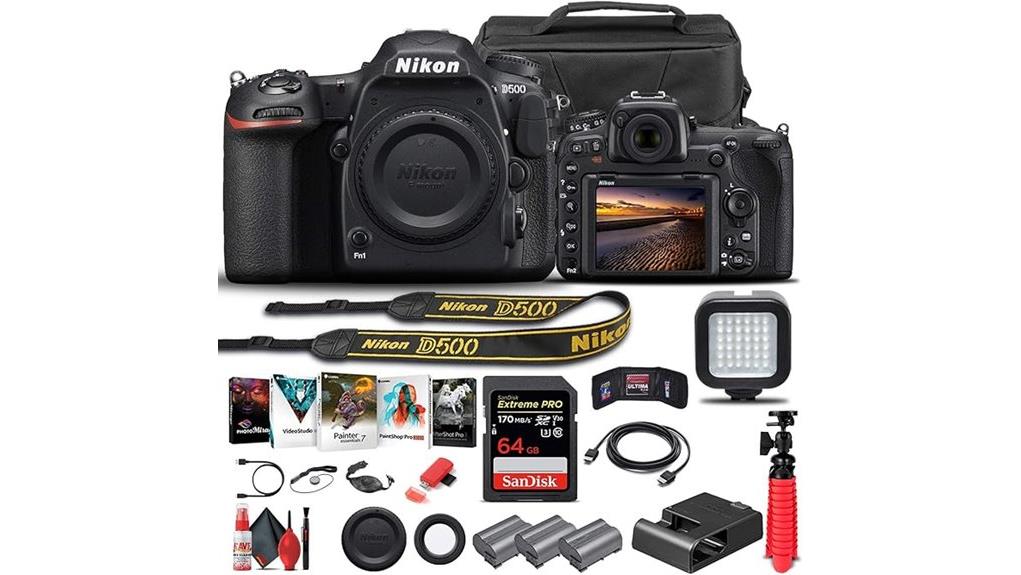
Because the D500 kit bundles a robust selection of accessories alongside the body, you get a lot of practical value for the price. The included SanDisk 64GB card, dual EN-EL15 batteries, card reader, HDMI cable, mini LED light, cleaning kit, flexible tripod and camera bag let you shoot immediately and sustain long sessions. Corel software and memory wallet add workflow utility. For budget shooters this package reduces initial accessory costs compared with buying body-only plus peripherals. You should buy this kit if you need pro-level AF, 10 fps burst, 4K video and a complete starter kit that’s ready out of the box. Perfect camera backpacks are a great way to carry this kit on photography adventures.
Some Questions Answered
Does the D500 Have Sensor-Based In-Body Image Stabilization?
No — the D500 doesn’t have sensor stabilization; it lacks in body VR. You’ll rely on lens-based VR (Vibration Reduction) or faster shutter speeds and higher ISO for stabilization. The camera’s body offers robust build and advanced AF, but vibration control is delegated to compatible Nikkor lenses with optical stabilization. If you need sensor-based stabilization, you’ll want a different model that explicitly lists in‑body image stabilization (IBIS) in its specs.
Can the D500 Use Modern Z-Mount Lenses With an Adapter?
Yes — you can use modern Z mount lenses on the D500 via Z mount adaptation with a Nikon FTZ or third‑party adapter. You’ll retain autofocus and EXIF communication in most cases, but expect limitations: no native Z electronic aperture coupling, so the adapter mediates aperture control electronically and some lens functions (eye‑AF, advanced stabilization coordination) may be reduced. Test specific lens/adapter combos for full compatibility and firmware updates.
How Long Does Battery Life Last Under Continuous 4K Recording?
You’ll typically get about 1 to 1.5 hours of continuous 4K recording per EN-EL15 battery under normal ambient conditions; with two batteries you’re looking at roughly 2–3 hours total if you hot-swap. Battery endurance varies with temperature, recording bitrate, and LCD use. Expect thermal throttling to kick in during prolonged 4K clips in warm environments, which can shorten effective recording time even if battery capacity remains.
Is the Autofocus System Compatible With Older AF-D Lenses?
Yes — AF‑D compatibility is supported, but with limits. You can mount older AF‑D lenses and use focus confirmation in single‑point AF with the D500’s body‑driven screw‑drive motor. However, those lenses won’t gain full autofocus performance: they rely on the camera’s mechanical AF motor, so you’ll miss advanced Multi‑CAM 20K features like Group Area AF responsiveness and some cross‑type recognition. Expect accurate focus confirmation but reduced AF speed and tracking.
Does the Camera Support Dual Card Backup or Overflow Recording?
Yes — you get dual slots and you can use overflow recording. You’ll assign the primary slot for capture and let the secondary take over when the first fills, enabling uninterrupted shooting for long bursts or timelapses. The camera also supports separate slot functions (RAW/JPEG, backup), so you can configure true dual-slot backup or overflow recording depending on workflow. This gives robust media management for demanding shoots.