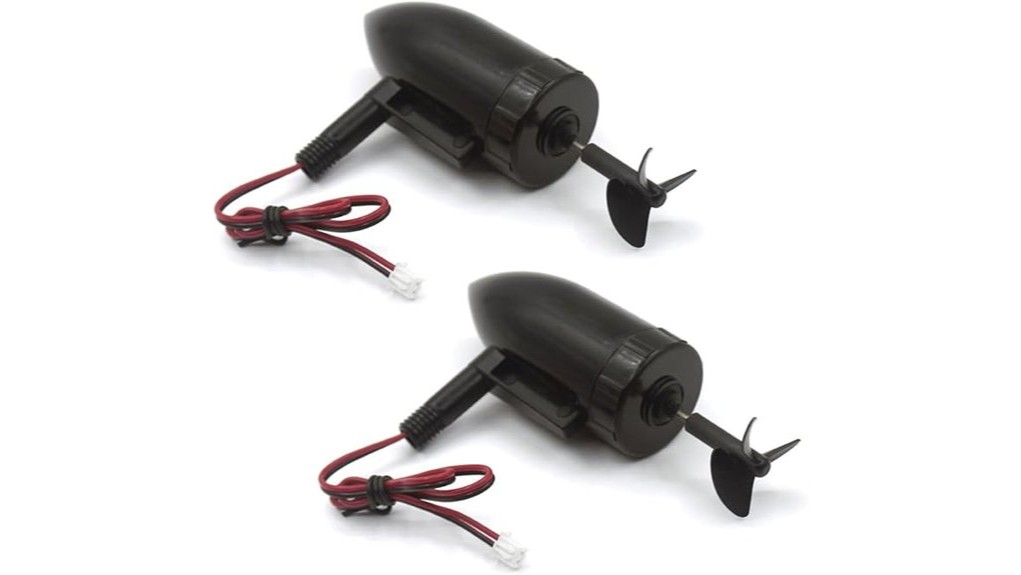
You’ll get a budget-friendly pair of three-blade plastic thrusters with motor housings, brackets, basic wiring and a 12,000 max speed rating; they trade a bit of top-end RPM for smoother, more linear thrust and better load handling, with slightly higher torque demand and sensitivity to clearance and balance. Installers should verify shaft diameter, pitch and motor fit, secure set-screws, trial-run at low throttle, and watch corrosion-prone metal inserts; continue for detailed tips and use cases. underwater thruster performance insights are crucial for optimizing the efficiency and durability of your setup. By regularly assessing factors such as thrust output, energy consumption, and environmental adaptability, you can ensure that your system operates at peak performance. Moreover, leveraging advanced analytics can help in predicting potential maintenance needs, ultimately extending the lifespan of your thrusters.
Some Key Takeaways
- Three-blade plastic propellers trade slight top-end RPM for smoother thrust, better load handling, and more linear acceleration.
- Verify shaft diameter, mounting hole spacing, and motor compatibility before retrofitting to avoid fitment issues.
- Trial-run at low throttle, monitor vibration and motor temperature, then incrementally increase load to detect problems early.
- Plastic construction is budget-friendly and easy to replace but less impact-resistant and sensitive to saltwater corrosion on metal inserts.
- Best for hobby RC boats, kayak camera rigs, and emergency propulsion, not for competitive racing or commercial heavy-duty use.
What the HEziej Underwater Thrusters Include and Key Specs
The HEziej underwater thruster kit includes one set of remote-control boat motor thrusters with a pair of three-blade plastic propellers and mounting components for retrofit installation. You’ll get pair contents listed: two propellers, motor housings, brackets, fasteners, and basic wiring. You’ll note key dimensions are indicated as “product size: as pictured” with manual tolerance of 1–2 cm; expect sturdy plastic construction and universal fit for RC boats. Specs include three-blade design, maximum speed rating 12000, and easy installation. You’ll assess compatibility, mounting footprint, and material robustness before retrofit to guarantee reliable performance. These kits are popular among paddlers and water photographers who outfit kayaks for underwater camera mounting and propulsion.
How the 3-Blade Propellers Perform in Speed and Thrust
While three-blade propellers sacrifice a bit of top-end rpm compared with two-blade designs, they deliver noticeably smoother thrust and better load handling for retrofit RC boat applications. You’ll find thrust curve stability improves; torque demand rises slightly but acceleration feels more linear, aiding control during maneuvers. Peak speed may drop marginally versus two-blade setups, yet effective thrust at cruising rpm increases, improving real-world performance under load. Monitor cavitation effects at high rpm—three blades distribute pressure pulses, reducing localized vapor pockets but can still induce blade noise if clearance or balance is poor. Overall, expect tradeoffs favoring thrust stability over absolute top speed. They are a popular choice for kayak and fishing enthusiasts who prioritize reliable thrust and control during water adventures.
Step-by-Step Installation and Compatibility Tips
If you’re retrofitting your RC boat with these HEziej 3-blade thrusters, begin by confirming shaft diameter, mounting hole spacing, and motor compatibility to avoid misalignment or electrical overload; document the existing propeller pitch and RPM range so you can anticipate changes in thrust and top speed. Use an installation checklist: verify propeller pair integrity, secure set-screws, correct rotation direction, and balance. Refer to a compatibility matrix mapping shaft sizes, KV ratings, and recommended ESC amperage. Torque mounting bolts to spec, trial-run at low throttle, monitor temperature and vibration, then incrementally increase load while logging performance metrics. Also make sure you have suitable repair and patch materials on hand for hull or skeg damage, including patches, adhesive, and repair tools to address any incidental issues encountered during installation.
Durability, Materials, and Real‑World Reliability
Although you’re buying a budget-friendly plastic assembly, expect the HEziej thrusters to withstand routine hobby use when installed and balanced correctly. You’ll assess long term durability by monitoring wear patterns on blades, shafts, and housings after repeated runs. Impact resistance is modest; the plastic resists minor collisions but deforms under high-energy strikes, so avoid debris. Corrosion testing isn’t a priority for inert plastics, yet metal inserts and fasteners need saltwater consideration—use sacrificial coatings or stainless replacements. In real-world reliability, predictable failure modes and easy part swaps keep downtime low, provided you follow maintenance intervals and inspection protocols. For best results on painted or molded surfaces, follow gelcoat care practices to protect finishes and extend service life.
Final Verdict : Who Should Buy These Thrusters?
Because these HEziej thrusters trade premium materials for affordability, you should buy them if you prioritize cost-effective speed upgrades and easy maintenance for hobby RC boats rather than maximum durability or professional-grade performance. You’ll benefit if you’re a budget buyer or hobbyists upgrading casual models: the 3-blade design and included propeller pair deliver measurable thrust gains and simplified installation. Don’t expect industrial longevity; plastic construction limits impact resistance and extended heavy-use reliability. Choose these thrusters for recreational speed boosts, spare-part economy, and straightforward swaps. Avoid them for competitive racing rigs or commercial applications that demand metal components and certified endurance. They’re especially suited to kayakers and other paddlers who want emergency propulsion options and compact power solutions for short outings, given the growing market for emergency power banks.
Some Questions Answered
Are Replacement Propellers Sold Separately?
No, replacement propellers aren’t listed as sold separately; the set includes a pair of propellers. You’ll want to verify spare compatibility before ordering aftermarket parts. Check propeller sizing against shaft diameter, pitch and blade count (3-blade) to guarantee fit and thrust performance. If you need spares, source universal RC boat propellers with matching dimensions or contact the manufacturer for compatible replacements or warranty options to avoid performance or installation issues.
Is a Warranty Registration Required After Purchase?
No, you’re not required to register after purchase, but registering can improve warranty benefits. You’ll follow a straightforward registration process—typically online or via the manufacturer’s instructions—to activate extended coverage and streamline claims. If you skip registration, basic warranty terms may still apply, but claim processing could be slower or limited. You should register promptly to document purchase details, receive product updates, and guarantee faster, clearer support if issues arise.
Do These Thrusters Come Pre-Lubricated?
No, they don’t come pre-lubricated. You’ll need to apply lubrication types suited for plastic and marine use, like silicone grease or PTFE-based lubricants. For maintenance tips, clean shafts and prop hubs, remove debris, and apply a thin, even coat to bearings and contact points. Recheck after initial runs and relubricate periodically. Avoid petroleum-based oils that can swell plastic and reduce thruster lifespan.
Can They Be Used in Saltwater Without Corrosion Risk?
No, they’re not inherently saltwater-safe long-term; plastic helps but metal fasteners and bearings can corrode. You’ll need rigorous saltwater maintenance and periodic inspection. Apply corrosion inhibitors to exposed metal, rinse thoroughly with fresh water after use, and lubricate bearings per schedule. For extended saltwater operation consider stainless or sealed bearings, sacrificial anodes, and replacement intervals based on exposure. These steps’ll minimize corrosion risk and prolong thruster life. In addition to regular maintenance, understanding the dc underwater thruster motor performance is crucial for ensuring optimal functionality in harsh marine environments. Monitoring how well the motor functions under various conditions can help identify potential issues before they become major problems. Always consult the manufacturer’s guidelines for specific performance metrics to ensure reliability throughout its operational lifespan.
Are Extra Mounting Screws Included in the Package?
No — the package doesn’t list extra mounting screws. You’ll need to verify screw inventory against your installation checklist before starting. As a technician, keep extra hardware on hand: compatible stainless screws, washers, and thread locker. Mounting tips: test-fit components dry, confirm hole alignment, then torque screws evenly to avoid stress. If screws are missing or sizes differ, source replacements matched to the plastic housing and shaft specifications.