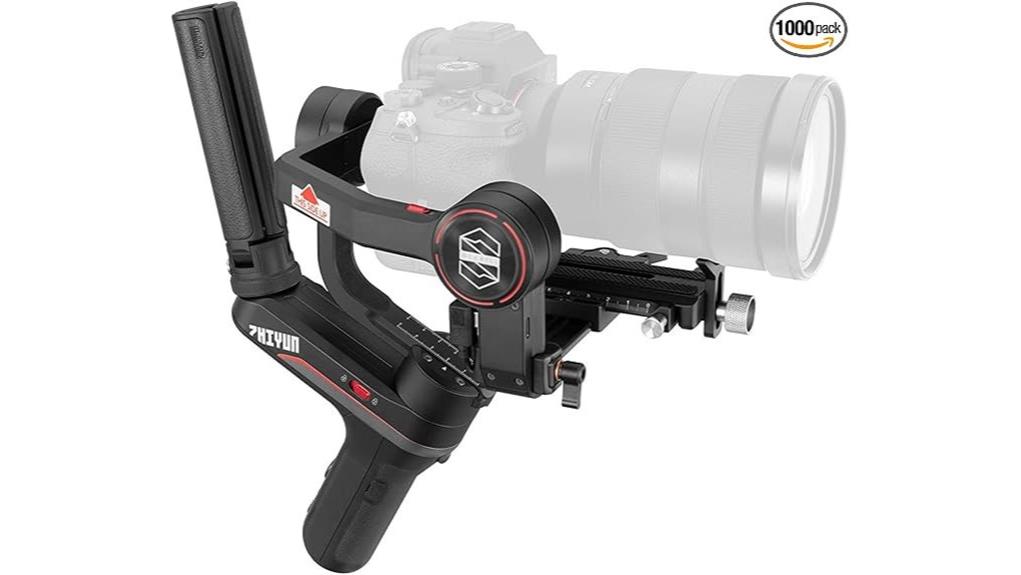
You’ll get a compact, highly responsive 3‑axis gimbal that stabilizes mirrorless or DSLR setups up to about 6.6 lb, uses Zhiyun’s 8th‑gen Instune algorithm for precise motion control, and runs roughly 14 hours on two 18650 cells. It’s balanced for underslung Sling work, recovers quickly from direction changes, and accepts TransMount accessories for wireless monitoring and focus motor support. Keep going and you’ll find hands‑on balancing tips, performance notes, and accessory guidance.
Some Key Takeaways
- Compact, highly responsive 3-axis gimbal for mirrorless or DSLR setups up to about 6.6 lb.
- Instune 8th-gen stabilization delivers smooth pans, brisk walking, and quick recovery from direction changes.
- Lightweight 926 g chassis with dual focus controls, OLED feedback, and comfortable Sling mode ergonomics.
- Reliable battery life around 14 hours under typical loads; heavy payloads will reduce runtime.
- Lacks built-in audio and needs optional TransMount module for wireless monitoring and added accessories.
Quick Verdict: Who the Weebill S Is Best For
If you need a compact, highly responsive gimbal that handles serious mirrorless or DSLR setups (up to about 6.6 lb) while delivering true mechanical stabilization and advanced control, the Zhiyun Weebill S is a strong choice. You’ll appreciate its 8th‑gen Instune algorithm, 3‑axis torque handling, and 14‑hour battery for long shoots. It suits beginner filmmakers stepping up from handheld rigs and urban vloggers who need underslung Sling mode and quick shifts. With a 926 g chassis, dual focus controls, and OLED feedback, it balances payload capability and ergonomics—ideal when you demand reliable, professional stabilization. This model is perfect for shooters focused on mastering smooth shots with handheld gimbals.
What’s in the Box and How to Balance Your Camera Fast
Unpack the Weebill S and you’ll find the gimbal body, detachable sling handle, quick‑release camera plate, three axis motor arms (folded), USB-C charging cable, two 18650 batteries installed or included (depending on package), a wrist strap, a tripod/baseplate, and basic documentation—enough to get you up and running without extra purchases. Inspect the in box contents: check plate clamps, motor arm alignment, battery seating. Mount camera, set lens position on plate, then balance axes sequentially—roll, tilt, pan—using small plate shifts. Balancing tips: start with lenses attached, use smooth incremental adjustments, verify neutral positions before powering on. For extended shoots consider shoulder rig comfort to reduce fatigue and improve stability.
Real-World Performance: Stabilization, Battery Life, and Handling
Put the Weebill S through motion-heavy scenarios and you'll quickly see where its Instune 8th stabilization algorithm and mechanical gimbals shine: panning, brisk walking, and low underslung moves remain smooth with minimal micro‑jitters, and rapid direction changes recover in a fraction of a second without visible bounce. You’ll notice reduced motion blur at slower shutter speeds versus handheld, preserving sharp frames during rolling shots. Battery life reliably hits roughly 14 hours under typical loads, though heavy payloads cut runtime. Handling is ergonomic and well-balanced; Sling mode lowers ergonomic fatigue for underslung work, and controls stay responsive during long shoots. It's a great choice for photographers and videographers looking to master smooth shots with gimbal stabilizers in varied shooting conditions.
Accessories, Transmission Module, and Compatibility With Popular Cameras
Explore the Weebill S ecosystem to make sure your rig matches each shoot: Zhiyun offers a quick-release plate, external TransMount Image Transmission Module, focus/wheel motors, and counterweights that let you balance larger mirrorless and DSLR combos while retaining the gimbal’s full motor performance. You’ll appreciate targeted accessory compatibility lists and payload specs when pairing heavy zooms or cine lenses. The TransMount module streams 1080p/30fps with claimed 100m range; you should test Transmission latency for your workflow—it’s low for framing but not zero. Overall, accessories expand capability, but confirm balancing limits and firmware matching before buying. For smoother motion and professional results, consider integrating motorized sliders into multi-axis setups for dynamic shots and repeatable moves with motorized camera sliders.
Final Pros, Cons, and Whether You Should Buy the Weebill S
While the Weebill S delivers class-leading stabilization, long battery life, and a compact form factor that suits demanding mirrorless and DSLR setups, you should weigh its strengths against specific workflow limits—payload ceiling, lack of onboard audio, and reliance on optional TransMount accessories for wireless monitoring. You’ll appreciate battery longevity (~14 hours), precise Instune 8th stabilization, and solid user ergonomics including sling mode and dual focus controls. Cons: 6.6 lb payload limit, no built-in audio, and extra cost for transmission/monitoring. Buy it if you prioritize mechanical stability, portability, and battery runtime over integrated audio or higher payloads. Consider pairing it with camera cages to enhance mounting flexibility and accessory support.
Some Questions Answered
Does the Weebill S Support Smartphone App Firmware Updates?
Yes — you can update the Weebill S via Zhiyun’s smartphone app. You’ll use the app to check app updates, download firmware packages, and push firmware compatibility updates to the gimbal over Bluetooth. You’ll want to confirm battery level, stable Bluetooth connection, and sufficient storage before starting. The app shows firmware version history and progress; if compatibility issues appear it prompts rollback or retry and logs errors for troubleshooting.
Can I Charge the Gimbal While Using It?
Yes — you can charge the gimbal while using it. You’ll enable battery charging via USB-C power input; this supports simultaneous operation but may slightly increase motor noise and heat. Runtime extends as you charge, though charging speed can be reduced under load. For peak performance, use a high-quality PD charger, monitor temperature, and avoid heavy payloads during charging to reduce stress on the motors and electronics for safer simultaneous operation.
Is There Warranty Coverage Outside the Country of Purchase?
Yes — Zhiyun typically offers an international warranty, but coverage varies by region and dealer. You’ll need to register your Weebill S and keep proof of purchase; otherwise coverage can be limited. Service centers abroad will honor repairs if the issue falls under warranty terms, though some parts or labor may be excluded. Before traveling, confirm warranty scope and authorized service centers in your destination to avoid unexpected costs.
Are Counterweights or Extra Batteries Sold Separately?
Yes — counterweights and extra batteries are sold separately. You’ll perform balance adjustments using removable counterweights for heavier rigs; Zhiyun offers accessory weight kits and lens support options. For battery management, you’ll buy spare 18650 cells or official battery packs to extend the Weebill S’s ~14-hour runtime and rotate cells safely. Evaluate vendor compatibility and firmware notes so your added weights and batteries won’t interfere with motor torque limits.
Does It Support Wireless Lens Focus Motors?
Yes — it supports wireless follow focus systems, but motor compatibility depends on the specific motor and mount. You’ll use the Weebill S’s dual focus control system and follow focus motor mounting points; many third‑party wireless focus motors (with standard 0.8/0.5 gear options) work, though some proprietary motors require adapters. Check motor torque, gear pitch, and power/control interface to guarantee reliable wireless follow focus operation and smooth focus pulls.