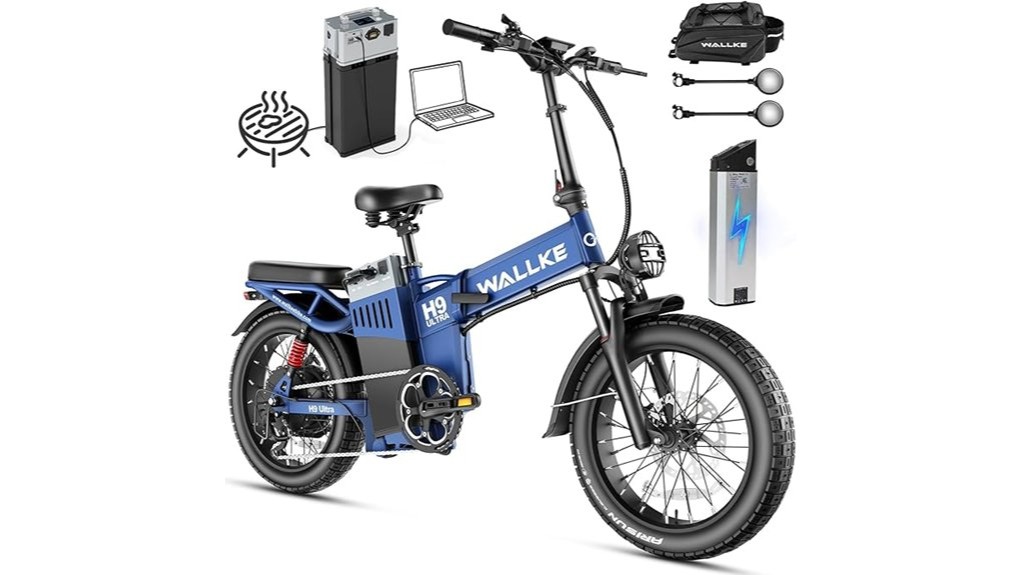
You’ll get a heavy-duty, long-range e-bike with a 6000W peak motor and torque-sensor PAS that delivers predictable, linear assist for sustained climbs and bursts. Dual removable batteries and onboard AC/solar charging support long mixed-terrain rides and provide a 600W portable power-station output. The foldable 6061 aluminum frame, full suspension, 4-piston brakes and 20×4″ tires handle heavy payloads, while accessory mounts and a 400 lb system rating favor utility over commuter agility—keep going to see detailed specs and tradeoffs.
Some Key Takeaways
- 6000W peak motor with 105 N·m torque and torque-sensor PAS delivers strong, linear assist and predictable throttle bursts for technical terrain.
- Dual removable batteries (48V 55Ah + 22Ah) provide long real-world range and on-board 600W AC/solar charging for off-grid top-ups.
- Robust 3mm 6061 aluminum foldable frame, full suspension, 20×4″ tires, and four-piston 203mm brakes prioritize durability and heavy-payload stability.
- Rated 400 lb system load and 150 lb rear rack, with integrated cargo mounts and accessory provisioning for deliveries and bikepacking.
- Trades commuter nimbleness for raw power and range; consider controller upgrades and warranty/service comparisons before purchase.
What the Wallke H9 Ultra Offers at a Glance
Curious what the Wallke H9 Ultra actually gives you? You get a purpose-built, high-torque 6000W platform with torque-sensor PAS for controlled power delivery and a robust 3mm 6061 aluminum frame rated for heavy loads. Battery aesthetics are integrated into the chassis with a removable front pack for modular capacity and serviceability. Full suspension, 20×4″ ARISUN tires, and 203 mm 4-piston hydraulic discs prioritize terrain versatility and confident braking. Accessory compatibility is broad: rear rack, mirror, and power-outlet provisioning support cargo, commutes, and campsite use. Build quality, certifications, and component choices signal long-term utility without guesswork. The bike pairs well with rugged protective storage like ebike battery cases designed for outdoor riders.
Real-World Range, Charging, and Power-Station Features
You’ve seen the H9 Ultra’s hardware and load capability; now look at how that hardware performs day-to-day. You’ll get a 48V 55Ah main and 22Ah front battery—battery chemistry is lithium-based with UL safety certifications—yielding combined usable capacity for long-range PAS claims. In practice, conservative mixed-terrain rides approach published figures when you favor pedal assist. Charging is flexible: onboard AC/solar integration supports 600W charge and simultaneous discharge. The unit doubles as a portable power station with 600W power output, multiple AC ports plus USB and Type-C. Expect predictable degradation, fast top-up times, and reliable off-grid utility. This makes the H9 Ultra a solid choice for outdoor riders seeking reliable portable ebike chargers.
Motor, Torque, and Ride Performance (Hills, Top Speed, PAS)
Although the H9 Ultra centers on a single 6000W peak motor, you’ll feel its strength through a measured 105 N·m of torque that delivers brisk launches, sustained hill climbs, and a top speed around 40 MPH when conditions allow. You get pedal-assist driven by a torque mapping strategy: the torque sensor provides pedal-force-proportional assist for smooth hill climbing without jerks. Throttle response is linear and predictable, useful for short bursts or technical terrain. Sensor calibration is precise out of the box, minimizing lag and misreads. Overall you’ll notice confident power delivery, efficient PAS range gains, and reliable solo-motor durability. For riders who want to further customize performance, consider upgrading the controller for smarter motor control to match specific terrain and riding styles.
Build, Load Capacity, Suspension, and Braking for Harsh Use
Power and torque matter little if the chassis can’t handle them, so let’s look at how the H9 Ultra’s build supports heavy-duty use. You get a 3mm 6061 aircraft‑grade aluminum frame that resists frame corrosion and keeps weight manageable. Foldable geometry preserves stiffness; claimed 400 lb system load and 150 lb rear rack rating let you carry tools or gear. Suspension pairs an adjustable air fork with dual rear shocks; tuning range and included pump let you match damping to payload. Four‑piston 203 mm hydraulic discs deliver predictable fade‑resistant stopping power; integrated mounting points aid cargo security. The bike’s design complements outdoor riders who need secure storage solutions for gear and accessories.
Who Should Buy the H9 Ultra and How It Compares to Alternatives
When you need an ebike built for long hauls, heavy payloads, and off‑grid power, the H9 Ultra stands out: its dual‑battery 2,640 Wh capacity, 6000W peak motor with torque‑sensing PAS, and 600W integrated AC/solar power hub make it a practical tool for delivery runs, camping, or remote work sites where range and onboard electricity matter as much as speed and climb ability. You should buy it if you prioritize maximum range, payload, rugged frame, and portable power. Compared to lighter commuter models it trades nimbleness and commuter ergonomics for durability and output; check warranty comparisons and service networks before committing. For riders planning extended trips, consider carrying spare ebike batteries to extend range and ensure uninterrupted power for devices.
Some Questions Answered
Is the H9 Ultra Legal to Ride on Public Roads in My Area?
Maybe — it depends on your local laws and speed limits. You’ll need to check classification, max motor power and top speed against regional e-bike rules; some areas ban 6000W / ~40 MPH units on public roads or require registration, plates, insurance, or helmet use. If it exceeds permitted wattage/speed, you can’t legally ride it on streets without special permits. Contact local DMV or law enforcement for definitive, location-specific guidance.
How Long Is the Warranty and What Does It Cover Specifically?
Warranty duration is typically 1 year standard, with extended options tied to Wallke’s lifetime technical support and service programs. Coverage specifics include manufacturing defects for frame, motor, battery (UL-certified cells), electronics, and braking systems; wear items and misuse aren’t covered. You’ll get repair or replacement procedures, parts labor terms, and prorated options for extended plans. Always register your bike and keep proof of purchase to validate claims.
Are Replacement Batteries or Parts Readily Available Globally?
Yes — you’ll generally find replacement batteries and parts available through Wallke’s regional distributors, plus some third party batteries compatible with standard 48V systems. You’ll rely on authorized channels for UL-certified packs and OEM components; third party options work for accessories but may void warranty. For remote regions, distributors and Wallke’s lifetime technical support help source parts, though shipping times and stock vary by market.
Can I Fly With the Removable Front Battery on Planes?
No — you can’t fly with the removable front battery in most cases. Airline policies and lithium restrictions typically forbid batteries over 100 Wh in checked baggage and restrict carry-on size; the H9 front battery (22Ah at 48V ≈ 1056 Wh) far exceeds limits. For battery transport, contact airlines for special handling, freight options, or shipping via hazardous goods carriers; follow packing procedures, state of charge limits, and manufacturer documentation for compliance.
What Maintenance Schedule Is Recommended for Long-Term Reliability?
You should follow a structured plan: perform monthly tune ups (check bolts, brake pads, tire pressure, suspension sag, torque sensor calibration, drivetrain lubrication, battery connections) and log findings. After heavy use, inspect motor mounts and wiring. For seasonal storage, charge batteries to ~50–70%, remove the front pack, store in cool dry place, and top-up every 3 months. Annually, do full service: brake bleed, shock rebuilds, and battery health check.