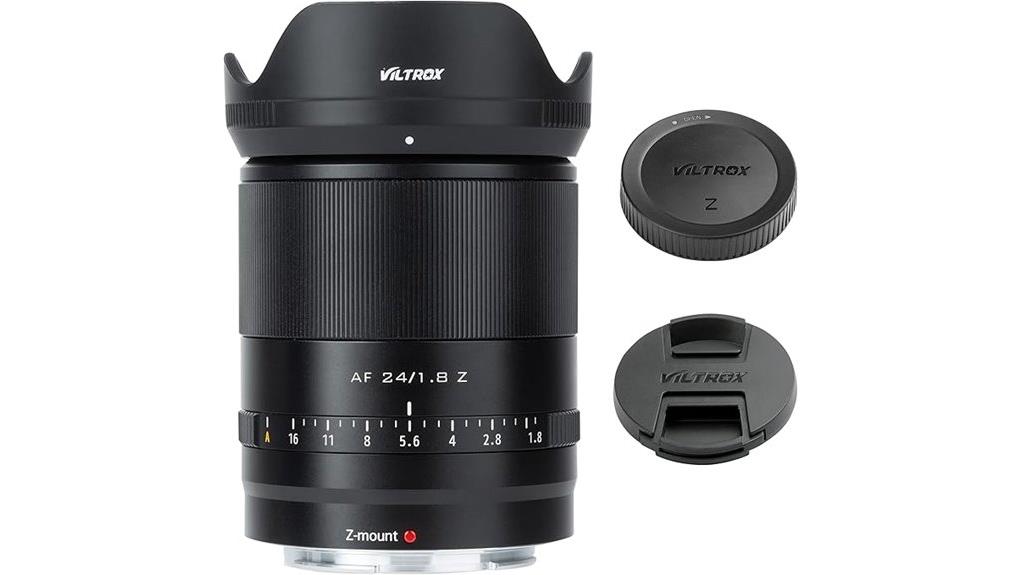
You’ll find the Viltrox 24mm f/1.8 delivers exceptional sharpness and low-light reach in a compact package, thanks to an 11-element, 9-group design with two aspherics and three ED elements. Autofocus is near-silent STM with internal focus for stable handling, though tracking speed isn’t pro-level and focus breathing is modest. f/1.8 gives notable subject isolation and improved nightstar point rendering with reduced coma. Continue for detailed comparisons, use cases, and handling notes.
Some Key Takeaways
- Exceptional sharpness center-to-corner with strong wide-open resolution thanks to 11 elements, including two aspherics and three ED elements.
- Fast f/1.8 aperture improves low-light sensitivity and subject isolation for environmental portraits and night scenes.
- STM lead-screw motor offers near-silent, responsive AF suitable for run-and-gun video and vlogging, though not pro-level speed.
- Good coma control and accurate point-source rendering make it useful for astrophotography, albeit not as fast as specialty astro lenses.
- Compact, lightweight build with internal focus and aperture ring, but only modest weather sealing—use caution in harsh conditions.
Optical Performance Deep-Dive: Sharpness, Aberration Control, and Low-Light Behavior
Although it's a wide-angle prime, the 24mm F1.8 delivers class-leading sharpness across much of the frame thanks to an 11-element, 9-group design that combines two aspheric elements with three ED and three high-refractive-index elements. You’ll notice superior edge sharpness compared with many rivals, with center-to-corner resolution holding up at wider apertures. The aspherics and ED glass improve coma correction and chromatic control, yielding more accurate point reproduction for nightscapes and star work. Its F1.8 aperture increases low light sensitivity, reducing exposure times and ISO needs versus slower glass, while maintaining controlled aberrations across the field. The lens is well suited for photographers focused on portrait work and optics selection thanks to Perfect Portrait Lenses' emphasis on matching lenses to shooting style and needs, making it a practical choice for those building a portrait-focused kit with optics selection.
Autofocus and Handling: STM and Internal Focus Performance for Stills and Video
Frequently, you'll find the Viltrox 24mm F1.8's STM + lead-screw stepping motor and internal-focus design give a balance of speed, silence, and compactness that suits both stills and video work. You’ll notice responsive AF with near-silent operation and reliable subject acquisition for landscapes and run-and-gun scenes. Compared to linear motors, the STM's silent tracking is superior for on-camera audio, though ultimate speed trails pro-level systems. Internal focus keeps handling stable and avoids front-element rotation, aiding filters and gimbals. Measured focus breathing is modest but present; for critical cinema work you may prefer a longer-throw cine lens. This makes the lens a good match for photographers using lens calibration tools to fine-tune focus performance.
Aperture, Bokeh, and Creative Control: F1.8 Performance, Aperture Ring Use, and Depth-of-Field Examples
At f/1.8 the Viltrox 24mm delivers a shallow depth of field uncommon for a 24mm wide-angle, letting you isolate subjects while still showing contextual background. You’ll notice creamy but restrained bokeh thanks to the 11-element design and aspheric/ED elements, which control coma and chromatic artifacts. The physical aperture ring offers manual click engagement and tactile feedback for deliberate stops; set to A for camera-controlled exposure. Compared with slower wide primes, this lens produces more pronounced shallow backgrounds useful for environmental portraits and night scenes. Use creative filters sparingly—the lens’s optical corrections preserve contrast and point-source rendering. This makes it a strong choice for enthusiasts seeking essential lens gear with an emphasis on wide-angle performance and creative control essential lens gear.
Build, Size, and Compatibility: Weight, Dimensions, Z-Mount Fit, and Camera Pairing Recommendations
Because Viltrox designed the 24mm F1.8 with mobility in mind, you get a compact, lightweight package (70 x 86.7 mm, 370 g) that keeps balance and handling predictable on mirrorless bodies. The metal-plastic composite barrel feels rigid; mount sealing is modest rather than weatherproof, so caution in adverse conditions is advised. Its internal-focus design preserves length during focusing, improving handheld use compared with longer zooms. Z-mount fit is precise across Z fc, Z6/7 series and Z50 bodies, maintaining reliable electronic communication. Tripod compatibility is conventional; use small support or clamp adapters for extended exposures to avoid strain on the mount. This lens is an excellent match for users focused on mirrorless photography who value portability and optical speed.
Verdict and Who Should Buy It: Strengths, Trade-Offs, and Buying Scenarios (Portrait, Landscape, Astrophotography, Vlog)
While the Viltrox 24mm F1.8 delivers notable optical versatility, you should weigh its strengths against specific trade-offs for each use case. You get strong low-light F1.8 performance, controlled aberrations via aspheric and ED elements, and accurate color rendition; build quality is solid for travel and handheld work. For portraits it offers environmental context but expect perspective distortion versus longer primes. For landscape it's sharp wide-open to mid apertures with minimal chromatic issues. For astrophotography the coma control helps point stars, though a faster aperture would be ideal. For vlogging the compact size and quiet AF make it a practical, cost-effective choice. It also pairs well with telephoto systems for users who specialize in wildlife photography.
Some Questions Answered
Does It Include Lens Hood and Caps in the Box?
Yes — the box contents typically include the lens hood and front/rear caps. You’ll find accessory compatibility noted for standard 62mm filters and the supplied hood, which mounts securely to control flare. Compared to some competitors that omit hoods or caps, this package is more complete for immediate use. You’ll still want to verify regional bundles, but most retail kits supply hood, caps, and documentation for straightforward out-of-box operation.
Is the Front Element Weather-Sealed or Weather-Resistant?
No — the front element isn't fully weather-sealed; it lacks thorough weather sealing. You’ll have front protection from the optical design and coatings, but not the rubber gaskets or full environmental sealing found on higher-end lenses. Comparatively, this lens offers light resistance for casual outdoor use but won’t match pro-grade weather sealing. You should avoid heavy rain, dust storms, or prolonged exposure without extra protection like a hood or rain cover.
What Filter Thread Size Does It Use?
It uses a 62mm filter threadsize. You’ll find accessory compatibility aligns with common 62mm filters, hoods, and caps, making it easier to share accessories across similar primes. Technically, 62mm is compact compared with larger wide-angle designs, reducing vignetting risk when using thin filters. Comparatively, it’s more versatile than uncommon sizes, so you’ll spend less on adapters and won’t compromise image quality with bulky step-up rings.
Does It Support In-Lens Image Stabilization?
No, it doesn't include optical stabilization or sensor shift in the lens. You'll rely on the camera body for stabilization; that can affect autofocus performance positively on stabilized bodies. Compared to IS-equipped lenses, you'll get lighter weight and simpler mechanics but no in-lens motion correction. Manual focus remains precise via the internal focus design and physical aperture ring, yet you'll miss lens-based stabilization benefits for handheld low-light or long-exposure shooting.
How Long Is the USB-C Firmware Support Period?
There’s no fixed public timeframe; manufacturers typically offer firmware longevity of about 2–5 years, depending on model popularity and issues. You should expect a support roadmap that prioritizes critical fixes and compatibility updates early, then tapering to occasional maintenance. Compare offerings: tier-one brands often sustain longer support than third-party makers. You’ll want to confirm with Viltrox or your retailer for an exact timeline and update policy.