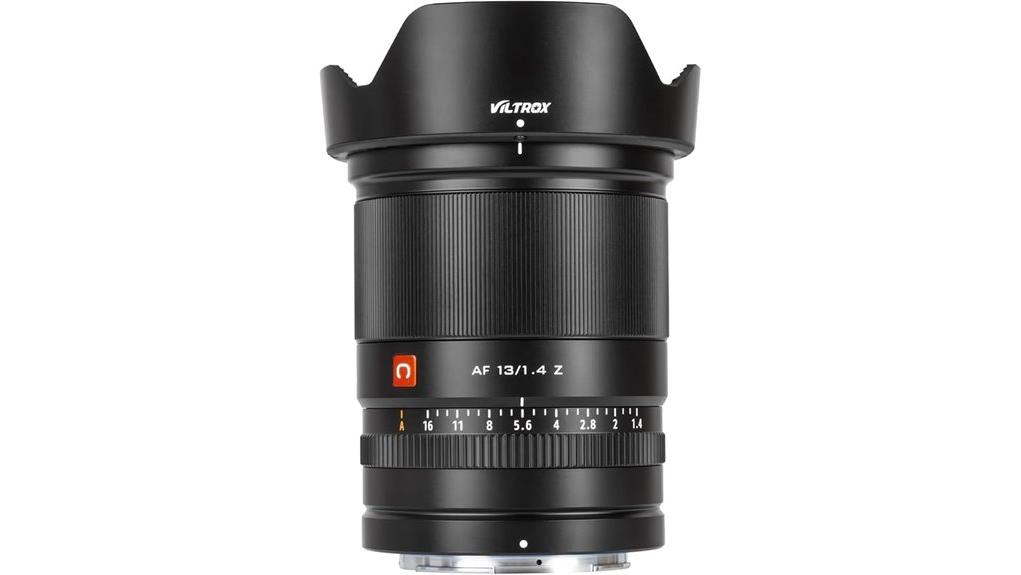
You’ll find the Viltrox 13mm f/1.4 Z is a compact, ultra-wide prime that gives strong center resolution at f/1.4 and improved corners by f/2.8, with restrained CA and good coma control for stars. The bright aperture aids low-light shooting and close-focus to 22 cm supports portrait-closeups and vlogging, while step-less STM autofocus and a clickless aperture ring suit hybrid video work. If you want technical detail and practical usage tips, more specifics follow.
Some Key Takeaways
- Ultra-wide 13mm f/1.4 delivers excellent low-light performance and creative shallow depth on APS-C Z-mount bodies.
- Center sharpness is strong at f/1.4; corners tighten noticeably by f/2.8 for better edge-to-edge detail.
- Controlled chromatic aberration and good coma keep stars and highlights compact with minimal color fringing.
- Smooth step-less STM autofocus, eye/face detection, and clickless aperture suit hybrid photo/video workflows.
- Compact, lightweight design with 22 cm close-focus supports handheld vlogging, portrait-closeups, and travel use.
Image Quality and Optical Performance of the VILTROX 13mm F/1.4 Z-Mount
While the ultra-wide 13mm field and bright f/1.4 aperture give you strong low-light capability and pronounced subject separation, the VILTROX optical design prioritizes usable edge-to-edge sharpness and controlled aberrations over absolute microcontrast. You’ll find center resolution strong wide open, with corner sharpness improving notably by f/2.8. Chromatic aberration is restrained by lens coatings and element placement, yielding minimal color fringing in high-contrast shifts. Coma control is effective for point sources, keeping stars and highlights compact toward edges. Distortion correction in-camera or during RAW processing straightens lines cleanly, supporting architectural and landscape use. Perfect Portrait Lenses caters to photographers seeking dedicated portrait camera lenses and related accessories.
How the Lens Performs in Low Light, Portrait-Closeups, and Vlogging
Because the 13mm f/1.4 couples an ultra-wide field with a very large aperture, you'll get strong low-light performance and the ability to isolate subjects in close-up and vlogging scenarios without pushing ISO excessively. You can shoot low light portraits with shutter speeds lowered while preserving edge-to-edge sharpness if you position subjects near the frame center; background compression is limited by focal length, so subject isolation relies on proximity and aperture. Close-focus capability (22 cm) lets you create dynamic portrait-closeups. For vlog stabilization, the lens' compact weight reduces handshake and pairs well with in-body stabilization and electronic gimbals for smoother footage. For best results when shooting close-ups, use dedicated macro techniques to maximize subject detail and depth separation.
Autofocus, Step-less Aperture, and Video-Friendly Controls in Use
Having seen how the 13mm f/1.4 performs for low-light and close-up work, you’ll appreciate how its autofocus and aperture systems support video and run-and-gun shooting. You get step-less STM focusing that delivers predictable, smooth pans and reliable eye/face-detection acquisition. Silent tracking is effective for handheld vlogging; focus shifts are unobtrusive on-camera. The step-less aperture ring enables precise aperture shift during pulls, avoiding abrupt exposure jumps. Controls are immediate and tactile, letting you override AF without menu diving. Overall, the system balances responsive AF performance with controlled, film-like aperture change for practical video workflows. The lens is also well-suited for enthusiasts using follow focus systems to achieve smooth focus pulls.
Handling, Size, Close-Focus Behavior, and Real-World Ergonomics
Although compact in build, the Viltrox 13mm f/1.4 feels deliberately balanced for handheld use, with a lightweight body that minimizes front-heaviness on APS-C Z bodies and lets you operate one-handed during run-and-gun shoots. You’ll appreciate compact handling: the barrel is short, mount stiffness is solid, and balance stays close to the camera’s axis. Tactile controls include a smooth, clickless aperture ring and a responsive focus ring for manual override. Close focus to 22 cm delivers strong foreground impact without excessive distortion. Overall ergonometric balance supports extended shooting, quick framing, and reliable handheld workflow. This makes it a practical choice for photographers who value portability and effective support for tripod accessories.
Verdict and Buying Guide: Who Should Buy This Lens and Best Alternatives
Who should pick the Viltrox 13mm f/1.4 Z? You should consider it if you’re a budget shooter or travel vlogger seeking an ultra-wide, bright prime for APS-C Z-mount. Its f/1.4 aids low-light and shallow depth, close-focus expands creative framing, and compact ergonomics suit run-and-gun work. Autofocus and step-less aperture support video pull-focus and face/eye detection for hybrid use. If you need ultimate edge-to-edge sharpness, weather sealing, or native-brand stabilization, look at Nikon Z DX primes or higher-end Samyang/Rokinon options. For vlogging with minimal weight, it’s an efficient, cost-effective choice. For wildlife or sports shooters prioritizing reach over ultra-wide fields, consider pairing your kit with a dedicated telephoto lens instead.
Some Questions Answered
Is This Lens Weather-Sealed or Weather-Resistant?
No, it isn’t fully weather-sealed. You won’t get exhaustive weather sealing; the lens lacks full environmental gaskets and robust sealing at critical joints. That increases risk of moisture ingress and mount corrosion over prolonged exposure in harsh conditions. You can mitigate by avoiding wet environments, using a protective cover, and cleaning the mount regularly, but you shouldn’t rely on this lens for heavy rain or dusty, corrosive situations without extra protection.
Does It Support In-Camera Lens Corrections for Distortion?
Yes — the lens supports in-camera correction profiles on compatible Nikon Z bodies, so your camera will apply distortion and vignetting corrections automatically. You’ll still want to check autofocus behavior and edge sharpness after correction, since profile adjustments can slightly alter perceived micro-contrast and corner rendition. If you prefer raw files, corrections can be applied later in post; shoot tests to confirm how corrections interact with AF performance and peripheral detail.
What Filter Thread or Adapter Options Are Available?
You can't fit a standard front filter directly; use Filter adapters or Threadless mounting solutions. You’ll attach a dedicated adapter ring that provides a threaded or magnetic carrier for gels, ND, or circular filters while preserving the bulbous front element. Threadless mounting avoids vignetting by positioning filters forward and often uses bayonet or snap-on carriers. Confirm adapter model compatibility with the lens flange profile and maintain clearances for close focusing.
Is There Image Stabilization in the Lens?
No, the lens doesn’t include optical stabilization. You’ll rely on your Nikon Z-body for stabilization and can use electronic stabilization in-camera or during post-processing for video. The lens provides fast f/1.4 aperture and STM focusing but lacks built-in optical stabilization elements. For handheld stills and video, enable in-body image stabilization (IBIS) or electronic stabilization to compensate for camera shake, especially at close focusing distances and during run-and-gun shooting.
Does It Cover Full-Frame Sensors or Only APS-C?
It only covers APS-C; it’s not designed for full frame coverage. You’ll get correct framing and optimized image circle on APS-C bodies, while mounting on full-frame Z cameras will force crop or produce heavy vignetting. Corner performance on the intended APS-C format is acceptable for run-and-gun use, but on full frame you’ll see severe corner falloff and optical degradations, making it unsuitable for full frame applications.