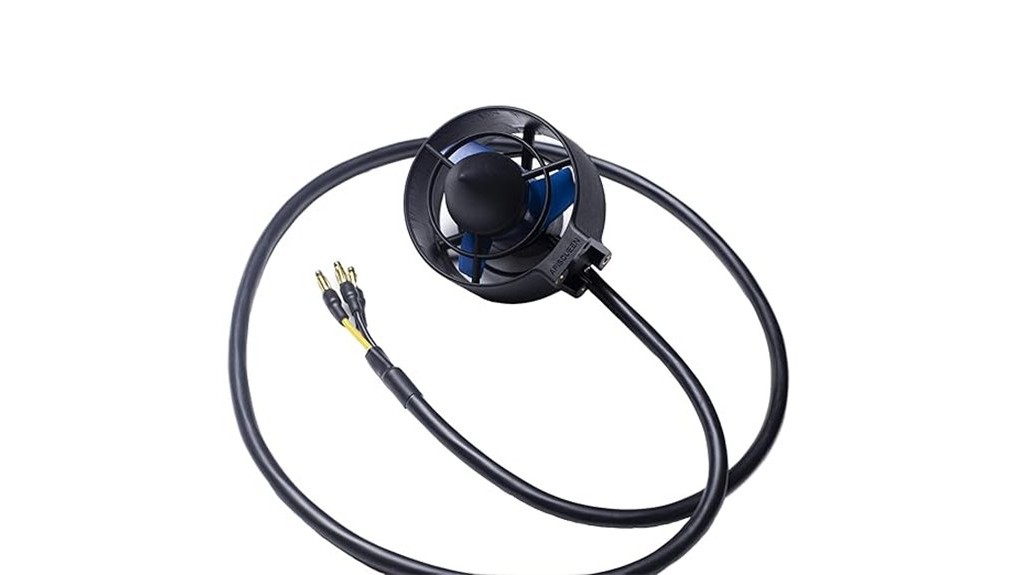
You’ll find the U2 CCW is a compact, corrosion-resistant 860 KV brushless thruster rated for 12–16 V that delivers up to about 1.7 kg peak thrust and roughly 150 W nominal draw. Real-world thrust and current depend on prop load, mounting and battery sag, with 4S giving better headroom. The composite housing resists salt and limits galvanic attack, but it needs an external ESC, proper wiring and cooling. Read on and you’ll get installation tips, performance caveats and use-case guidance.
Some Key Takeaways
- Brushless 860 KV CCW motor rated 12–16V (3–4S LiPo) delivers up to 1.7 kg peak thrust under ideal mounting conditions.
- Nominal power draw ≈150 W; measure current vs throttle and expect battery sag on 3S during bursts.
- Composite one-piece housing resists seawater corrosion, with ribs for structural protection and debris deflection.
- Requires external ESC, marine-grade wiring (18 AWG min, 16 AWG preferred >50 cm), and swap two phase wires to reverse rotation.
- Best for small RCs, kayaks, hobbyist divers, and light ROVs; unsuitable for heavy-duty, long-endurance commercial applications.
U2 Underwater Thruster (CCW) At a Glance: Specs and What It Promises
While compact and lightweight, the U2 Underwater Thruster (CCW) promises practical propulsion for small underwater platforms, delivering up to 1.7 kg of thrust from a brushless 860 KV motor at 12–16 V (3–4S LiPo) and drawing roughly 150 W nominal power. You’ll appreciate the compact design and one-piece composite construction for corrosion resistance and simplified mounting. The CCW motor orientation matters for vehicle yaw control. You’ll need an external ESC and should plan wiring and mounting clearances around front and rear protective ribs. Assess noise levels for sensor suites; acoustic signature will affect close-range operations and arrayed deployments. Consider pairing this thruster with kayaks and prusik gear for versatile waterborne adventures.
Real-World Performance: Thrust, Power Draw, and Battery Compatibility
Because real-world thrust and draw vary with prop load and mounting, you should benchmark the U2 under representative conditions rather than rely solely on the spec sheet. Measure static and dynamic thrust at multiple RPMs; expect 1.7 kg peak under ideal mounting but lower in confined or inefficient housings. Monitor current vs. throttle to map power draw; the 150 W rating is a practical target, not absolute. Watch for battery sag during peak bursts on 3S systems and confirm 4S headroom if using aggressive props. Evaluate prop efficiency vs. shaft loading to optimize endurance and avoid ESC overheating or voltage collapse. Also confirm compatibility with your kayak’s accessory layout and electric bilge pump placement to ensure safe integration and gear clearance.
Build, Materials, and Seawater Durability You Can Expect
If you plan to run the U2 in saltwater, you’ll appreciate that ApisQueen uses a one-piece open-mold composite housing engineered for corrosion and oxidation resistance; the material mix resists galvanic attack and minimizes crevice sites where salt can accumulate. You’ll find the composite’s measured stiffness balances weight and impact tolerance. Corrosion testing cited by the maker indicates multi-week salt spray endurance without visible pitting; field exposure will vary. Front and rear ribs enhance structural protection and channel flow—Ribs effectiveness is evident in debris deflection and span stiffening. Seal interfaces are minimal; inspect O-rings regularly to maintain expected seawater durability. For water-based adventures, consider storing electronics in clear dry boxes to keep gear dry and protected.
How to Install and Wire the U2 With an External ESC
Having inspected the housing and seals for seawater readiness, you’re ready to mount and wire the U2 to an external ESC. Secure the U2 UT001 with recommended fasteners, aligning its CCW rotation clearances. Use marine-grade connectors and select wire gauge based on 12–16 V, 150 W draw—18 AWG minimum, 16 AWG preferred for runs over 50 cm. Route wires to avoid chafe; pot and strain-relief all penetrations. Match motor phase leads to ESC phases; confirm rotation and swap two phase wires if direction is incorrect. Calibrate ESC programming for throttle range, braking, and soft-start to protect the motor and battery. For kayak installations, keep a small bilge pump on board and ensure easy access to it in case of water ingress essential bilge pump.
Best Use Cases and Who Should (Or Shouldn’t) Buy This Thruster
Where will the U2 UT001 perform best? You’ll find the UT001 ideal for small RCs, kayak racing support craft, and hobbyist divers needing compact, corrosion-resistant thrust. Marine researchers can deploy it on light survey platforms and shallow commercial ROVs for low-power maneuvers. Entry level builders will appreciate simple integration and external ESC compatibility. Avoid it for heavy duty applications and large commercial ROVs where 1.7 kg thrust and 150 W limit sustained performance. Advanced engineers will recognize constraints — consider higher-power alternatives for payload-heavy or long-endurance projects. Don’t buy it if you need high-thrust, continuous-duty propulsion.
Some Questions Answered
Does the Thruster Include Mounting Hardware or Screws?
No, it doesn’t include mounting hardware or screws. You’ll need to source your own mounting options and fasteners compatible with marine use. For installation tips, choose corrosion-resistant stainless steel or marine-grade bolts, use backing plates to distribute load, and seal threads with marine sealant or PTFE tape. Make certain alignment with the propeller axis, secure connections to an external ESC, and verify torque specs to prevent vibration or loosening during operation.
Is There a Warranty or Return Policy From Apisqueen?
ApisQueen doesn’t list a standard warranty duration or return window on the product listing; you’ll need to confirm with the seller or retailer. Check your purchase invoice and platform policy for explicit warranty duration, return window, and any restocking or shipping conditions. If buying directly from ApisQueen, request written warranty terms covering defects, expected remedies, and claim procedure. Keep serial, order details, and photos to support any claim.
Can the Propeller Be Replaced or Upgraded Separately?
Yes — you can replace or upgrade the propeller separately, but you’ll need to confirm propeller compatibility. You’ll want blades sized and balanced for the U2’s shaft, CCW rotation, and 12–16V motor RPM range. Upgrade options include higher-efficiency or corrosion-resistant blades and matched pitch changes for more thrust or speed; expect to verify shaft fit, mounting type, and hydrodynamic balance. Use an external ESC and test for vibration and motor load.
How Loud Is the Motor Underwater in Decibels?
You’ll hear moderate motor noise underwater, typically around 70–85 dB re 1 µPa at 1 m for similar 150 W brushless thrusters; exact levels depend on mounting and RPM. Expect higher broadband noise at blade passage frequencies. Sound attenuation in water is low, so noise propagates farther than in air; using isolation mounts and lower RPMs reduces radiated levels. Measure on-site with a hydrophone for precise dB readings.
Is There an Available CW (Clockwise) Version of This Model?
Yes — a clockwise variant is available. You’ll get identical motor rotation reversed for the CW version, matching propeller direction requirements. Verify housing compatibility since CCW and CW housings are symmetric in many designs but may differ in shaft coupling or rib orientation. You’ll still need an external ESC configured for the motor rotation. Check product listing or manufacturer specs to confirm part number and compatibility before purchase.