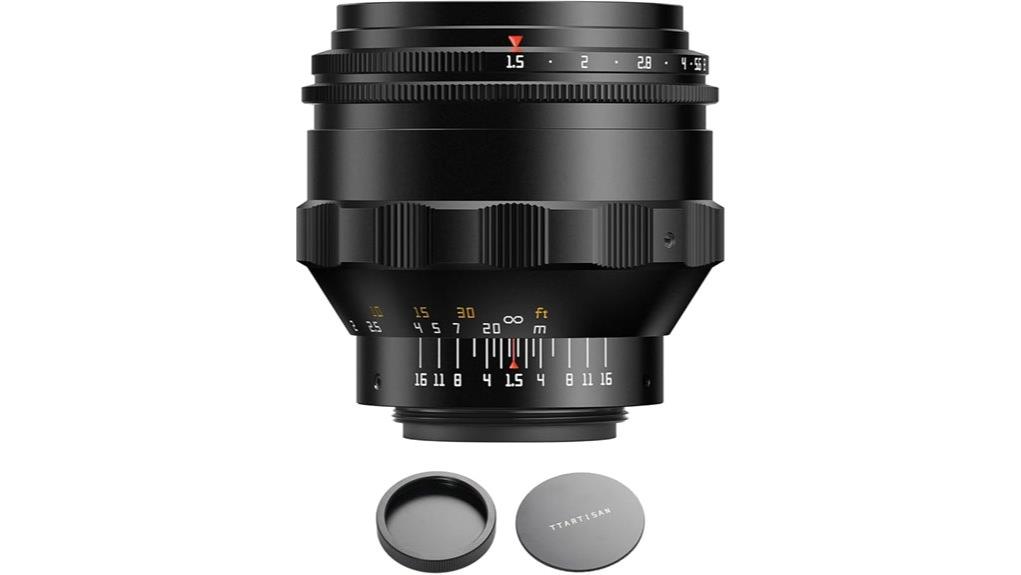
You get a compact, all‑metal 75mm f/1.5 on M42 that’s aimed at manual‑focus portrait and low‑light work. Center sharpness is excellent by f/2.8 and strong at f/4, while edges improve stopped down but show slight coma wide open. The fast aperture produces pronounced swirl bokeh and helps exposure, though microcontrast softens a bit. Focus throw is long and precise; mount may need a T5 tweak for alignment. Keep going and you’ll find detailed test tips, adapter notes, and buying guidance.
Some Key Takeaways
- Fast 75mm f/1.5 delivers strong subject separation and pronounced swirl bokeh ideal for creative portraits at wide apertures.
- Center sharpness is excellent by f/2.8 and very usable at f/1.5, with edges improving when stopped down to f/4–f/5.6.
- Compact, mostly metal build feels solid with a long, damped focus throw; M42 screw mount may need T5 Torx alignment.
- Lacks stabilization and weather sealing; best used with mirrorless adapters, focus peaking, and magnification for precise manual focus.
- Great budget alternative for characterful rendering, but compare to vintage Zeiss and modern third-party options before buying.
What the TTArtisan 75mm F1.5 (Black) Is and Who It's For
What makes the TTArtisan 75mm F1.5 (Black) distinctive is that it’s a full-frame, manual-focus short-telephoto prime built on an M42 screw mount and engineered to deliver a wide f/1.5 aperture with a pronounced swirl bokeh; you’ll get precise manual control over focus and exposure while exploiting a 44.4° angle of view for portraits, low-light work, and creative background separation. You’ll appreciate its manual control and mechanical simplicity if you favor deliberate technique. It’s targeted at photographers seeking vintage character and creative portraits without high cost, serving as a budget alternative for mirrorless conversions and tactile, hands-on shooting. It’s a good match for photographers focused on portrait lenses and portraiture perfect portrait lenses.
Optical Performance: Sharpness, Bokeh Swirl, and Low‑Light Handling
Evaluating the TTArtisan 75mm F1.5's optical character requires separating its three core behaviors: center and edge sharpness across apertures, the distinctive swirl bokeh and its rendering of specular highlights, and how the lens performs in low‑light situations. You’ll find center sharpness excellent by f/2.8 and strong at f/4; edges improve but never fully match the center, with slight softness and coma wide open. The swirl characteristics are pronounced at f/1.5–2.0, producing circular subject separation and stretched specular highlights toward the frame periphery. In low light the fast f/1.5 aids exposure and preserves usable night sharpness despite some microcontrast loss. This makes it a compelling choice for portrait and creative close‑up work with macro lenses.
Build, Handling, and M42 Mounting Quirks (Alignment Fix + Adapters)
Although compact and primarily metal in construction, the TTArtisan 75mm F1.5 feels deliberately utilitarian and requires deliberate handling. You get solid machining, crisp aperture clicks, and a long, damped focus throw for precise manual work. The M42 screw mount is robust but can exhibit slight mount alignment issues out of box; a T5 Torx adjustment at the centerline corrects lateral offset. When adapting to mirrorless bodies, pick a thin, well-made adapter to preserve flange distance and infinity focus. No stabilization or weather sealing means you’ll rely on technique; the mechanical build rewards careful, intentional operation. For anyone working on small mounts and adapters, a precision screwdriver set makes maintenance and adjustments far easier.
Real‑World Shoot Tests: Portraits, Backlit Scenes, and Sample Images
Start your real‑world testing with controlled portrait sessions to isolate how the TTArtisan 75mm F1.5 renders skin tones, microcontrast, and the signature swirl bokeh at various apertures. You’ll evaluate edge-to-edge sharpness stopped down versus dreamy f/1.5 separation, noting subtle chromatic fringing and microcontrast shifts. In backlit scenes, assess flare behavior and highlight halos around specular points; the lens yields soft, diffused rim light rather than harsh artifacts. Include systematic sample images: same frame at f/1.5, f/2.8, f/5.6 with exposure/white balance constants. Tag images with focal distance, aperture, and crop percentages to quantify portrait baggage. For readers interested in using long-reach optics for sports or wildlife, consider testing similar telephoto setups to compare handling and bokeh characteristics with telephoto lenses.
Should You Buy It? Price, Alternatives, and When to Choose This Lens
If you’re after a compact, characterful short-tele for full‑frame manual shooting, the TTArtisan 75mm F1.5 delivers a distinct optical signature—strong swirl bokeh, wide f/1.5 separation, and modest microcontrast—at an affordable entry point, but you’ll trade autofocus, weather sealing, and in‑camera stabilization for that look. You should buy it if you prioritize rendering over convenience: precise manual focus, shallow DOF and unique bokeh. Consider price comparison with vintage Zeiss or modern third‑party lenses; adapter support to alternative mounts expands usability (except Nikon F). Opt for this lens for portraits, low‑light art, and creative background separation. For those wanting to maximize creative results, pairing it with a camera that offers reliable manual-focus aids like focus peaking and focus magnification will make shooting much easier.
Some Questions Answered
Does It Support Autofocus on Any Camera Bodies?
No, it doesn't support autofocus; you’ll use manual focus only. The M42 screw-mount lens lacks electronic contacts, so it can't communicate AF or EXIF with camera bodies. You can adapt it to many mirrorless systems with a mechanical adapter, but autofocus won't be enabled. You’ll focus manually and control exposure from the camera or lens. For some bodies you may get focus peaking or magnification aids, but AF remains unsupported.
Is There Weather Sealing or Moisture Protection?
No, it isn't weather sealed or moisture protected. You’ll note the build quality is solid mechanically, but there’s no gasket presence at mounts or seams and no environmental rating provided. Don’t expect positive results from a moisture test—avoid rain or high-humidity shoots without added protection. You’ll need external covers or a rain sleeve for reliable use in wet conditions, and the manual exposure mechanics make rapid on-the-fly protection awkward.
Can I Use Rear Filters or Gelatin Filters?
Yes — you can use rear filters and gelatin filters, but you’ll need to adapt workflow. The lens’s M42 rear thread allows thin rear-mounted filter holders or tiny gelatin held against the rear element; avoid thick items that impede focus or contact. Gelatin filters work well for color or diffusion but must be cut precisely and secured. Check for light leaks, re-check infinity focus after installation, and don’t force anything against the glass.
What Is the Exact Weight and Dimensions?
The exact weight is 420 grams; the dimensions chart lists length 68 mm and maximum diameter 63 mm. You’ll note the M42 screw mount adds minimal extra length, and the front filter thread measures 58 mm. These technical figures let you calculate balance and adapter clearance precisely. Verify the adapter’s flange focal distance and any added spacers when planning fitment, since the physical specs affect focusing range and vignetting on different bodies.
Is Lens Calibration Required After Adapter Mounting?
You generally won’t need optical calibration after mounting via an adapter, but you should check and adjust mechanical alignment. Because this manual 75mm has noticeable focus throw and potential focus breathing, verify infinity focus and focus throw range on your camera. If you see plane tilt or misalignment, use the adjustable centerline with a T5 Torx to correct mount offset. Re-test focus consistency across apertures to guarantee accurate focus performance.