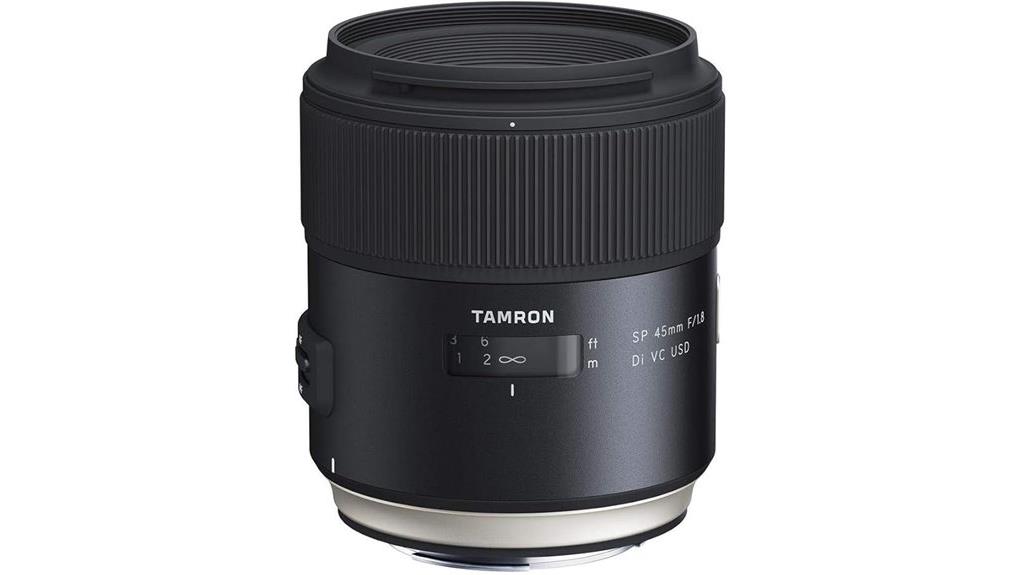
You’ll get a fast, stabilized 45mm normal prime for Nikon F‑mount full‑frame bodies that’s built for practical pro use. The f/1.8 aperture with nine rounded blades gives controlled depth and smooth bokeh, USD AF is quick and quiet, and Tamron’s VC buys roughly 3–4 stops for handheld low‑light work. Optically it’s sharp center‑wide with edge improvement stopped to f/2.8–f/4 and good flare/CA control. Keep going to see hands‑on performance, handling, and tradeoffs.
Some Key Takeaways
- Fast f/1.8 standard prime offering a natural 45mm perspective with nine rounded blades for pleasing bokeh and shallow depth of field.
- Built‑in VC stabilization gives roughly 3–4 stops of handheld low‑light compensation, useful for stills and run‑and‑gun video.
- USD AF is quick and quiet with reliable single‑shot focus on Nikon bodies; AF‑C tracking is competent but not class‑leading.
- Excellent center sharpness wide open, edge falloff improves by f/2.8–f/4; coatings (eBAND/BBAR) control flare and preserve contrast.
- Weather‑resistant, solidly built with tactile controls; modestly larger and heavier than unstabilized primes but strong value for hybrid shooters.
What the Tamron 45mm F/1.8 Is and Who It’s For
Think of the Tamron 45mm F/1.8 as a fast, stabilized standard prime engineered for Nikon F‑mount full‑frame DSLRs; it gives you a 45mm normal perspective, a bright f/1.8 aperture, and built‑in VC stabilization in a compact, weather‑resistant package. You’ll get high resolving power, reliable USD autofocus, and effective VC that extends handheld usability in low light. It’s aimed at full‑frame shooters seeking portrait versatility without resorting to longer focal lengths, offering close‑focus capability and pleasing bokeh. As a budget alternative to native Nikon primes, it balances optical performance, stabilization, and build quality for hybrid shooters. It’s a solid choice for mirrorless camera enthusiasts looking to expand their lens options while shooting with adapters or hybrid setups, especially those focused on mirrorless accessories.
Key Specs That Matter: Aperture, Stabilization, Focus, and Build
While you evaluate the Tamron 45mm F/1.8, focus on four practical specs that determine everyday performance: the f/1.8 aperture, the VC stabilization, the USD autofocus and close‑focus behavior, and the lens’ build and weather resistance. You’ll use f/1.8 for low‑light reach and controlled depth; note nine rounded blades’ contribution to out‑of‑focus rendition. VC lets you handhold at slower speeds; validate stabilization lag across shutter speeds. USD delivers fast, quiet AF and predictable close‑focus hunting. Inspect build: weather sealing, tactile switches, and a solid mount. Review glass coatings and stated optical formulas for flare control and contrast. Also consider how a motorized camera slider can enhance your creative use of this lens by enabling smooth motion shots with controlled depth and stabilization, especially for video on DSLR rigs and mirrorless setups that benefit from smooth motion.
Real-World Image Quality: Sharpness, Bokeh, Low-Light, and Close-Focus Results
Because the Tamron 45mm f/1.8 pairs a fast aperture with modern coatings and VC, you'll see strong real‑world performance: sharp center resolution is excellent wide open, falloff to the edges diminishes by f/2.8–f/4, and contrast remains high thanks to eBAND/BBAR treatments that suppress flare. You’ll notice restrained chromatic aberration—longitudinal CA is minimal at f/1.8, lateral CA corrects well in RAW. Bokeh is smooth with rounded blades; specular highlights render without harsh edges. Color rendition is natural, micro contrast gives texture and depth, and edge performance becomes competitive stopped down, useful for portraits and close‑focus work. For those who care about consistent color across workflows, proper color calibration with monitor profiles ensures what you see on-screen matches your prints and client expectations.
Autofocus, Stabilization, and Handling on Nikon Bodies (D500, D780, D810, D850)
Although the Tamron 45mm f/1.8 uses Tamron's USD AF and VC systems, you'll notice its autofocus and stabilization behave like a well-integrated Nikon-compatible third‑party lens on D500, D780, D810 and D850 bodies: focus is fast and quiet with reliable subject acquisition in single‑shot AF, and VC provides 3–4 stops of compensation for hand‑held low‑light work. You’ll find autofocus reliability strong for portraits and general use, with AF-C tracking acceptable but not class-leading on fast action. Handling ergonomics are thoughtful: balanced on full‑frame bodies, a responsive manual‑focus ring, and solid build; AF override and VC interaction are predictable and unobtrusive. If you're looking to improve your photography, pairing the lens with the right camera grip can enhance handling and stability.
Verdict: Strengths, Tradeoffs, and Who Should Buy This Lens
If you want a fast, sharp standard prime with stabilization for Nikon FX bodies, the Tamron 45mm f/1.8 delivers a compelling balance of image quality, low‑light capability, and practical handling. You’ll get excellent resolving power wide open, reliable VC for slower shutter work, and a tactile, weather‑resistant build hinting at long term reliability. Tradeoffs include modest extra weight versus unstabilized primes and slightly larger size for a 45mm. It’s ideal for hybrid shooters who need single‑lens versatility—portraits, street, and close focus—offering real award potential for reviewers and image makers seeking technical excellence without flagship cost. Consider pairing it with essential lens gear to get the most from its optical and stabilization benefits.
Some Questions Answered
Does It Come With a Lens Hood and Carrying Pouch?
Yes — the retail packaging typically lists box contents including the lens, a lens hood and a soft carrying pouch. You’ll want to confirm accessory compatibility with your vendor since hood types can vary (petal vs. round) and aftermarket pouches differ. Evaluate the supplied hood for secure fit and light-blocking performance; if you need weatherproof protection or hard-case transport, plan to purchase a dedicated pouch or case separately.
Is the Lens Weather-Sealed for Heavy Rain Conditions?
No — it isn’t fully guaranteed for heavy rainproofing. You’ll get moisture resistance and a gasketed mount that helps keep out splashes and light rain, but this weather sealing isn’t rated for prolonged heavy rain or immersion. In technical terms, the sealing mitigates moisture ingress at critical points, yet you should avoid sustained exposure and use additional protection (rain cover or shelter) when shooting in severe wet conditions to guarantee reliability.
What Warranty Length and Transferability Does Tamron Provide?
You get a 6 years warranty length from Tamron; it covers defects per their manufacturer’s terms. You should register or retain proof of purchase to expedite service. Transferability policy is limited: warranties generally apply to the original purchaser and may not transfer unless explicitly stated by Tamron or regional law. You’ll want to confirm specific coverage, exclusions, and transfer rules with Tamron customer service for your country before relying on transferability.
Is This Lens Compatible With Nikon DX Cameras in Crop Mode?
Yes — you can use it on Nikon DX bodies in crop mode; it’ll work optically and autofocus, though the effective field of view tightens to ~67.5mm equiv. You should evaluate field curvature and focus breathing: field curvature may affect edge sharpness on APS-C and focus breathing can shift framing during focus pulls. Overall performance remains strong, but check edges and close-focus behavior on your specific DX camera before critical shoots.
Can I Use 67MM Filters Like Polarizers and ND Without Vignetting?
Yes — you can use 67mm filters like polarizers and ND without noticeable vignetting on full-frame and DX-crop bodies. The lens’ front element and optical design are sized for a 67mm filter thread, so filter compatibility is native. Very thick stacked filters or heavy circular polarizers at wide apertures might introduce minor corner shading, but normal slim or standard filters won't cause significant vignetting. Always test at widest focal plane and f/1.8.